Abbie Leaver
Empiricism and rationalism Analytic truths – true by virtue of the
meanings of the terms (2+2=4) / the predicate
Two competing views on the origins of: is already built into the subject term
Synthetic truths – non-analytic truths (David
a. Our concepts has red curtains)
b. Knowledge
Empiricism states that all concepts and all synthetic knowledge, is derived from
EXPERIENCE.
Rationalism states that at least one concept, and/or at least one piece of synthetic
knowledge, comes from some source other than experience. This source is usually INNATE
(born into us) or arrived at my REASON or both.
IN 3.1.3. WE WILL EXAMINE ARGUMENTS BETWEEN EMPIRICSM AND RATIONALISM.
IN THIS SECTION, WE WILL ASSUME EMPIRICISM IS RIGHT AND THEREFORE, LOOK AT 3
COMPETING EMPIRICIST VIEWS ON WHAT THE IMMEDIATE OBJECTS OF PERCEPTION ARE.
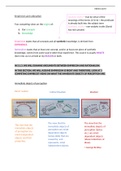
Immediate objects of perception
Direct realism Indirect Realism Idealism
The view that the The view that the
The view that the
immediate objects of immediate objects of
immediate objects
perception are mind- perception (tastes
of perception are
dependent objects etc.) are mind-
mind-independent
(sense-data) that are dependent objects
objects and their
caused by, and (ideas/collections of
properties.
represents, mind ideas).
independent objects.
= George Berkley
, Abbie Leaver
Direct realism
Realism: ontological/physical thesis – claim about what there is. It is opposed to idealism.
= There is a world of mind-independent objects
Direct: epistemological thesis – a claim about the nature of our cognitive contact with the
world.
Mind-independence
The property of not relying on minds for existence, not depending on being perceived or
thought about to exist.
*This is crucial. Realists will admit that there are designed objects (watches); but if you
wiped out all sentient life, these things would still carry on existing. Minds can create mind-
independent objects.
Direct realism is the view that:
- We perceive, more immediately than we perceive anything else, the mind independent
objects and their properties.
- There is no intermediary perceived object.
CONVERSELY, indirect realism is the view that:
- We perceive (mental) images of the mind-independent objects.
- There is an intermediary perceived object (the image in our mind).
- This means each of us perceives his/her own images.
A key difference between DR and IR is that:
Per direct realism, everyone perceives the same thing
Whereas
Per indirect realism, everyone perceives their own image of the thing
,HARD
Abbie Leaver
Issues in direct realism
1. Argument from illusion
Illusion= of a perceptual experience, in which an object’s apparent properties are not those it possesses.
e.g. A straight stick looks bent in water. Parallel railway lines seeming to converge.
The argument:
I. The X looks F
E.g. the stick looks bent
I. The X is not F
II. Whenever something looks F, there is a different object that is F and is perceived.
THEREFORE:
I. What is perceived is not the X, but something else
= A mind dependent sense datum (plural sense data)
Condition 2 and 3 are known as the phenomenal principle.
2. Bertrand Russell’s argument from “perceptual variation”
I. The table appears different from different viewpoints and perspectives (in shape, colour,
warmth, texture etc.).
II. A single object cannot possess have conflicting/inconsistent properties.
III. No perspective has a privileged state- none can be named as the correct perception
THEREFORE:
I. We must distinguish between appearance and reality. We perceive appearances of objects not
the objects themselves. These appearances are known as sense data.
3. Time lag argument
I. The star is not bright (because, for example, it is dead)
This is because for any perception to occur, it takes time, we can never perceive any object
as being the way it is now.
I. The phenomenal principle = whenever something appears F, some perceived object is F,
therefore, what we perceive is not X it is an appearance (sense data).
The difference between these arguments is WHY X is not F.
Illusion because it’s an illusion
Perceptual because of viewpoints
Time lag because of time delay
All arguments assume, or invoke, as an explicit premise, ‘that an object’s appearance (F) to a subject
necessarily involves there being an object that has that appearance (F) and that is perceived by the
subject.’. Basically, for someone to perceive an object with properties, there must be an object with
those properties.
4.
, Abbie Leaver
Argument from hallucination
Hallucination is an experience which is subjectively just like perceiving, but in which no external object is
perceived.
I. I see [rats/daggers]
II. There is no external [rat/daggers] in my vicinity
THEREFORE:
III. What I see must be an internal, mind-dependent object – a sense datum
Weaknesses of these arguments:
1. Arguments from illusion and hallucination are incomplete as so far stated. Each argument needs
an additional stage: it needs to be shown that, if we perceive sense datum in
illusion/hallucination we also perceive sense datum in veridical perception (one that represents
things correctly).
Basically, these arguments may show that in some cases we see sense data/image as opposed
to a real thing; however, they do not show that this is always the case with all perceptions.
a. For the argument from illusion, the additional premise might be:
i. Illusory experiences merge seamlessly into veridical ones. (e.g. circular plate
looks elliptical and then gradually more round until it is circular).
ii. Its implausible that the nature of the process changes once when we perceive it
as it is
THEREFORE:
iii. If we perceive sense data in illusions, it’s plausible that we perceive sense data
in veridical perception too.
b. For the argument from hallucination, the additional premise might be:
i. Hallucinations can be subjectively indistinguishable from perceptual
experiences. (e.g. dreams are indistinguishable from reality)
THEREFORE:
ii. It’s plausible that, if sense datum are perceived in hallucination, they are also
perceived in perceptual experience.
Basically, if they seem so similar, maybe they are perceived in the same way.
^
This argument is not very convincing as just because something looks similar, it
does not mean it is similar. (Just because hallucination seems like a perceptual
experience, it does not mean it should be treated like one).
2. Argument from illusion depends on the existence of the ‘phenomenal principle’ (= that
whenever anything appears F to a subject, there must be an object that is F and that is perceived
by the subject at that time, basically, you cannot see something that isn’t there).
This is not necessarily the case! For example, with a straight stick in water.
The straight stick has the property of looking bent in water.
The experience represents the stick as bent, even though nothing is bent.
This shows that the phenomenal principle is not always correct. It is a too naïve way to explain
perception.
Empiricism and rationalism Analytic truths – true by virtue of the
meanings of the terms (2+2=4) / the predicate
Two competing views on the origins of: is already built into the subject term
Synthetic truths – non-analytic truths (David
a. Our concepts has red curtains)
b. Knowledge
Empiricism states that all concepts and all synthetic knowledge, is derived from
EXPERIENCE.
Rationalism states that at least one concept, and/or at least one piece of synthetic
knowledge, comes from some source other than experience. This source is usually INNATE
(born into us) or arrived at my REASON or both.
IN 3.1.3. WE WILL EXAMINE ARGUMENTS BETWEEN EMPIRICSM AND RATIONALISM.
IN THIS SECTION, WE WILL ASSUME EMPIRICISM IS RIGHT AND THEREFORE, LOOK AT 3
COMPETING EMPIRICIST VIEWS ON WHAT THE IMMEDIATE OBJECTS OF PERCEPTION ARE.
Immediate objects of perception
Direct realism Indirect Realism Idealism
The view that the The view that the
The view that the
immediate objects of immediate objects of
immediate objects
perception are mind- perception (tastes
of perception are
dependent objects etc.) are mind-
mind-independent
(sense-data) that are dependent objects
objects and their
caused by, and (ideas/collections of
properties.
represents, mind ideas).
independent objects.
= George Berkley
, Abbie Leaver
Direct realism
Realism: ontological/physical thesis – claim about what there is. It is opposed to idealism.
= There is a world of mind-independent objects
Direct: epistemological thesis – a claim about the nature of our cognitive contact with the
world.
Mind-independence
The property of not relying on minds for existence, not depending on being perceived or
thought about to exist.
*This is crucial. Realists will admit that there are designed objects (watches); but if you
wiped out all sentient life, these things would still carry on existing. Minds can create mind-
independent objects.
Direct realism is the view that:
- We perceive, more immediately than we perceive anything else, the mind independent
objects and their properties.
- There is no intermediary perceived object.
CONVERSELY, indirect realism is the view that:
- We perceive (mental) images of the mind-independent objects.
- There is an intermediary perceived object (the image in our mind).
- This means each of us perceives his/her own images.
A key difference between DR and IR is that:
Per direct realism, everyone perceives the same thing
Whereas
Per indirect realism, everyone perceives their own image of the thing
,HARD
Abbie Leaver
Issues in direct realism
1. Argument from illusion
Illusion= of a perceptual experience, in which an object’s apparent properties are not those it possesses.
e.g. A straight stick looks bent in water. Parallel railway lines seeming to converge.
The argument:
I. The X looks F
E.g. the stick looks bent
I. The X is not F
II. Whenever something looks F, there is a different object that is F and is perceived.
THEREFORE:
I. What is perceived is not the X, but something else
= A mind dependent sense datum (plural sense data)
Condition 2 and 3 are known as the phenomenal principle.
2. Bertrand Russell’s argument from “perceptual variation”
I. The table appears different from different viewpoints and perspectives (in shape, colour,
warmth, texture etc.).
II. A single object cannot possess have conflicting/inconsistent properties.
III. No perspective has a privileged state- none can be named as the correct perception
THEREFORE:
I. We must distinguish between appearance and reality. We perceive appearances of objects not
the objects themselves. These appearances are known as sense data.
3. Time lag argument
I. The star is not bright (because, for example, it is dead)
This is because for any perception to occur, it takes time, we can never perceive any object
as being the way it is now.
I. The phenomenal principle = whenever something appears F, some perceived object is F,
therefore, what we perceive is not X it is an appearance (sense data).
The difference between these arguments is WHY X is not F.
Illusion because it’s an illusion
Perceptual because of viewpoints
Time lag because of time delay
All arguments assume, or invoke, as an explicit premise, ‘that an object’s appearance (F) to a subject
necessarily involves there being an object that has that appearance (F) and that is perceived by the
subject.’. Basically, for someone to perceive an object with properties, there must be an object with
those properties.
4.
, Abbie Leaver
Argument from hallucination
Hallucination is an experience which is subjectively just like perceiving, but in which no external object is
perceived.
I. I see [rats/daggers]
II. There is no external [rat/daggers] in my vicinity
THEREFORE:
III. What I see must be an internal, mind-dependent object – a sense datum
Weaknesses of these arguments:
1. Arguments from illusion and hallucination are incomplete as so far stated. Each argument needs
an additional stage: it needs to be shown that, if we perceive sense datum in
illusion/hallucination we also perceive sense datum in veridical perception (one that represents
things correctly).
Basically, these arguments may show that in some cases we see sense data/image as opposed
to a real thing; however, they do not show that this is always the case with all perceptions.
a. For the argument from illusion, the additional premise might be:
i. Illusory experiences merge seamlessly into veridical ones. (e.g. circular plate
looks elliptical and then gradually more round until it is circular).
ii. Its implausible that the nature of the process changes once when we perceive it
as it is
THEREFORE:
iii. If we perceive sense data in illusions, it’s plausible that we perceive sense data
in veridical perception too.
b. For the argument from hallucination, the additional premise might be:
i. Hallucinations can be subjectively indistinguishable from perceptual
experiences. (e.g. dreams are indistinguishable from reality)
THEREFORE:
ii. It’s plausible that, if sense datum are perceived in hallucination, they are also
perceived in perceptual experience.
Basically, if they seem so similar, maybe they are perceived in the same way.
^
This argument is not very convincing as just because something looks similar, it
does not mean it is similar. (Just because hallucination seems like a perceptual
experience, it does not mean it should be treated like one).
2. Argument from illusion depends on the existence of the ‘phenomenal principle’ (= that
whenever anything appears F to a subject, there must be an object that is F and that is perceived
by the subject at that time, basically, you cannot see something that isn’t there).
This is not necessarily the case! For example, with a straight stick in water.
The straight stick has the property of looking bent in water.
The experience represents the stick as bent, even though nothing is bent.
This shows that the phenomenal principle is not always correct. It is a too naïve way to explain
perception.