CAUSES OF GLOBAL CLIMATE CHANGE
The atmospheric system
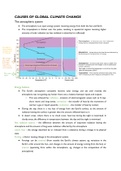
● The atmosphere is an open energy system receiving energy from both the Sun and Earth
● The troposphere is thicker near the poles, resulting in equatorial regions receiving higher
amounts of solar radiation (so less radiation is absorbed or reflected)
Energy balance
● The Earth’s atmosphere constantly receives solar energy, and yet until recently the
atmosphere was not getting any hotter: there was a balance between inputs and outputs
○ This was achieved by: radiation - emission of electromagnetic waves such as X-rays,
short waves and long waves; convection - the transfer of heat by the movement of
warmer a gas or liquid upwards; conduction - the transfer of heat by contact
● During the day, there is a net loss of energy from the Earth’s surface, as the amount of
radiation leaving the surface is greater than the amount reflected back to it
● In desert areas, where there is no cloud cover, heat loss during the night is maximised. In
cloudy areas, the difference in temperature between the day and the night is minimised
Net radiation balance - the difference between the amount of long-wave radiation leaving the
atmosphere and the amount of long-wave radiation reflected by the atmosphere
Latent heat - the energy absorbed by or released from a substance during a change in its physical
state
Forcing - a factor causing change in the atmospheric system
● Forcings can be external (from outside the Earth's climate system, eg. variations in the
Earth's orbit around the Sun, and changes in the amount of energy coming from the Sun) or
internal (operating from within the atmosphere, eg. changes in the composition of the
atmosphere)
,Albedo - the amount of radiation reflected by a surface, expressed as a percentage of the incoming
radiation
● The planetary albedo is about 6%
Insolation - radiation from the Sun entering the atmosphere
● As the Sun is a very hot body, most of its radiation has very short wavelengths such as
ultraviolet and visible light
● Insolation is the main source of energy in the atmosphere; its amount is affected by latitude,
season and cloud cover
○ The thicker the cloud cover, the less radiation reaches the Earth’s surface
■ Cirrus clouds allow 30% more radiation to reach the Earth’s surface than
nimbostratus do
Natural greenhouse effect
● In the greenhouse effect, certain gases called the greenhouses gases or GHGs for short
allow short-wave radiation from the Sun to pass through the atmosphere, but trap outgoing
long-wave radiation
● The natural greenhouse effect results in the Earth’s temperature being higher and more
stable than it would be without it
○ On the Moon, which is located in the same distance from the Sun, has no
atmosphere and thus no greenhouse effect, the average temperature is -18°C
(compared to the Earth’s 15°C), with fluctuations between -170°C and 100°C
Greenhouse principle - most of the incoming short-wave radiation is let in, outgoing long-wave
radiation is trapped, warming the atmosphere from below
, The greenhouse gases: Water vapour, which is responsible for 50% of the greenhouse effect
Methane, which is the second-largest contributor to the greenhouse
effect and is 25 more powerful than CO2
CO2, which accounts for 75% of greenhouse gases by volume and about a
fifth of the greenhouse effect; this proportion is increasing
NOx
Tropospheric O3
Chlorofluorocarbons (CFCs) are destroying ozone and are 10,000 more
effective at trapping heat than CO2
Sources of GHGs
GHG Natural sources Anthropogenic sources
Water vapour Evaporation from seas and oceans,
evapotranspiration from plants
CO2 Wildfires, respiration of animals Burning of fossil fuels, deforestation
CH4 Decaying vegetation Agriculture, sewage disposal, emissions
from decaying matter at landfills
NOx Volcanic eruptions Fertilisers, engine exhausts
CFCs - AC, aerosols, fridges
Changes in the global energy balance
● Natural: Living organisms affect the atmosphere by changing the amounts and proportions
of O2 and CO2
Changes in the energy cycles of the Sun (11-year-long cycles and the
thousands-year-long Milankovitch cycles) - variations in eccentricity, axial tilt
(obliquity), and precession result in cyclical variations in the solar radiation reaching
the Earth
Orbital eccentricity cycles (the Earth’s orbit changes from more round to more
elliptical every 40,000 years, resulting in changes to the climate)
Global dimming - the reduction of the amount of sunlight reaching the earth’s
surface and a resultant cooling effect - is partly caused by volcanic eruptions
● Anthropogenic: Emission of GHGs (eg. for electricity generation, agriculture or transport)
enhances the greenhouse effect
Polluted air contains more particles (eg. soot, ash, sulphur dioxide) than clean air,
which increases the number of condensation nuclei for water.
The atmospheric system
● The atmosphere is an open energy system receiving energy from both the Sun and Earth
● The troposphere is thicker near the poles, resulting in equatorial regions receiving higher
amounts of solar radiation (so less radiation is absorbed or reflected)
Energy balance
● The Earth’s atmosphere constantly receives solar energy, and yet until recently the
atmosphere was not getting any hotter: there was a balance between inputs and outputs
○ This was achieved by: radiation - emission of electromagnetic waves such as X-rays,
short waves and long waves; convection - the transfer of heat by the movement of
warmer a gas or liquid upwards; conduction - the transfer of heat by contact
● During the day, there is a net loss of energy from the Earth’s surface, as the amount of
radiation leaving the surface is greater than the amount reflected back to it
● In desert areas, where there is no cloud cover, heat loss during the night is maximised. In
cloudy areas, the difference in temperature between the day and the night is minimised
Net radiation balance - the difference between the amount of long-wave radiation leaving the
atmosphere and the amount of long-wave radiation reflected by the atmosphere
Latent heat - the energy absorbed by or released from a substance during a change in its physical
state
Forcing - a factor causing change in the atmospheric system
● Forcings can be external (from outside the Earth's climate system, eg. variations in the
Earth's orbit around the Sun, and changes in the amount of energy coming from the Sun) or
internal (operating from within the atmosphere, eg. changes in the composition of the
atmosphere)
,Albedo - the amount of radiation reflected by a surface, expressed as a percentage of the incoming
radiation
● The planetary albedo is about 6%
Insolation - radiation from the Sun entering the atmosphere
● As the Sun is a very hot body, most of its radiation has very short wavelengths such as
ultraviolet and visible light
● Insolation is the main source of energy in the atmosphere; its amount is affected by latitude,
season and cloud cover
○ The thicker the cloud cover, the less radiation reaches the Earth’s surface
■ Cirrus clouds allow 30% more radiation to reach the Earth’s surface than
nimbostratus do
Natural greenhouse effect
● In the greenhouse effect, certain gases called the greenhouses gases or GHGs for short
allow short-wave radiation from the Sun to pass through the atmosphere, but trap outgoing
long-wave radiation
● The natural greenhouse effect results in the Earth’s temperature being higher and more
stable than it would be without it
○ On the Moon, which is located in the same distance from the Sun, has no
atmosphere and thus no greenhouse effect, the average temperature is -18°C
(compared to the Earth’s 15°C), with fluctuations between -170°C and 100°C
Greenhouse principle - most of the incoming short-wave radiation is let in, outgoing long-wave
radiation is trapped, warming the atmosphere from below
, The greenhouse gases: Water vapour, which is responsible for 50% of the greenhouse effect
Methane, which is the second-largest contributor to the greenhouse
effect and is 25 more powerful than CO2
CO2, which accounts for 75% of greenhouse gases by volume and about a
fifth of the greenhouse effect; this proportion is increasing
NOx
Tropospheric O3
Chlorofluorocarbons (CFCs) are destroying ozone and are 10,000 more
effective at trapping heat than CO2
Sources of GHGs
GHG Natural sources Anthropogenic sources
Water vapour Evaporation from seas and oceans,
evapotranspiration from plants
CO2 Wildfires, respiration of animals Burning of fossil fuels, deforestation
CH4 Decaying vegetation Agriculture, sewage disposal, emissions
from decaying matter at landfills
NOx Volcanic eruptions Fertilisers, engine exhausts
CFCs - AC, aerosols, fridges
Changes in the global energy balance
● Natural: Living organisms affect the atmosphere by changing the amounts and proportions
of O2 and CO2
Changes in the energy cycles of the Sun (11-year-long cycles and the
thousands-year-long Milankovitch cycles) - variations in eccentricity, axial tilt
(obliquity), and precession result in cyclical variations in the solar radiation reaching
the Earth
Orbital eccentricity cycles (the Earth’s orbit changes from more round to more
elliptical every 40,000 years, resulting in changes to the climate)
Global dimming - the reduction of the amount of sunlight reaching the earth’s
surface and a resultant cooling effect - is partly caused by volcanic eruptions
● Anthropogenic: Emission of GHGs (eg. for electricity generation, agriculture or transport)
enhances the greenhouse effect
Polluted air contains more particles (eg. soot, ash, sulphur dioxide) than clean air,
which increases the number of condensation nuclei for water.