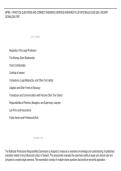
,CONTENT
Chapter 1: Dental Anatomy
Chapter 2: Variation in Size and Shape of Teeth
Chapter 3: Occlusion
Chapter 4: Sequence and Timing of Dental Growth
Chapter 5: Dental Enamel
Chapter 6: Dentine
Chapter 7: Dental Cement
Chapter 8: Histological Methods of Age Determination in Adults
Chapter 9: Chemistry of Dental Tissues and Calculus
Chapter 10: Tooth Wear and Modification
Chapter 11: Dental Disease
,Chapter 1: Dental Anatomy
Q1. [Recall]
Which crown surface of a maxillary incisor is defined by its orientation toward
the lips and its role in initial food incision?
A. Lingual surface
B. Mesial surface
C. Buccal surface
D. Occlusal surface
✅ Answer: C
📝 Rationale: The buccal (labial in anterior teeth) surface of incisors faces the
lips and is functionally adapted for cutting during incision. Hillson emphasizes
the functional orientation of crown surfaces in relation to mastication, with the
labial/buccal surface playing a key role in food acquisition and processing.
Q2. [Comprehension]
Which feature best distinguishes a molar crown from that of a premolar in
terms of occlusal morphology?
A. Presence of a single dominant cusp
B. Bilateral symmetry of cusps
C. Multiple cusps separated by fissure systems
D. Absence of ridges
✅ Answer: C
📝 Rationale: Molars are characterized by complex occlusal surfaces with
multiple cusps separated by fissures, reflecting their role in grinding food.
Hillson highlights that this complexity contrasts with premolars, which
generally have fewer cusps and simpler occlusal morphology.
Q3. [Analysis]
Which homologous feature across tooth classes is most reliable for identifying
the mesial-distal orientation of an isolated tooth?
A. Enamel thickness distribution
B. Curvature of the cervical line
C. Root length
D. Presence of wear facets
,✅ Answer: B
📝 Rationale: The curvature of the cervical line (cementoenamel junction) is
typically greater on the mesial surface than the distal surface. Hillson notes
this as a consistent anatomical marker across tooth classes, making it highly
reliable for determining orientation in isolated specimens.
Q4. [Application]
A tooth fragment displays a prominent cusp with adjacent ridges and a deep
fissure pattern. Which tooth type is most consistent with this morphology?
A. Incisor
B. Canine
C. Premolar
D. Molar
✅ Answer: D
📝 Rationale: The presence of multiple cusps with pronounced fissures is
indicative of molars, which are adapted for grinding. Hillson emphasizes the
diagnostic value of fissure patterns and cusp complexity in distinguishing
molars from other tooth types.
Q5. [Comprehension]
Which dental tissue forms the bulk of the tooth and supports the overlying
enamel?
A. Cementum
B. Dentine
C. Enamel
D. Pulp
✅ Answer: B
📝 Rationale: Dentine constitutes the majority of the tooth structure and
provides mechanical support for enamel. Hillson describes dentine as a
resilient tissue underlying enamel, critical for absorbing masticatory forces.
Q6. [Analysis]
Which structural difference between deciduous and permanent teeth is most
relevant for distinguishing them in archaeological assemblages?
A. Presence of enamel
B. Degree of root divergence
C. Presence of pulp cavity
D. Crown color
✅ Answer: B
,📝 Rationale: Deciduous teeth typically exhibit more divergent roots compared
to permanent teeth, facilitating identification. Hillson highlights root
morphology as a key distinguishing feature, especially in fragmentary remains.
Q7. [Recall]
In the FDI notation system, which quadrant is represented by the number “1”?
A. Lower left permanent dentition
B. Upper left permanent dentition
C. Upper right permanent dentition
D. Lower right permanent dentition
✅ Answer: C
📝 Rationale: In the FDI system, quadrant “1” refers to the upper right
permanent dentition. Hillson explains that the system uses a two-digit code,
with the first digit indicating quadrant.
Q8. [Application]
Which supporting structure anchors the tooth to the alveolar bone while
allowing slight movement under masticatory forces?
A. Enamel
B. Dentine
C. Periodontal ligament
D. Cementum
✅ Answer: C
📝 Rationale: The periodontal ligament connects the tooth root to the alveolar
bone and allows controlled movement during chewing. Hillson describes its role
in shock absorption and force distribution.
Fill-in-the-Blank MCQs
Q9. [Recall]
The ______ is the junction between enamel and cementum at the neck of the
tooth.
A. Apical foramen
B. Cementoenamel junction
C. Dentinoenamel junction
D. Furcation
✅ Answer: B
📝 Rationale: The cementoenamel junction marks the boundary between
,enamel covering the crown and cementum covering the root. Hillson identifies
this as a key anatomical landmark.
Q10. [Comprehension]
The ______ surface of a tooth faces toward the tongue in the lower jaw.
A. Buccal
B. Lingual
C. Distal
D. Occlusal
✅ Answer: B
📝 Rationale: The lingual surface is oriented toward the tongue. Hillson
distinguishes this from buccal surfaces, which face the cheeks or lips.
Q11. [Application]
The ______ refers to the area where the roots of a multi-rooted tooth diverge.
A. Apex
B. Cervical line
C. Furcation
D. Ridge
✅ Answer: C
📝 Rationale: The furcation is the point at which roots divide in multi-rooted
teeth. Hillson notes its importance in identifying molars and assessing
periodontal conditions.
Q12. [Analysis]
The ______ is the soft tissue within the tooth that contains nerves and blood
vessels.
A. Cementum
B. Dentine
C. Enamel
D. Pulp
✅ Answer: D
📝 Rationale: The pulp is the central soft tissue responsible for nourishment
and sensory function. Hillson emphasizes its biological role in maintaining
tooth vitality.
True/False
,Q13. [Recall]
Enamel is capable of regeneration after damage.
✅ Answer: FALSE
📝 Rationale: Enamel is a non-living tissue that does not regenerate once
formed. Hillson stresses its acellular nature and inability to repair itself.
Q14. [Comprehension]
Canines are typically adapted for tearing rather than grinding.
✅ Answer: TRUE
📝 Rationale: Canines have a pointed cusp suited for tearing food. Hillson
describes their functional role in the dentition as distinct from grinding molars.
Q15. [Application]
The Universal notation system assigns numbers to both deciduous and
permanent teeth using the same sequence.
✅ Answer: FALSE
📝 Rationale: The Universal system uses numbers for permanent teeth and
letters for deciduous teeth. Hillson highlights this distinction in notation
systems.
Q16. [Analysis]
Alveolar bone remodels in response to tooth loss and occlusal forces.
✅ Answer: TRUE
📝 Rationale: Alveolar bone is dynamic and responds to mechanical loading and
tooth presence. Hillson explains its remodeling capacity in relation to
functional demands.
Scenario-Based Questions
Q17. [Application]
An archaeologist recovers a tooth with three roots and a complex occlusal
surface featuring multiple cusps. Which tooth is most likely represented?
A. Mandibular premolar
B. Maxillary molar
C. Mandibular incisor
D. Maxillary canine
, ✅ Answer: B
📝 Rationale: Maxillary molars commonly have three roots and complex cusp
patterns. Hillson identifies this morphology as characteristic of upper molars.
Q18. [Analysis]
A forensic odontologist identifies a tooth with a pronounced lingual cingulum
and a single root. Which tooth class is most consistent with this description?
A. Incisor
B. Canine
C. Premolar
D. Molar
✅ Answer: A
📝 Rationale: Incisors often exhibit a lingual cingulum and a single root. Hillson
highlights these features as diagnostic for anterior teeth.
Q19. [Application]
During analysis of skeletal remains, a researcher notes widely divergent roots
in a small tooth. What is the most likely interpretation?
A. Permanent molar
B. Deciduous molar
C. Permanent incisor
D. Supernumerary tooth
✅ Answer: B
📝 Rationale: Deciduous molars typically have widely divergent roots to
accommodate developing permanent teeth. Hillson emphasizes this as a key
identifying feature.
Q20. [Analysis]
A fragmentary tooth shows thick enamel and a large dentine core, with
evidence of attachment to alveolar bone via fibrous tissue. Which functional
interpretation is most accurate?
A. The tooth was non-functional
B. The tooth was adapted for cutting only
C. The tooth participated in load-bearing mastication
D. The tooth lacked periodontal support
✅ Answer: C
📝 Rationale: The presence of thick enamel, substantial dentine, and
periodontal attachment indicates a tooth adapted for bearing masticatory
Chapter 1: Dental Anatomy
Chapter 2: Variation in Size and Shape of Teeth
Chapter 3: Occlusion
Chapter 4: Sequence and Timing of Dental Growth
Chapter 5: Dental Enamel
Chapter 6: Dentine
Chapter 7: Dental Cement
Chapter 8: Histological Methods of Age Determination in Adults
Chapter 9: Chemistry of Dental Tissues and Calculus
Chapter 10: Tooth Wear and Modification
Chapter 11: Dental Disease
,Chapter 1: Dental Anatomy
Q1. [Recall]
Which crown surface of a maxillary incisor is defined by its orientation toward
the lips and its role in initial food incision?
A. Lingual surface
B. Mesial surface
C. Buccal surface
D. Occlusal surface
✅ Answer: C
📝 Rationale: The buccal (labial in anterior teeth) surface of incisors faces the
lips and is functionally adapted for cutting during incision. Hillson emphasizes
the functional orientation of crown surfaces in relation to mastication, with the
labial/buccal surface playing a key role in food acquisition and processing.
Q2. [Comprehension]
Which feature best distinguishes a molar crown from that of a premolar in
terms of occlusal morphology?
A. Presence of a single dominant cusp
B. Bilateral symmetry of cusps
C. Multiple cusps separated by fissure systems
D. Absence of ridges
✅ Answer: C
📝 Rationale: Molars are characterized by complex occlusal surfaces with
multiple cusps separated by fissures, reflecting their role in grinding food.
Hillson highlights that this complexity contrasts with premolars, which
generally have fewer cusps and simpler occlusal morphology.
Q3. [Analysis]
Which homologous feature across tooth classes is most reliable for identifying
the mesial-distal orientation of an isolated tooth?
A. Enamel thickness distribution
B. Curvature of the cervical line
C. Root length
D. Presence of wear facets
,✅ Answer: B
📝 Rationale: The curvature of the cervical line (cementoenamel junction) is
typically greater on the mesial surface than the distal surface. Hillson notes
this as a consistent anatomical marker across tooth classes, making it highly
reliable for determining orientation in isolated specimens.
Q4. [Application]
A tooth fragment displays a prominent cusp with adjacent ridges and a deep
fissure pattern. Which tooth type is most consistent with this morphology?
A. Incisor
B. Canine
C. Premolar
D. Molar
✅ Answer: D
📝 Rationale: The presence of multiple cusps with pronounced fissures is
indicative of molars, which are adapted for grinding. Hillson emphasizes the
diagnostic value of fissure patterns and cusp complexity in distinguishing
molars from other tooth types.
Q5. [Comprehension]
Which dental tissue forms the bulk of the tooth and supports the overlying
enamel?
A. Cementum
B. Dentine
C. Enamel
D. Pulp
✅ Answer: B
📝 Rationale: Dentine constitutes the majority of the tooth structure and
provides mechanical support for enamel. Hillson describes dentine as a
resilient tissue underlying enamel, critical for absorbing masticatory forces.
Q6. [Analysis]
Which structural difference between deciduous and permanent teeth is most
relevant for distinguishing them in archaeological assemblages?
A. Presence of enamel
B. Degree of root divergence
C. Presence of pulp cavity
D. Crown color
✅ Answer: B
,📝 Rationale: Deciduous teeth typically exhibit more divergent roots compared
to permanent teeth, facilitating identification. Hillson highlights root
morphology as a key distinguishing feature, especially in fragmentary remains.
Q7. [Recall]
In the FDI notation system, which quadrant is represented by the number “1”?
A. Lower left permanent dentition
B. Upper left permanent dentition
C. Upper right permanent dentition
D. Lower right permanent dentition
✅ Answer: C
📝 Rationale: In the FDI system, quadrant “1” refers to the upper right
permanent dentition. Hillson explains that the system uses a two-digit code,
with the first digit indicating quadrant.
Q8. [Application]
Which supporting structure anchors the tooth to the alveolar bone while
allowing slight movement under masticatory forces?
A. Enamel
B. Dentine
C. Periodontal ligament
D. Cementum
✅ Answer: C
📝 Rationale: The periodontal ligament connects the tooth root to the alveolar
bone and allows controlled movement during chewing. Hillson describes its role
in shock absorption and force distribution.
Fill-in-the-Blank MCQs
Q9. [Recall]
The ______ is the junction between enamel and cementum at the neck of the
tooth.
A. Apical foramen
B. Cementoenamel junction
C. Dentinoenamel junction
D. Furcation
✅ Answer: B
📝 Rationale: The cementoenamel junction marks the boundary between
,enamel covering the crown and cementum covering the root. Hillson identifies
this as a key anatomical landmark.
Q10. [Comprehension]
The ______ surface of a tooth faces toward the tongue in the lower jaw.
A. Buccal
B. Lingual
C. Distal
D. Occlusal
✅ Answer: B
📝 Rationale: The lingual surface is oriented toward the tongue. Hillson
distinguishes this from buccal surfaces, which face the cheeks or lips.
Q11. [Application]
The ______ refers to the area where the roots of a multi-rooted tooth diverge.
A. Apex
B. Cervical line
C. Furcation
D. Ridge
✅ Answer: C
📝 Rationale: The furcation is the point at which roots divide in multi-rooted
teeth. Hillson notes its importance in identifying molars and assessing
periodontal conditions.
Q12. [Analysis]
The ______ is the soft tissue within the tooth that contains nerves and blood
vessels.
A. Cementum
B. Dentine
C. Enamel
D. Pulp
✅ Answer: D
📝 Rationale: The pulp is the central soft tissue responsible for nourishment
and sensory function. Hillson emphasizes its biological role in maintaining
tooth vitality.
True/False
,Q13. [Recall]
Enamel is capable of regeneration after damage.
✅ Answer: FALSE
📝 Rationale: Enamel is a non-living tissue that does not regenerate once
formed. Hillson stresses its acellular nature and inability to repair itself.
Q14. [Comprehension]
Canines are typically adapted for tearing rather than grinding.
✅ Answer: TRUE
📝 Rationale: Canines have a pointed cusp suited for tearing food. Hillson
describes their functional role in the dentition as distinct from grinding molars.
Q15. [Application]
The Universal notation system assigns numbers to both deciduous and
permanent teeth using the same sequence.
✅ Answer: FALSE
📝 Rationale: The Universal system uses numbers for permanent teeth and
letters for deciduous teeth. Hillson highlights this distinction in notation
systems.
Q16. [Analysis]
Alveolar bone remodels in response to tooth loss and occlusal forces.
✅ Answer: TRUE
📝 Rationale: Alveolar bone is dynamic and responds to mechanical loading and
tooth presence. Hillson explains its remodeling capacity in relation to
functional demands.
Scenario-Based Questions
Q17. [Application]
An archaeologist recovers a tooth with three roots and a complex occlusal
surface featuring multiple cusps. Which tooth is most likely represented?
A. Mandibular premolar
B. Maxillary molar
C. Mandibular incisor
D. Maxillary canine
, ✅ Answer: B
📝 Rationale: Maxillary molars commonly have three roots and complex cusp
patterns. Hillson identifies this morphology as characteristic of upper molars.
Q18. [Analysis]
A forensic odontologist identifies a tooth with a pronounced lingual cingulum
and a single root. Which tooth class is most consistent with this description?
A. Incisor
B. Canine
C. Premolar
D. Molar
✅ Answer: A
📝 Rationale: Incisors often exhibit a lingual cingulum and a single root. Hillson
highlights these features as diagnostic for anterior teeth.
Q19. [Application]
During analysis of skeletal remains, a researcher notes widely divergent roots
in a small tooth. What is the most likely interpretation?
A. Permanent molar
B. Deciduous molar
C. Permanent incisor
D. Supernumerary tooth
✅ Answer: B
📝 Rationale: Deciduous molars typically have widely divergent roots to
accommodate developing permanent teeth. Hillson emphasizes this as a key
identifying feature.
Q20. [Analysis]
A fragmentary tooth shows thick enamel and a large dentine core, with
evidence of attachment to alveolar bone via fibrous tissue. Which functional
interpretation is most accurate?
A. The tooth was non-functional
B. The tooth was adapted for cutting only
C. The tooth participated in load-bearing mastication
D. The tooth lacked periodontal support
✅ Answer: C
📝 Rationale: The presence of thick enamel, substantial dentine, and
periodontal attachment indicates a tooth adapted for bearing masticatory