

BSN 266 HESI Med Surg Study Guide 4
versions | 220 New Questions with
Verified Answers | Medical-Surgical
Nursing HESI Exam Prep | Complete
Review 2026-2028
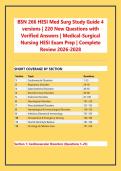
SHORT COVERAGE BY SECTION
Section Topic Questions
1 Cardiovascular Disorders 1–25
2 Respiratory Disorders 26–45
3 Gastrointestinal Disorders 46–65
4 Renal & Urinary Disorders 66–80
5 Endocrine Disorders 81–100
6 Neurological Disorders 101–120
7 Musculoskeletal Disorders 121–135
8 Hematological & Immunological Disorders 136–150
9 Infectious Diseases & Immunology 151–165
10 Perioperative & Emergency Nursing 166–180
11 Fluid & Electrolyte Balance 181–190
12 Oncology & Palliative Care 191–220
Section 1: Cardiovascular Disorders (Questions 1–25)
,1. A client with heart failure is prescribed digoxin. Which finding indicates digoxin
toxicity?
a) Heart rate 72 bpm and regular
b) Blood pressure 118/76 mmHg
c) Serum potassium 4.0 mEq/L
d) Nausea, vomiting, and blurred vision with yellow-green halos
Digoxin toxicity presents with gastrointestinal symptoms (nausea, vomiting,
anorexia), visual disturbances (yellow-green halos, blurred vision), and cardiac
dysrhythmias (bradycardia, heart block, PVCs). Hypokalemia increases the risk of
toxicity.
2. A client with atrial fibrillation is prescribed warfarin. Which international
normalized ratio (INR) indicates therapeutic anticoagulation for this client?
a) 1.0-1.5
b) 1.5-2.0
c) 2.0-3.0
d) 3.5-4.5
*For atrial fibrillation, the therapeutic INR range is 2.0-3.0. INRs below 2.0
increase stroke risk; INRs above 3.0 increase bleeding risk. For mechanical heart
valves, the target INR is higher (2.5-3.5).*
3. A client with hypertension is prescribed lisinopril. Which adverse effect should
the nurse teach the client to report immediately?
a) Dry, nonproductive cough
b) Headache and dizziness
c) Fatigue and weakness
d) Swelling of the face, lips, or tongue
Angioedema (swelling of the face, lips, tongue, or airway) is a serious adverse
effect of ACE inhibitors that can compromise the airway. Clients should seek
emergency care immediately. Dry cough is common but not life-threatening.
,4. A client with peripheral artery disease (PAD) complains of leg pain when
walking that resolves with rest. Which term describes this symptom?
a) Rest pain
b) Paresthesia
c) Intermittent claudication
d) Venous stasis
Intermittent claudication is muscle pain (usually in the calves) that occurs with
exercise and resolves with rest. It is caused by inadequate blood flow to meet the
metabolic demands of exercising muscles in patients with PAD.
5. A client with deep vein thrombosis (DVT) is receiving a heparin infusion. Which
laboratory test should the nurse monitor to evaluate therapeutic effect?
a) Prothrombin time (PT)
b) International normalized ratio (INR)
c) Platelet count
d) Activated partial thromboplastin time (aPTT)
*Heparin therapy is monitored using aPTT. The therapeutic goal is usually 1.5-2.5
times the normal control value (approximately 60-80 seconds). PT/INR is used to
monitor warfarin therapy.*
6. A client receiving heparin develops thrombocytopenia. Which complication
should the nurse suspect?
a) Disseminated intravascular coagulation (DIC)
b) Idiopathic thrombocytopenic purpura (ITP)
c) Hemolytic uremic syndrome (HUS)
d) Heparin-induced thrombocytopenia (HIT)
, *Heparin-induced thrombocytopenia (HIT) is an immune-mediated complication of
heparin therapy characterized by a drop in platelet count and paradoxical
thrombosis. HIT typically occurs 5-10 days after starting heparin.*
7. A client with heart failure has jugular venous distension (JVD) and peripheral
edema. Which type of heart failure is most likely?
a) Left-sided heart failure
b) High-output heart failure
c) Left-sided heart failure with pulmonary edema
d) Right-sided heart failure
Right-sided heart failure causes systemic venous congestion, leading to JVD,
hepatomegaly, ascites, and peripheral edema. Left-sided heart failure causes
pulmonary congestion (crackles, dyspnea, orthopnea).
8. A client with hypertension is prescribed metoprolol. Which adverse effect
should the nurse monitor for?
a) Tachycardia
b) Bronchodilation
c) Hyperglycemia
d) Bradycardia
Metoprolol is a beta-blocker that reduces heart rate and contractility. Adverse
effects include bradycardia, hypotension, fatigue, dizziness, and bronchospasm
(especially with non-selective beta-blockers). Clients should monitor their pulse
daily.
9. A client with angina is prescribed nitroglycerin sublingual. Which instruction
should the nurse include in the teaching plan?
versions | 220 New Questions with
Verified Answers | Medical-Surgical
Nursing HESI Exam Prep | Complete
Review 2026-2028
SHORT COVERAGE BY SECTION
Section Topic Questions
1 Cardiovascular Disorders 1–25
2 Respiratory Disorders 26–45
3 Gastrointestinal Disorders 46–65
4 Renal & Urinary Disorders 66–80
5 Endocrine Disorders 81–100
6 Neurological Disorders 101–120
7 Musculoskeletal Disorders 121–135
8 Hematological & Immunological Disorders 136–150
9 Infectious Diseases & Immunology 151–165
10 Perioperative & Emergency Nursing 166–180
11 Fluid & Electrolyte Balance 181–190
12 Oncology & Palliative Care 191–220
Section 1: Cardiovascular Disorders (Questions 1–25)
,1. A client with heart failure is prescribed digoxin. Which finding indicates digoxin
toxicity?
a) Heart rate 72 bpm and regular
b) Blood pressure 118/76 mmHg
c) Serum potassium 4.0 mEq/L
d) Nausea, vomiting, and blurred vision with yellow-green halos
Digoxin toxicity presents with gastrointestinal symptoms (nausea, vomiting,
anorexia), visual disturbances (yellow-green halos, blurred vision), and cardiac
dysrhythmias (bradycardia, heart block, PVCs). Hypokalemia increases the risk of
toxicity.
2. A client with atrial fibrillation is prescribed warfarin. Which international
normalized ratio (INR) indicates therapeutic anticoagulation for this client?
a) 1.0-1.5
b) 1.5-2.0
c) 2.0-3.0
d) 3.5-4.5
*For atrial fibrillation, the therapeutic INR range is 2.0-3.0. INRs below 2.0
increase stroke risk; INRs above 3.0 increase bleeding risk. For mechanical heart
valves, the target INR is higher (2.5-3.5).*
3. A client with hypertension is prescribed lisinopril. Which adverse effect should
the nurse teach the client to report immediately?
a) Dry, nonproductive cough
b) Headache and dizziness
c) Fatigue and weakness
d) Swelling of the face, lips, or tongue
Angioedema (swelling of the face, lips, tongue, or airway) is a serious adverse
effect of ACE inhibitors that can compromise the airway. Clients should seek
emergency care immediately. Dry cough is common but not life-threatening.
,4. A client with peripheral artery disease (PAD) complains of leg pain when
walking that resolves with rest. Which term describes this symptom?
a) Rest pain
b) Paresthesia
c) Intermittent claudication
d) Venous stasis
Intermittent claudication is muscle pain (usually in the calves) that occurs with
exercise and resolves with rest. It is caused by inadequate blood flow to meet the
metabolic demands of exercising muscles in patients with PAD.
5. A client with deep vein thrombosis (DVT) is receiving a heparin infusion. Which
laboratory test should the nurse monitor to evaluate therapeutic effect?
a) Prothrombin time (PT)
b) International normalized ratio (INR)
c) Platelet count
d) Activated partial thromboplastin time (aPTT)
*Heparin therapy is monitored using aPTT. The therapeutic goal is usually 1.5-2.5
times the normal control value (approximately 60-80 seconds). PT/INR is used to
monitor warfarin therapy.*
6. A client receiving heparin develops thrombocytopenia. Which complication
should the nurse suspect?
a) Disseminated intravascular coagulation (DIC)
b) Idiopathic thrombocytopenic purpura (ITP)
c) Hemolytic uremic syndrome (HUS)
d) Heparin-induced thrombocytopenia (HIT)
, *Heparin-induced thrombocytopenia (HIT) is an immune-mediated complication of
heparin therapy characterized by a drop in platelet count and paradoxical
thrombosis. HIT typically occurs 5-10 days after starting heparin.*
7. A client with heart failure has jugular venous distension (JVD) and peripheral
edema. Which type of heart failure is most likely?
a) Left-sided heart failure
b) High-output heart failure
c) Left-sided heart failure with pulmonary edema
d) Right-sided heart failure
Right-sided heart failure causes systemic venous congestion, leading to JVD,
hepatomegaly, ascites, and peripheral edema. Left-sided heart failure causes
pulmonary congestion (crackles, dyspnea, orthopnea).
8. A client with hypertension is prescribed metoprolol. Which adverse effect
should the nurse monitor for?
a) Tachycardia
b) Bronchodilation
c) Hyperglycemia
d) Bradycardia
Metoprolol is a beta-blocker that reduces heart rate and contractility. Adverse
effects include bradycardia, hypotension, fatigue, dizziness, and bronchospasm
(especially with non-selective beta-blockers). Clients should monitor their pulse
daily.
9. A client with angina is prescribed nitroglycerin sublingual. Which instruction
should the nurse include in the teaching plan?

