Advanced Contract Law Lecture 5 28/10/19
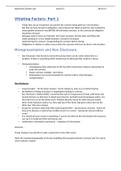
Vitiating Factors- Part 1
- Things that can go wrong that can prevent the contract being perfect in its formation.
- Not that we have formed an obligation, and someone has failed to perform, but instead the
unacceptable behaviour was BEFORE the formation contract, so the contractual obligation
should be removed.
- Damages seek to move you forward; Tort move you back- but this does not follow this
understanding it’s in the middle between Contract/Tort/Equity
- Undermining the contract- incapacitating the contract before closing
- Obligations in relation to others may restrict the outcome what can be done in the situation
Misrepresentation and Non-Disclosure
• Non-disclosure: Not forced to reveal all facts but there can be a time where this is a
problem. If there is something which should have be disclosed this could be a mirep.
• Misrepresentation:
• Unambiguous false statement of fact by which representor induces representee to
enter the contract
• Makes contract voidable- restrictions
• Representee can rescind (unwind) the contract and/or claim damages
(compensation)
Non-disclosure
• Caveat emptor – let the buyer beware- not be stupid e.g. look at a car before buying
• No liability for failing to disclose in negotiations leading to contract.
But, Dimmock v Hallett (1866)- concerned the sale of a large parcel of land, with farms and
tenants farmers on this land. It stated two farms let- but both tenants had given notice- it is
the truth but it is not the whole truth. Problem became worse for seller because stated
other farms had given notice. E,g. they said two of the farms had given notice but not the
other two. This was a misrep.
• Except for contracts uberrimae fidei (utmost good faith) – eg insurance contracts - failure by
insured to disclose a material fact entitles insurer to rescind – leaving the insured without
cover!
• You should tell your insurers everything, if you do not disclose this information the insurance
can say it is invalid and they will not pay out.
• Justification: information asymmetry – imbalance of information
However…
Things change if you decide to make a statement to the other party…
(Note the situational geography of misrep straddling the boundary between Contract and Tort and in
some instances, Equity)
, Advanced Contract Law Lecture 5 28/10/19
Misrep- what is ‘representation’?
• Emerges during negotiation ‘things said along the way’- things said may be a term of the
contract, not unimportant/remembered, or not part of the contract but persuaded us to be
in the contract
= It is this not contractual term that is completely untrue or reflect something other than the
truth which is a misrepresentation
• It is before the contract that is completed that is important where no one is under and
obligation. This is why damages will not work so we need something else.
• Statement of fact which encourages the development of a contractual relationship, but does
not become a term of the contract – the significance of this distinction does not always
make itself apparent in the obvious way
Leaf v International Galleries [1950] 2 KB 86, [1950] 1 All ER 693
o Range of arguments- how actions go on in the court- they do not consider just misrep.
Concerns a picture of Constable, purchased from the gallery for £85 for a number of years
before they decide to sell it, they take it to an auction/dealers, this is constable/Salisbury
Cathedral, they were told it was not what they claimed to be, wanted rescission- unwind
contract back to base level. Rescission is not available forever, too much time had lapsed
since the purchase. It was too late- must respond quicker, they were happy with picture
If it is statement of fact it is a misrepresentation, and this will allow someone out of the contract.
Not looking for damages because we are not saying it is a term of the contract.
e.g. we will give you X for your car, if you buy this one.
Defining Misrepresentation
• ‘An unambiguous false statement of fact’
• Not mere puffery or sales hype – ‘comes out at 40 degrees’- washing powder or ‘red
bull gives you wings’ is simply advertising speak
• Not a statement of opinion or belief – although note the significance of expert
knowledge- talking about facts
Boundary between fact and opinion may depend on balance of knowledge between the parties
Compare:
Bissett v Wilkinson [1927] AC 177- land for sale in NZ, seller states ‘will take 2000 sheep’,
buyer finds it does not, this is a statement of fact and it is wrong and has caused the other
person to enter the contract, seller has never kept sheep on this land so will not know, the
buyer knew the seller had not kept sheep on this land, opinion not facts.
Esso Petroleum Co v Marden [1976] QB 801- Marden decides he in interested in taking the
lease of the development of a petrol station. Esso has much experience what they expect to
sell- gallons of fuel- turnover. This makes the deal viable, he has a future in this business to
make a profit. Expert knowledge and planning permission in relation to the building od the
petrol station was changed- could not enter from main road. This impacted turnover and the
successful future envisaged did not turn out like that. This is not a term of the contract how
much fuel you will sell but it was information provided before the contract the proved to be
false, they argued it was opinion only, but it was EXPERT opinion. Reasonable grounds for
that opinion.
Vitiating Factors- Part 1
- Things that can go wrong that can prevent the contract being perfect in its formation.
- Not that we have formed an obligation, and someone has failed to perform, but instead the
unacceptable behaviour was BEFORE the formation contract, so the contractual obligation
should be removed.
- Damages seek to move you forward; Tort move you back- but this does not follow this
understanding it’s in the middle between Contract/Tort/Equity
- Undermining the contract- incapacitating the contract before closing
- Obligations in relation to others may restrict the outcome what can be done in the situation
Misrepresentation and Non-Disclosure
• Non-disclosure: Not forced to reveal all facts but there can be a time where this is a
problem. If there is something which should have be disclosed this could be a mirep.
• Misrepresentation:
• Unambiguous false statement of fact by which representor induces representee to
enter the contract
• Makes contract voidable- restrictions
• Representee can rescind (unwind) the contract and/or claim damages
(compensation)
Non-disclosure
• Caveat emptor – let the buyer beware- not be stupid e.g. look at a car before buying
• No liability for failing to disclose in negotiations leading to contract.
But, Dimmock v Hallett (1866)- concerned the sale of a large parcel of land, with farms and
tenants farmers on this land. It stated two farms let- but both tenants had given notice- it is
the truth but it is not the whole truth. Problem became worse for seller because stated
other farms had given notice. E,g. they said two of the farms had given notice but not the
other two. This was a misrep.
• Except for contracts uberrimae fidei (utmost good faith) – eg insurance contracts - failure by
insured to disclose a material fact entitles insurer to rescind – leaving the insured without
cover!
• You should tell your insurers everything, if you do not disclose this information the insurance
can say it is invalid and they will not pay out.
• Justification: information asymmetry – imbalance of information
However…
Things change if you decide to make a statement to the other party…
(Note the situational geography of misrep straddling the boundary between Contract and Tort and in
some instances, Equity)
, Advanced Contract Law Lecture 5 28/10/19
Misrep- what is ‘representation’?
• Emerges during negotiation ‘things said along the way’- things said may be a term of the
contract, not unimportant/remembered, or not part of the contract but persuaded us to be
in the contract
= It is this not contractual term that is completely untrue or reflect something other than the
truth which is a misrepresentation
• It is before the contract that is completed that is important where no one is under and
obligation. This is why damages will not work so we need something else.
• Statement of fact which encourages the development of a contractual relationship, but does
not become a term of the contract – the significance of this distinction does not always
make itself apparent in the obvious way
Leaf v International Galleries [1950] 2 KB 86, [1950] 1 All ER 693
o Range of arguments- how actions go on in the court- they do not consider just misrep.
Concerns a picture of Constable, purchased from the gallery for £85 for a number of years
before they decide to sell it, they take it to an auction/dealers, this is constable/Salisbury
Cathedral, they were told it was not what they claimed to be, wanted rescission- unwind
contract back to base level. Rescission is not available forever, too much time had lapsed
since the purchase. It was too late- must respond quicker, they were happy with picture
If it is statement of fact it is a misrepresentation, and this will allow someone out of the contract.
Not looking for damages because we are not saying it is a term of the contract.
e.g. we will give you X for your car, if you buy this one.
Defining Misrepresentation
• ‘An unambiguous false statement of fact’
• Not mere puffery or sales hype – ‘comes out at 40 degrees’- washing powder or ‘red
bull gives you wings’ is simply advertising speak
• Not a statement of opinion or belief – although note the significance of expert
knowledge- talking about facts
Boundary between fact and opinion may depend on balance of knowledge between the parties
Compare:
Bissett v Wilkinson [1927] AC 177- land for sale in NZ, seller states ‘will take 2000 sheep’,
buyer finds it does not, this is a statement of fact and it is wrong and has caused the other
person to enter the contract, seller has never kept sheep on this land so will not know, the
buyer knew the seller had not kept sheep on this land, opinion not facts.
Esso Petroleum Co v Marden [1976] QB 801- Marden decides he in interested in taking the
lease of the development of a petrol station. Esso has much experience what they expect to
sell- gallons of fuel- turnover. This makes the deal viable, he has a future in this business to
make a profit. Expert knowledge and planning permission in relation to the building od the
petrol station was changed- could not enter from main road. This impacted turnover and the
successful future envisaged did not turn out like that. This is not a term of the contract how
much fuel you will sell but it was information provided before the contract the proved to be
false, they argued it was opinion only, but it was EXPERT opinion. Reasonable grounds for
that opinion.