

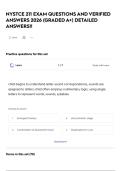
NYSTCE 211 EXAM QUESTIONS AND VERIFIED
ANSWERS 2026 (GRADED A+) DETAILED
ANSWERS!!
Save
Practice questions for this set
Learn 1 /7 Study with Learn
child begins to understand letter-sound correspondence, sounds are
assigned to letters-child often employs rudimentary logic, using single
letters to represent words, sounds, syllables
Choose an answer
1 Emergent literacy 2 semi phonetic stage
3 Combination of assessment tools 4 Graphophonic Cues
Don't know?
Terms in this set (70)
, Emergent literacy what children do to learn how to read and write,
what a child knows about reading and writing
before learning, continues early and keeps
going. Authentic experiences exposes children to
language and it is critical in his stage
Cues readers use these to construct meaning
Semantic cues "meaning cues". Help readers understand what
language means (symbols, sounds, pictures, word
phrases, etc)
Syntactic cues This helps readers understand structure.
Structure cues that help readers understand how
words are organized into patterns.
Graphophonic Cues Letter and sound cues that help readers identify
individual letters or patterns or clusters of letters
such as root and whole words.
Conventions of print print cues that enable readers to follow print
Pragmatic cues Social and cultural functions of language for
different purposes. Different language based on
who we are speaking to.
Strategies for applying cues Sampling; reading or listening
Predicting; making an educated guess
Confirming; using text into to confirm predictions
self-correcting; using text info to correct an initial
prediction that was proven incorrect
ANSWERS 2026 (GRADED A+) DETAILED
ANSWERS!!
Save
Practice questions for this set
Learn 1 /7 Study with Learn
child begins to understand letter-sound correspondence, sounds are
assigned to letters-child often employs rudimentary logic, using single
letters to represent words, sounds, syllables
Choose an answer
1 Emergent literacy 2 semi phonetic stage
3 Combination of assessment tools 4 Graphophonic Cues
Don't know?
Terms in this set (70)
, Emergent literacy what children do to learn how to read and write,
what a child knows about reading and writing
before learning, continues early and keeps
going. Authentic experiences exposes children to
language and it is critical in his stage
Cues readers use these to construct meaning
Semantic cues "meaning cues". Help readers understand what
language means (symbols, sounds, pictures, word
phrases, etc)
Syntactic cues This helps readers understand structure.
Structure cues that help readers understand how
words are organized into patterns.
Graphophonic Cues Letter and sound cues that help readers identify
individual letters or patterns or clusters of letters
such as root and whole words.
Conventions of print print cues that enable readers to follow print
Pragmatic cues Social and cultural functions of language for
different purposes. Different language based on
who we are speaking to.
Strategies for applying cues Sampling; reading or listening
Predicting; making an educated guess
Confirming; using text into to confirm predictions
self-correcting; using text info to correct an initial
prediction that was proven incorrect

