

Escrito por estudiantes que aprobaron Inmediatamente disponible después del pago Leer en línea o como PDF ¿Documento equivocado? Cámbialo gratis 4,6 TrustPilot
logo-home
Document preview thumbnail
Vista previa 4 fuera de 176 páginas
Examen

SOCE Certification Exam V1 | Latest 2026/2027 Update | State Officer Exam | Latest Questions & Verified Answers | Pass Guaranteed

Document preview thumbnail
Vista previa 4 fuera de 176 páginas

SOCE Certification Exam V1 | Latest 2026/2027 Update | State Officer Exam | Latest Questions & Verified Answers | Pass Guaranteed Q: What type of job is Law Enforcement? Answer A service-oriented profession. Q: How is the majority of the time of a law enforcement Officer spent? Answer Serving the community, as an officer's customer is the public. Q: What are the traits of a law enforcement Officer? Answer Service-oriented, dependable, communicative, a problem-solver, and a multi-tasker. Q: What is a supporter? Answer This role is one law enforcement should adopt automatically when interacting with their community. This requires law enforcement to take time to learn about the community and the people who live there. Reaching out to the community members will give law enforcement the tools they need to properly fill the role of the supporter. Q: What is the main benefit of being a supporter? Answer The increased likelihood that community members will reach out to law enforcement with their own support. Q: What is a stabilizer? Answer This role is used whenever critical incidents occur, law enforcement will need to display confidence to calm those around them. Maintaining composure and displaying confidence in their capabilities are important to this role. Q: What is the main responsibility of a stabilizer? Answer Helping individuals who are struggling to remain calm. A law enforcement officer will guide them through the confusion and bring order to uncontrolled situations. Q: What is an enforcer? Answer This role represents duties that are typically associated with a law enforcement officer. Making arrests and maintaining order by giving lawful commands when deemed necessary. Q: What is emotional intelligence? Answer The ability to identify and cope with one's own emotions while also doing the same for the people around them. This not mean to suppress one's own emotions or the emotions of others. It means that one knows how to recognize them, cope with them, and even view them as assets to one's professional life. Q: What are the benefits of having emotional intelligence? Answer Officers more easily recognize when to take on and switch roles. They also acknowledge that during chaotic situations, the ability to manage their own emotions helps manage disorder. Q: How may some people react to law enforcement presence? Answer Due to the imbalance of power, some individuals may react to law enforcement with fear, mistrust, or even anger. Q: What does CJSTC stand for? Answer Criminal Justice Standards and Training Commission Q: What is the Criminal Justice Standards and Training Commission? Answer This body oversees the certification, employment, training, maintenance of officer records, and over conduct of all criminal justice officers in Florida. It seeks to ensure that qualified, competent, and ethical criminal justice officers serve the residents and visitors of Florida. Q: Who supports and assists the Criminal Justice Standards and Training Commission? Answer The Criminal Justice Professionalism (CJP) Division within the Florida Department of Law Enforcement (FDLE) is appointed by Florida State Statute. Q: What are the requirements of Basic Recruit Training? Answer Achieving a passing score of 80% on each of the end-of-course examinations, demonstrating proficiency in DUI traffic stops, demonstrating proficiency in High Liability courses, and participating in the Physical Fitness Program. Q: How many attempts does an aspiring law enforcement officer have for the State Officer Certification Examination (SOCE)? Answer Three attempts. Not passing the SOCE within three attempts means that the entire Basic Recruit Training Program must be repeated. Q: What are the requirements to become a sworn law enforcement Officer in the State of Florida? Answer Meet all of the minimum requirements and standards, complete the Basic Recruit Training Program, pass the State Officers Certification Examination (SOCE), and be employed with a law enforcement agency in a full-time, part-time, or auxiliary position. Q: How long does one have to complete the certification process? Answer Four years from the starting date of the Basic Recruit Training Program. Q: What is "nolo contendere"? Answer When a person does not accept or deny responsibility for the charges but agrees to accept punishment or pleads guilty to, or is found guilty of, any felony. Q: On what grounds can the CJSTC deny your certification? If an officer does any of the following: Answer • pleads nolo contendere or pleads guilty to, or is found guilty of, any felony • pleads nolo contendere or pleads guilty to, or is found guilty of, a misdemeanor involving perjury or false statement • fails to maintain good moral character, as defined by the Florida Statutes and described in the F.A.C • commits any act constituting a felony offense, regardless of criminal prosecution • commits any act constituting any of the serious misdemeanor offenses specified in the F.A.C., regardless of criminal prosecution •commits or attempts to commit, as a principal or accessory or through solicitation or conspiracy, an act that, according the to Florida Statutes, would have been a felony offense had the crime been completed or committed •commits any act in any jurisdiction other than the state of Florida that, if committed in the state of Florida, would constitute a felony, any of the serious misdemeanors specified in F.A.C., or a violation of the Florida Statutes •tests positive for a controlled substance by a urine or blood test, in accordance with the requirements specified in F.A.C. •commits an act of excessive use of force as explained under F.A.C. •engages in sexual harassment involving physical contact or misuse of official position •misuses the official position, as described in the Florida Statutes •engages in sex while on duty •has unprofessional relationships with an inmate, detainee, probationer, parolee, or community controlee •has written or oral communication that is intended to facilitate conduct prohibited by the CJSTC •engages in any physical contact not required in the performance of official duties, that is normally associated with the demonstration of affection or sexual misconduct as defined in the Florida Statutes •false statements during the employment process Q: How may the CJSTC discipline an officer who commits violations? Answer A written reprimand, probation or suspension of up to two years, and revocation of certification. Q: What is the criminal justice system? Answer Involves the maintenance and enforcement of criminal laws and includes the structures, functions, and decision-making processes of the agencies that deal with the management and control of crime and criminal offenders. Q: What is law enforcement? Answer Enforces laws, maintains civil order, and protects the constitutional rights of everyone within the United States. Q: What is the court system? Answer Interprets laws Q: What is corrections? Answer Enforces punishment and rehabilitation services as defined by the court system. Q: What are the four levels of law enforcement, in order of authority (smallest to largest)? Answer Local or municipal, county, state, and federal Q: What is local or municipal law enforcement? Answer Enforces the ordinances of the municipality, as well as state laws within the jurisdiction of the agency. What is county law enforcement? Answer Enforces county ordinances and state laws within the county (including unincorporated areas), oversee the county jail, and handle civil processing. What is state law enforcement? Answer Enforces state laws within the state. What is federal law enforcement? Enforces federal laws across state lines and within the states. What are county jails? Facilities where arrestees go through booking procedures, arrestees await trial, and convicted offenders serve a year or less detention. What are juvenile assessment/detention centers? The processing and pretrial detention of juvenile arrestees occurs in juvenile assessment and detention centers. What is a juvenile? Sometimes referred to as a child or youth, this means any person younger than 18. What are prisons? Both federal and state, prisons are correctional institutions, maintained by the federal and state governments for confining convicted felons. Values are principles, standards, or qualities considered worthwhile or desirable. Assumption is a notion, statement, or belief about a person, group, or event that may or may not be factual Bribery corruptly to give, offer, or promise to any public servant, or, if a public servant, corruptly to request, solicit, accept, or agree to accept for himself or herself or another, any pecuniary or other benefit not authorized by law with an intent or purpose to influence the performance of any act or omission which the person believes to be, or the public servant represents as being, within the official discretion of a public servant, in violation of a public duty, or in performance of a public duty. Quid pro quo Latin term that means "something for something in return." Insubordination failure to follow orders from superiors in the chain of command Probation is a sentence placing a person under the supervision of a probation officer for a specified length of time instead of confinement. Misuse of position or authority No public officer, employee of an agency, or local government attorney shall corruptly use or attempt to use his or her official position or any property or resource which may be within his or her trust, or perform his or her official duties, to secure a special privilege, benefit, or exemption for himself, herself, or others. Chain of command the order of authority within an organization Nolo contendere where an individual does not accept or deny responsibility for the charges but agrees to accept punishment Prosecution presents the government's case Hostile work environment a job culture where lewd jokes or other offensive habits are acceptable. Perception is the impression in a person's mind of an individual, a group of people, or events based on experiences, biases, beliefs, assumptions, and observations. EEOC (Equal Employment Opportunity Commission) the governmental agency that enforces compliance with the civil rights act State Attorney same as prosecutor; responsible for filing formal charges in criminal cases Judge is authorized to preside over the courtroom and to decide questions of law brought before the

Vista previa del contenido

https://www.stuvia.com/user/quizbit07


SOCE Certification Exam V1 | Latest
2026/2027 Update | State Officer Exam |
Latest Questions & Verified Answers |
Pass Guaranteed

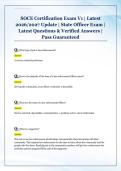
Q: What type of job is Law Enforcement?
Answer

A service-oriented profession.


Q: How is the majority of the time of a law enforcement Officer spent?
Answer

Serving the community, as an officer's customer is the public.


Q: What are the traits of a law enforcement Officer?
Answer

Service-oriented, dependable, communicative, a problem-solver, and a multi-tasker.


Q: What is a supporter?
Answer

This role is one law enforcement should adopt automatically when interacting with their
community. This requires law enforcement to take time to learn about the community and the
people who live there. Reaching out to the community members will give law enforcement the
tools they need to properly fill the role of the supporter.

,https://www.stuvia.com/user/quizbit07


Q: What is the main benefit of being a supporter?
Answer

The increased likelihood that community members will reach out to law enforcement with their
own support.


Q: What is a stabilizer?
Answer

This role is used whenever critical incidents occur, law enforcement will need to display
confidence to calm those around them. Maintaining composure and displaying confidence in
their capabilities are important to this role.


Q: What is the main responsibility of a stabilizer?
Answer

Helping individuals who are struggling to remain calm. A law enforcement officer will guide
them through the confusion and bring order to uncontrolled situations.


Q: What is an enforcer?
Answer

This role represents duties that are typically associated with a law enforcement officer. Making
arrests and maintaining order by giving lawful commands when deemed necessary.

,https://www.stuvia.com/user/quizbit07


Q: What is emotional intelligence?
Answer

The ability to identify and cope with one's own emotions while also doing the same for the
people around them. This not mean to suppress one's own emotions or the emotions of others.
It means that one knows how to recognize them, cope with them, and even view them as assets
to one's professional life.


Q: What are the benefits of having emotional intelligence?
Answer

Officers more easily recognize when to take on and switch roles. They also acknowledge that
during chaotic situations, the ability to manage their own emotions helps manage disorder.


Q: How may some people react to law enforcement presence?
Answer

Due to the imbalance of power, some individuals may react to law enforcement with fear,
mistrust, or even anger.


Q: What does CJSTC stand for?
Answer

Criminal Justice Standards and Training Commission


Q: What is the Criminal Justice Standards and Training Commission?
Answer

, https://www.stuvia.com/user/quizbit07


This body oversees the certification, employment, training, maintenance of officer records, and
over conduct of all criminal justice officers in Florida. It seeks to ensure that qualified,
competent, and ethical criminal justice officers serve the residents and visitors of Florida.


Q: Who supports and assists the Criminal Justice Standards and Training Commission?
Answer

The Criminal Justice Professionalism (CJP) Division within the Florida Department of Law
Enforcement (FDLE) is appointed by Florida State Statute.


Q: What are the requirements of Basic Recruit Training?
Answer

Achieving a passing score of 80% on each of the end-of-course examinations, demonstrating
proficiency in DUI traffic stops, demonstrating proficiency in High Liability courses, and
participating in the Physical Fitness Program.


Q: How many attempts does an aspiring law enforcement officer have for the State Officer
Certification Examination (SOCE)?

Answer

Three attempts. Not passing the SOCE within three attempts means that the entire Basic Recruit
Training Program must be repeated.


Información del documento

Subido en
12 de abril de 2026
Número de páginas
176
Escrito en
2025/2026
Tipo
Examen
Contiene
Preguntas y respuestas
$13.49

¿Documento equivocado? Cámbialo gratis Dentro de los 14 días posteriores a la compra y antes de descargarlo, puedes elegir otro documento. Puedes gastar el importe de nuevo.
Escrito por estudiantes que aprobaron
Inmediatamente disponible después del pago
Leer en línea o como PDF

Seller avatar
Los indicadores de reputación están sujetos a la cantidad de artículos vendidos por una tarifa y las reseñas que ha recibido por esos documentos. Hay tres niveles: Bronce, Plata y Oro. Cuanto mayor reputación, más podrás confiar en la calidad del trabajo del vendedor.
EliteStudyExams
4.0
(700)
Vendido
3588
Seguidores
2869
Artículos
9199
Última venta
19 horas hace


Por qué los estudiantes eligen Stuvia

Creado por compañeros estudiantes, verificado por reseñas

Calidad en la que puedes confiar: escrito por estudiantes que aprobaron y evaluado por otros que han usado estos resúmenes.

¿No estás satisfecho? Elige otro documento

¡No te preocupes! Puedes elegir directamente otro documento que se ajuste mejor a lo que buscas.

Paga como quieras, empieza a estudiar al instante

Sin suscripción, sin compromisos. Paga como estés acostumbrado con tarjeta de crédito y descarga tu documento PDF inmediatamente.

Student with book image

“Comprado, descargado y aprobado. Así de fácil puede ser.”

Alisha Student

Preguntas frecuentes