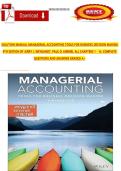
MANAGERIAL ACCOUNTING TOOLS FOR BUSINESS DECISION MAKING 9TH EDITION BY JERRY J. WEYGANDT,
PAUL D. KIMMEL
SOLUTION MANUAL MANAGERIAL ACCOUNTING TOOLS FOR BUSINESS DECISION MAKING
9TH EDITION BY JERRY J. WEYGANDT, PAUL D. KIMMEL ALL CHAPTERS 1 - 14, COMPLETE
QUESTIONS AND ANSWERS GRADED A+
,TABLE OF CONTENTS
Chapter 1: Managerial Accounting
Chapter 2: Job Order Costing
Chapter 2A: Job Order Costing: Non-Debit and Credit Approach
Chapter 3: Process Costing
Chapter 3A: Process Costing: Non-Debit and Credit Approach
Chapter 4: Activity-Based Costing
Chapter 5: Cost-Volume-Profit
Chapter 6: Cost-Volume-Profit Analysis: Additional Issues
Chapter 7: Incremental Analysis
Chapter 8: Pricing
Chapter 9: Budgetary Planning
Chapter 10: Budgetary Control and Responsibility Accounting
Chapter 11: Standard Costs and Balanced Scorecard
Chapter 12: Planning for Capital Investments
Chapter 13: Statement of Cash Flows
Chapter 14: Financial Analysis
,MANAGERIAL ACCOUNTING TOOLS FOR BUSINESS DECISION MAKING 9TH EDITION BY JERRY J. WEYGANDT,
PAUL D. KIMMEL
CHAPTER 1
Managerial Accounting
Learning Objectives
1. Identify the features of managerial accounting and the functions of management.
2. Describe the classes of manufacturing costs and the differences between product
and period costs.
3. Demonstrate how to compute cost of goods manufactured and prepare financial
statements for a manufacturer.
4. Discuss trends in managerial accounting.
ANSWERS TO QUESTIONS
1. (a) Not true. Managerial accounting is a field of accounting that provides economic and
financial information for managers and other internal users.
(b) Joe is incorrect. Managerial accounting applies to all types of businesses—service,
merchandising, and manufacturing.
LO1 BT: C Difficulty: Easy TOT: 3 min. AACSB: None AICPA FC: Measurement, Analysis and Interpretation IMA: Cost
Management
2. (a) Financial accounting is concerned primarily with external users such as stockholders,
creditors, and regulators. In contrast, managerial accounting is concerned primarily
with internal users such as officers and managers.
(b) Financial statements are the end product of financial accounting. These statements
are prepared quarterly and annually. In managerial accounting, internal reports may
be prepared as frequently as needed.
(c) The purpose of financial accounting is to provide general-purpose information for
external users. The purpose of managerial accounting is to provide special-purpose
information for specific internal decisions.
LO1 BT: C Difficulty: Easy TOT: 5 min. AACSB: None AICPA FC: Measurement, Analysis and Interpretation IMA: Cost
Management
3. Differences in the content of the reports are as follows:
Financial Managerial
• Pertains to business as a whole and is • Pertains to subunits of the business
highly aggregated. and may be very detailed.
• Limited to accrual accounting and cost • Extends beyond accrual
data. accounting system to any relevant
• Generally accepted accounting principles. data.
, • Standard is relevance to decisions.
In financial accounting, financial statements are verified annually through an
independent audit by certified public accountants. There are no independent audits of
internal reports prepared by managerial accountants.
LO1 BT: C Difficulty: Easy TOT: 5 min. AACSB: None AICPA FC: Measurement, Analysis and Interpretation IMA: Cost Management
4. Linda should know that the management of an organization performs three broad functions:
(1) Planning requires management to look ahead and to establish objectives.
(2) Directing involves coordinating the diverse activities and human resources of a
company to produce a smooth-running operation.
(3) Controlling is the process of keeping the company’s activities on track.
LO1 BT: C Difficulty: Easy TOT: 3 min. AACSB: None AICPA FC: Measurement, Analysis and Interpretation IMA: Cost Management
5. Not true. Decision-making is not a separate management function. Rather, decision-
making involves the exercise of good judgment in performing the three management
functions explained in the answer to question four above.
LO1 BT: C Difficulty: Easy TOT: 2 min. AACSB: None AICPA FC: Measurement, Analysis and Interpretation IMA: Cost Management
6. Employees with line positions are directly involved in the company’s primary revenue
generating operating activities. Examples would include factory managers and
supervisors, and the vice president of operations. In contrast, employees with staff
positions are not directly involved in revenue-generating operating activities, but rather
serve in a support capacity to line employees. Examples include employees in finance,
legal, and human resources.
LO1 BT: C Difficulty: Easy TOT: 3 min. AACSB: None AICPA FC: Measurement, Analysis and Interpretation IMA: Cost Management
Questions Chapter 1 (Continued)
7. The difference in balance sheets pertains to the presentation of inventories in the current
asset section. In a merchandising company, only inventory is shown. In a manufacturing
company, three inventory accounts are shown: finished goods, work in process, and raw
materials.
LO3 BT: C Difficulty: Easy TOT: 2 min. AACSB: None AICPA FC: Measurement, Analysis and Interpretation IMA: Cost management
8. Manufacturing costs are classified as either direct materials, direct labor, or
manufacturing overhead.
LO2 BT: C Difficulty: Easy TOT: 1 min. AACSB: None AICPA FC: Measurement, Analysis and Interpretation IMA: Cost management
9. No, Mel is not correct. The distinction between direct and indirect materials is based on two criteria:
(1) physical association and (2) the convenience of making the physical association.
Materials which cannot be easily associated with the finished product are considered
indirect materials.
LO2 BT: C Difficulty: Easy TOT: 2 min. AACSB: None AICPA FC: Measurement, Analysis and Interpretation IMA: Cost management
10. Product costs, or inventoriable costs, are costs that are a necessary and integral part of
producing the finished product, they are classified as manufacturing costs. Period costs
are costs that are identified with a specific time period rather than with a salable product.
These costs relate to nonmanufacturing activities and therefore are not inventoriable
costs, they are expensed as incurred.
LO2 BT: K Difficulty: Easy TOT: 2 min. AACSB: None AICPA FC: Measurement, Analysis and Interpretation IMA: Cost management
PAUL D. KIMMEL
SOLUTION MANUAL MANAGERIAL ACCOUNTING TOOLS FOR BUSINESS DECISION MAKING
9TH EDITION BY JERRY J. WEYGANDT, PAUL D. KIMMEL ALL CHAPTERS 1 - 14, COMPLETE
QUESTIONS AND ANSWERS GRADED A+
,TABLE OF CONTENTS
Chapter 1: Managerial Accounting
Chapter 2: Job Order Costing
Chapter 2A: Job Order Costing: Non-Debit and Credit Approach
Chapter 3: Process Costing
Chapter 3A: Process Costing: Non-Debit and Credit Approach
Chapter 4: Activity-Based Costing
Chapter 5: Cost-Volume-Profit
Chapter 6: Cost-Volume-Profit Analysis: Additional Issues
Chapter 7: Incremental Analysis
Chapter 8: Pricing
Chapter 9: Budgetary Planning
Chapter 10: Budgetary Control and Responsibility Accounting
Chapter 11: Standard Costs and Balanced Scorecard
Chapter 12: Planning for Capital Investments
Chapter 13: Statement of Cash Flows
Chapter 14: Financial Analysis
,MANAGERIAL ACCOUNTING TOOLS FOR BUSINESS DECISION MAKING 9TH EDITION BY JERRY J. WEYGANDT,
PAUL D. KIMMEL
CHAPTER 1
Managerial Accounting
Learning Objectives
1. Identify the features of managerial accounting and the functions of management.
2. Describe the classes of manufacturing costs and the differences between product
and period costs.
3. Demonstrate how to compute cost of goods manufactured and prepare financial
statements for a manufacturer.
4. Discuss trends in managerial accounting.
ANSWERS TO QUESTIONS
1. (a) Not true. Managerial accounting is a field of accounting that provides economic and
financial information for managers and other internal users.
(b) Joe is incorrect. Managerial accounting applies to all types of businesses—service,
merchandising, and manufacturing.
LO1 BT: C Difficulty: Easy TOT: 3 min. AACSB: None AICPA FC: Measurement, Analysis and Interpretation IMA: Cost
Management
2. (a) Financial accounting is concerned primarily with external users such as stockholders,
creditors, and regulators. In contrast, managerial accounting is concerned primarily
with internal users such as officers and managers.
(b) Financial statements are the end product of financial accounting. These statements
are prepared quarterly and annually. In managerial accounting, internal reports may
be prepared as frequently as needed.
(c) The purpose of financial accounting is to provide general-purpose information for
external users. The purpose of managerial accounting is to provide special-purpose
information for specific internal decisions.
LO1 BT: C Difficulty: Easy TOT: 5 min. AACSB: None AICPA FC: Measurement, Analysis and Interpretation IMA: Cost
Management
3. Differences in the content of the reports are as follows:
Financial Managerial
• Pertains to business as a whole and is • Pertains to subunits of the business
highly aggregated. and may be very detailed.
• Limited to accrual accounting and cost • Extends beyond accrual
data. accounting system to any relevant
• Generally accepted accounting principles. data.
, • Standard is relevance to decisions.
In financial accounting, financial statements are verified annually through an
independent audit by certified public accountants. There are no independent audits of
internal reports prepared by managerial accountants.
LO1 BT: C Difficulty: Easy TOT: 5 min. AACSB: None AICPA FC: Measurement, Analysis and Interpretation IMA: Cost Management
4. Linda should know that the management of an organization performs three broad functions:
(1) Planning requires management to look ahead and to establish objectives.
(2) Directing involves coordinating the diverse activities and human resources of a
company to produce a smooth-running operation.
(3) Controlling is the process of keeping the company’s activities on track.
LO1 BT: C Difficulty: Easy TOT: 3 min. AACSB: None AICPA FC: Measurement, Analysis and Interpretation IMA: Cost Management
5. Not true. Decision-making is not a separate management function. Rather, decision-
making involves the exercise of good judgment in performing the three management
functions explained in the answer to question four above.
LO1 BT: C Difficulty: Easy TOT: 2 min. AACSB: None AICPA FC: Measurement, Analysis and Interpretation IMA: Cost Management
6. Employees with line positions are directly involved in the company’s primary revenue
generating operating activities. Examples would include factory managers and
supervisors, and the vice president of operations. In contrast, employees with staff
positions are not directly involved in revenue-generating operating activities, but rather
serve in a support capacity to line employees. Examples include employees in finance,
legal, and human resources.
LO1 BT: C Difficulty: Easy TOT: 3 min. AACSB: None AICPA FC: Measurement, Analysis and Interpretation IMA: Cost Management
Questions Chapter 1 (Continued)
7. The difference in balance sheets pertains to the presentation of inventories in the current
asset section. In a merchandising company, only inventory is shown. In a manufacturing
company, three inventory accounts are shown: finished goods, work in process, and raw
materials.
LO3 BT: C Difficulty: Easy TOT: 2 min. AACSB: None AICPA FC: Measurement, Analysis and Interpretation IMA: Cost management
8. Manufacturing costs are classified as either direct materials, direct labor, or
manufacturing overhead.
LO2 BT: C Difficulty: Easy TOT: 1 min. AACSB: None AICPA FC: Measurement, Analysis and Interpretation IMA: Cost management
9. No, Mel is not correct. The distinction between direct and indirect materials is based on two criteria:
(1) physical association and (2) the convenience of making the physical association.
Materials which cannot be easily associated with the finished product are considered
indirect materials.
LO2 BT: C Difficulty: Easy TOT: 2 min. AACSB: None AICPA FC: Measurement, Analysis and Interpretation IMA: Cost management
10. Product costs, or inventoriable costs, are costs that are a necessary and integral part of
producing the finished product, they are classified as manufacturing costs. Period costs
are costs that are identified with a specific time period rather than with a salable product.
These costs relate to nonmanufacturing activities and therefore are not inventoriable
costs, they are expensed as incurred.
LO2 BT: K Difficulty: Easy TOT: 2 min. AACSB: None AICPA FC: Measurement, Analysis and Interpretation IMA: Cost management