

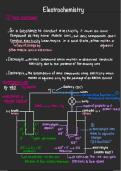
Electrochemistry
1 Inert electrodes
-for substance to conduct electricity
a it must an ionic
Compound as they have mobile ions but ,
ionic compounds don't
conduct When they're solid State , either molten
electricity in a or
↳ flow of charge by aqueous
either mobile ions or electrons
·
Electrolyte anionic compound when molten or dissolved conducts
electricity due to the presence of free ions
moving
· Electrolysis - the break down of ionic compounds using electricity when
molten or
aqueous only by
the
passage of an electric current
19) electrolytic cell
+
Eg Naci 1b) molten
..
t -
Battery (DC)
> E wires
①
I
electrons flow from the C
& electrolyte is
terimenal of the
battery
always Used Up bulb
2NaCI > 2Na + Cl2 made of graphite so it
V
doesn't react
(t) Anode cathode 1
-
)
Anions cations
-
g
8 Silvery grayish ②
8
deposit g
z
+
Cl O O Na in electrolyte ions
S
-
Co oc- Nat move to opposite
woNa
o
Cl- green gas bubbles
+
charges
Nat "REDUCTION"
+
e - Na
2C1- > (12 + 2e - Na +
electrolyte
Oxidation Reduction
(molten Nack
↳ at anodethe-veions lose ↳at cathode the -ve ions gain
electrons & form atoms / molecules electrons a form atoms
, 1c) electrolysis of aqueous solutions & H20 = H
+
+ OH-
i) concentrated
& electrolyte isn't Used up Battery (DC)
+
i) wires
①
I
C electrons flow from the C
terimenal of the
bulb
battery
made of graphite so it
V
doesn't react
( ( Anode
+ cathode -(
Anions +
ions present : OH 1 cations
Cl-Nat
-
8 G
Cl O
O O
Cl-
+
W
G ②
H 0 O
C- Cl in electrolyte ions
-
0
O -
O O + +
OH move to
0 00 0 H 0
H opposite
↳ green gas bubbles L colorless charges
>
-
electrolyte left gas bubbles "REDUCTION"
201+ Ch + 2e (NaOH) 2H
+
+ 20 = H2 electrolyte
>
- sodium hydroxide NACI (
(ageous
*
hydrogen is always produced at cathode (-) if a metal is present below ,
hydrogen in the reactivity series then it'll be formed at cathode instead
,
Battery (DC)
+
(ii) Dilute <x > e-
wires
O
1
electrons flow from the
terimenal of the
bulb
battery
made of graphite so it
(t) Anode
Anions
ionspresent : OH V
cathode -(
cations
doesn't react
80
o
8 - 2 g Oo 0
②
- 2 +
j H 0 o - inelectrolyte ions
E
Op -
2 H +
0 H
"
move to opposite
ooxygen
g
charges
hydrogen "REDUCTION"
+
2H
40H- 2H20 + 02 + He 2e - Hz
+ >
electrolyte
(aqdilute Nack
1 Inert electrodes
-for substance to conduct electricity
a it must an ionic
Compound as they have mobile ions but ,
ionic compounds don't
conduct When they're solid State , either molten
electricity in a or
↳ flow of charge by aqueous
either mobile ions or electrons
·
Electrolyte anionic compound when molten or dissolved conducts
electricity due to the presence of free ions
moving
· Electrolysis - the break down of ionic compounds using electricity when
molten or
aqueous only by
the
passage of an electric current
19) electrolytic cell
+
Eg Naci 1b) molten
..
t -
Battery (DC)
> E wires
①
I
electrons flow from the C
& electrolyte is
terimenal of the
battery
always Used Up bulb
2NaCI > 2Na + Cl2 made of graphite so it
V
doesn't react
(t) Anode cathode 1
-
)
Anions cations
-
g
8 Silvery grayish ②
8
deposit g
z
+
Cl O O Na in electrolyte ions
S
-
Co oc- Nat move to opposite
woNa
o
Cl- green gas bubbles
+
charges
Nat "REDUCTION"
+
e - Na
2C1- > (12 + 2e - Na +
electrolyte
Oxidation Reduction
(molten Nack
↳ at anodethe-veions lose ↳at cathode the -ve ions gain
electrons & form atoms / molecules electrons a form atoms
, 1c) electrolysis of aqueous solutions & H20 = H
+
+ OH-
i) concentrated
& electrolyte isn't Used up Battery (DC)
+
i) wires
①
I
C electrons flow from the C
terimenal of the
bulb
battery
made of graphite so it
V
doesn't react
( ( Anode
+ cathode -(
Anions +
ions present : OH 1 cations
Cl-Nat
-
8 G
Cl O
O O
Cl-
+
W
G ②
H 0 O
C- Cl in electrolyte ions
-
0
O -
O O + +
OH move to
0 00 0 H 0
H opposite
↳ green gas bubbles L colorless charges
>
-
electrolyte left gas bubbles "REDUCTION"
201+ Ch + 2e (NaOH) 2H
+
+ 20 = H2 electrolyte
>
- sodium hydroxide NACI (
(ageous
*
hydrogen is always produced at cathode (-) if a metal is present below ,
hydrogen in the reactivity series then it'll be formed at cathode instead
,
Battery (DC)
+
(ii) Dilute <x > e-
wires
O
1
electrons flow from the
terimenal of the
bulb
battery
made of graphite so it
(t) Anode
Anions
ionspresent : OH V
cathode -(
cations
doesn't react
80
o
8 - 2 g Oo 0
②
- 2 +
j H 0 o - inelectrolyte ions
E
Op -
2 H +
0 H
"
move to opposite
ooxygen
g
charges
hydrogen "REDUCTION"
+
2H
40H- 2H20 + 02 + He 2e - Hz
+ >
electrolyte
(aqdilute Nack

