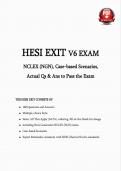
HESI EXIT V6 EXAM
NCLEX (NGN), Case-based Scenarios,
Actual Qs & Ans to Pass the Exam
THIS HESI EXIT CONSISTS OF
160 Questions and Answers
Multiple-choice Style
Select All That Apply (SATA), ordering, fill-in-the-blank for dosage
including Next Generation NCLEX (NGN) items
Case-based Scenarios
Expert Rationales consistent with HESI−Elsevier/Evolve standards.
,1) (NGN-Style: Single Best Response)
The nurse is caring for a pre-adolescent client in skeletal Dunlop traction. Which nursing
intervention is appropriate for this child?
A. Make certain the child is maintained in correct body alignment.
B. Be sure the traction weights touch the end of the bed.
C. Adjust the head and foot of the bed for the child's comfort.
D. Release the traction for 15–20 minutes every 6 hours PRN.
Answer: A. Make certain the child is maintained in correct body alignment.
Expert-Verified Explanation:
• Proper body alignment is essential in skeletal traction to ensure effective pull and prevent
complications (e.g., nerve damage, skin breakdown, impaired bone healing).
• Weights should hang freely, not touching the bed or floor.
• Releasing traction without an order disturbs the healing process.
───────────────────────────────────────
─────────────────
2) (Standard Multiple Choice)
The nurse is assessing a healthy child at the 2-year checkup. Which of the following should
the nurse report immediately to the health care provider?
A. Height and weight percentiles vary widely.
B. Growth pattern appears to have slowed.
C. Recumbent and standing height are different.
,D. Short-term weight changes are uneven.
Answer: A. Height and weight percentiles vary widely.
Expert-Verified Explanation:
• A big discrepancy between height and weight percentiles (e.g., height 10th percentile but
weight 90th) could indicate nutritional or endocrine issues.
• Slowed growth can be normal variation, but extreme differences warrant further evaluation.
───────────────────────────────────────
─────────────────
3) (NGN-Style: Single Best Response)
The parents of a 2-year-old child report that he has been holding his breath whenever he has
temper tantrums. What is the best action by the nurse?
A. Teach the parents how to perform cardiopulmonary resuscitation.
B. Recommend that the parents give in when he holds his breath to prevent anoxia.
C. Advise the parents to ignore breath holding because breathing will begin as a reflex.
D. Instruct the parents on how to reason with the child about possible harmful effects.
Answer: C. Advise the parents to ignore breath holding because breathing will begin as a
reflex.
Expert-Verified Explanation:
• Breath-holding spells in toddlers are typically triggered by anger/frustration; children
resume breathing spontaneously due to reflex.
• Overreacting or giving in reinforces the negative behavior.
, ───────────────────────────────────────
─────────────────
4) (Case Study Format: Acute Chest Pain)
The nurse is assessing a client in the emergency room. Which statement suggests that the
problem is acute angina?
A. “My pain is deep in my chest behind my sternum.”
B. “When I sit up, the pain gets worse.”
C. “As I take a deep breath, the pain gets worse.”
D. “The pain is right here in my stomach area.”
Answer: A. “My pain is deep in my chest behind my sternum.”
Expert-Verified Explanation:
• Angina often feels like pressure behind the sternum, possibly radiating.
• Pain worsened by position changes might be pericarditis; pain on inspiration might be
pleuritic.
───────────────────────────────────────
─────────────────
5) (NGN-Style: Single Best Response)
The nurse is assessing the mental status of a client admitted with possible organic brain
disorder. Which of these questions will best assess the function of the client's recent memory?
A. “Name the year. What season is this?”
B. “Subtract 7 from 100 and then keep subtracting 7…”
NCLEX (NGN), Case-based Scenarios,
Actual Qs & Ans to Pass the Exam
THIS HESI EXIT CONSISTS OF
160 Questions and Answers
Multiple-choice Style
Select All That Apply (SATA), ordering, fill-in-the-blank for dosage
including Next Generation NCLEX (NGN) items
Case-based Scenarios
Expert Rationales consistent with HESI−Elsevier/Evolve standards.
,1) (NGN-Style: Single Best Response)
The nurse is caring for a pre-adolescent client in skeletal Dunlop traction. Which nursing
intervention is appropriate for this child?
A. Make certain the child is maintained in correct body alignment.
B. Be sure the traction weights touch the end of the bed.
C. Adjust the head and foot of the bed for the child's comfort.
D. Release the traction for 15–20 minutes every 6 hours PRN.
Answer: A. Make certain the child is maintained in correct body alignment.
Expert-Verified Explanation:
• Proper body alignment is essential in skeletal traction to ensure effective pull and prevent
complications (e.g., nerve damage, skin breakdown, impaired bone healing).
• Weights should hang freely, not touching the bed or floor.
• Releasing traction without an order disturbs the healing process.
───────────────────────────────────────
─────────────────
2) (Standard Multiple Choice)
The nurse is assessing a healthy child at the 2-year checkup. Which of the following should
the nurse report immediately to the health care provider?
A. Height and weight percentiles vary widely.
B. Growth pattern appears to have slowed.
C. Recumbent and standing height are different.
,D. Short-term weight changes are uneven.
Answer: A. Height and weight percentiles vary widely.
Expert-Verified Explanation:
• A big discrepancy between height and weight percentiles (e.g., height 10th percentile but
weight 90th) could indicate nutritional or endocrine issues.
• Slowed growth can be normal variation, but extreme differences warrant further evaluation.
───────────────────────────────────────
─────────────────
3) (NGN-Style: Single Best Response)
The parents of a 2-year-old child report that he has been holding his breath whenever he has
temper tantrums. What is the best action by the nurse?
A. Teach the parents how to perform cardiopulmonary resuscitation.
B. Recommend that the parents give in when he holds his breath to prevent anoxia.
C. Advise the parents to ignore breath holding because breathing will begin as a reflex.
D. Instruct the parents on how to reason with the child about possible harmful effects.
Answer: C. Advise the parents to ignore breath holding because breathing will begin as a
reflex.
Expert-Verified Explanation:
• Breath-holding spells in toddlers are typically triggered by anger/frustration; children
resume breathing spontaneously due to reflex.
• Overreacting or giving in reinforces the negative behavior.
, ───────────────────────────────────────
─────────────────
4) (Case Study Format: Acute Chest Pain)
The nurse is assessing a client in the emergency room. Which statement suggests that the
problem is acute angina?
A. “My pain is deep in my chest behind my sternum.”
B. “When I sit up, the pain gets worse.”
C. “As I take a deep breath, the pain gets worse.”
D. “The pain is right here in my stomach area.”
Answer: A. “My pain is deep in my chest behind my sternum.”
Expert-Verified Explanation:
• Angina often feels like pressure behind the sternum, possibly radiating.
• Pain worsened by position changes might be pericarditis; pain on inspiration might be
pleuritic.
───────────────────────────────────────
─────────────────
5) (NGN-Style: Single Best Response)
The nurse is assessing the mental status of a client admitted with possible organic brain
disorder. Which of these questions will best assess the function of the client's recent memory?
A. “Name the year. What season is this?”
B. “Subtract 7 from 100 and then keep subtracting 7…”