TESOL OHIO ASSESSMENT FOR
EDUCATORS TEST PRACTICE
QUESTIONS AND ANSWERS WITH
COMPLETE SOLUTIONS 100%
CORRECT
morpheme -ANSWER ✔✔The smallest unit of meaning in a language. It cannot
be divided into smaller meaningful parts. For example, "unbreakable" contains
three morphemes: un- (not), break (root), and -able (capable of).
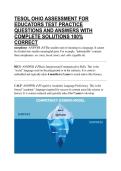
BICS -ANSWER ✔✔Basic Interpersonal Communicative Skills. This is the
"social" language used on the playground or in the cafeteria. It is context-
embedded and typically takes 6 months to 2 years to reach native-like fluency.
CALP -ANSWER ✔✔Cognitive Academic Language Proficiency. This is the
formal "academic" language required for success in content areas like science or
history. It is context-reduced and typically takes 5 to 7 years to develop.
,The Silent Period -ANSWER ✔✔A stage where an ELL is taking in a new
language but is not yet ready to produce it. Forcing speech during this time can
increase anxiety and hinder the learning process.
Scaffolding -ANSWER ✔✔Temporary supports (like graphic organizers, sentence
frames, or visuals) used to bridge the gap between what a student can do alone and
what they can do with help.
Zone of Proximal Development (ZPD) -ANSWER ✔✔Developed by Vygotsky;
the "sweet spot" of learning. It is the distance between a student's ability to perform
a task under adult supervision and their ability to solve the problem independently.
Cognitive Constructivism -ANSWER ✔✔Jean Piaget - Asserts that language is a
reflection of cognitive stages. A child cannot use certain language structures until
they have reached the corresponding developmental milestone.
Social Constructivism -ANSWER ✔✔Lev Vygotsky - Argues that social
interaction is the primary source of language development. Language is first social,
then internalized as thought.
Input Hypothesis ($i + 1$) -ANSWER ✔✔Stephen Krashen - To move to the
next level of proficiency, a student must be exposed to "comprehensible input" that
is just one step beyond their current level ($i$).
Affective Filter -ANSWER ✔✔A psychological "screen" that blocks language
acquisition. When a student is stressed, bored, or self-conscious, the filter is high,
and input cannot get in. When they feel safe, the filter is low.
Digraph -ANSWER ✔✔two letters blended to make one new sound
, diphthong -ANSWER ✔✔2 vowels start out with one sound and glides into the
second vowel sound
diphthongs -ANSWER ✔✔a complex speech sound or glide that begins with one
vowel and gradually changes to another vowel within the same syllable. Examples:
/oi/ in boil / ī/ in fine
consonant cluster -ANSWER ✔✔also called consonant blends; a group of
consonants that appears together in a word without any vowels in between them
Phonology -ANSWER ✔✔study of the sound system of the language
phonetic variation -ANSWER ✔✔encompasses the phonetic, morphosyntactic and
lexical differences people make in their pronunciation, word choices and
grammatical arrangements
Manner of Articulation -ANSWER ✔✔The way in which airflow is changed when
consonant sounds are produced, e.g., plosive, fricative, affricate, approximates,
nasals
Places of Articulation -ANSWER ✔✔alveolar and post alveolar, labio dental area,
bi labial, teeth, velar/velum, palatal, glottis/glottal
Fricative -ANSWER ✔✔partial closure, audible friction. Sustained
Plosive -ANSWER ✔✔full closure somewhere in the vocal tract, buildup of air
pressure, explosive release. Unsustained
EDUCATORS TEST PRACTICE
QUESTIONS AND ANSWERS WITH
COMPLETE SOLUTIONS 100%
CORRECT
morpheme -ANSWER ✔✔The smallest unit of meaning in a language. It cannot
be divided into smaller meaningful parts. For example, "unbreakable" contains
three morphemes: un- (not), break (root), and -able (capable of).
BICS -ANSWER ✔✔Basic Interpersonal Communicative Skills. This is the
"social" language used on the playground or in the cafeteria. It is context-
embedded and typically takes 6 months to 2 years to reach native-like fluency.
CALP -ANSWER ✔✔Cognitive Academic Language Proficiency. This is the
formal "academic" language required for success in content areas like science or
history. It is context-reduced and typically takes 5 to 7 years to develop.
,The Silent Period -ANSWER ✔✔A stage where an ELL is taking in a new
language but is not yet ready to produce it. Forcing speech during this time can
increase anxiety and hinder the learning process.
Scaffolding -ANSWER ✔✔Temporary supports (like graphic organizers, sentence
frames, or visuals) used to bridge the gap between what a student can do alone and
what they can do with help.
Zone of Proximal Development (ZPD) -ANSWER ✔✔Developed by Vygotsky;
the "sweet spot" of learning. It is the distance between a student's ability to perform
a task under adult supervision and their ability to solve the problem independently.
Cognitive Constructivism -ANSWER ✔✔Jean Piaget - Asserts that language is a
reflection of cognitive stages. A child cannot use certain language structures until
they have reached the corresponding developmental milestone.
Social Constructivism -ANSWER ✔✔Lev Vygotsky - Argues that social
interaction is the primary source of language development. Language is first social,
then internalized as thought.
Input Hypothesis ($i + 1$) -ANSWER ✔✔Stephen Krashen - To move to the
next level of proficiency, a student must be exposed to "comprehensible input" that
is just one step beyond their current level ($i$).
Affective Filter -ANSWER ✔✔A psychological "screen" that blocks language
acquisition. When a student is stressed, bored, or self-conscious, the filter is high,
and input cannot get in. When they feel safe, the filter is low.
Digraph -ANSWER ✔✔two letters blended to make one new sound
, diphthong -ANSWER ✔✔2 vowels start out with one sound and glides into the
second vowel sound
diphthongs -ANSWER ✔✔a complex speech sound or glide that begins with one
vowel and gradually changes to another vowel within the same syllable. Examples:
/oi/ in boil / ī/ in fine
consonant cluster -ANSWER ✔✔also called consonant blends; a group of
consonants that appears together in a word without any vowels in between them
Phonology -ANSWER ✔✔study of the sound system of the language
phonetic variation -ANSWER ✔✔encompasses the phonetic, morphosyntactic and
lexical differences people make in their pronunciation, word choices and
grammatical arrangements
Manner of Articulation -ANSWER ✔✔The way in which airflow is changed when
consonant sounds are produced, e.g., plosive, fricative, affricate, approximates,
nasals
Places of Articulation -ANSWER ✔✔alveolar and post alveolar, labio dental area,
bi labial, teeth, velar/velum, palatal, glottis/glottal
Fricative -ANSWER ✔✔partial closure, audible friction. Sustained
Plosive -ANSWER ✔✔full closure somewhere in the vocal tract, buildup of air
pressure, explosive release. Unsustained