

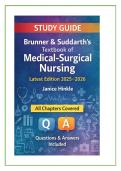
, STUDY GUIDE FOR BRUNNER AND SUDDARTH'S TEXTBOOK
OF MEDICAL-SURGICAL NURSING, LATEST EDITION
2025,2026 - JANICE HINKLE - ( ALL CHAPTERS
COVERED)QUESTIONS & ANSWERS INCLUDED
Introduction
Welcome to the Study Guide for Brunner & Suddarth’s Textbook of Medical-Surgical Nursing
(Latest Edition 2025–2026) by Janice Hinkle. This guide is designed to support nursing students
and healthcare professionals in mastering the essential concepts, clinical skills, and critical
thinking required in medical-surgical nursing practice.
Medical-surgical nursing forms the foundation of clinical nursing, focusing on the care of adult
patients with a wide range of acute and chronic health conditions. As healthcare continues to
evolve, nurses must be equipped with up-to-date knowledge, evidence-based practices, and the
ability to make sound clinical judgments in diverse and often complex patient situations.
This study guide provides a comprehensive review of all chapters, ensuring full coverage of key
topics presented in the main textbook. Each section includes carefully structured questions and
answers to reinforce understanding, promote active learning, and prepare students for exams
such as nursing school assessments and licensure examinations.
The questions are designed to test not only recall but also application, analysis, and clinical
reasoning. Detailed answers and explanations help bridge the gap between theory and practice,
enabling learners to confidently apply knowledge in real-world healthcare settings.
Whether you are preparing for exams, reviewing course material, or strengthening your clinical
knowledge, this guide serves as a reliable and practical companion to your studies. By using this
resource consistently, you will build a strong foundation in medical-surgical nursing and enhance
your readiness for professional practice.
Preface
This Study Guide for Brunner & Suddarth’s Textbook of Medical-Surgical Nursing (Latest
Edition 2025–2026) has been carefully developed to enhance learning, strengthen understanding,
and support success in both academic and clinical settings.
Medical-surgical nursing is one of the most comprehensive and demanding areas of nursing
education. It requires not only a solid grasp of theoretical knowledge but also the ability to apply
that knowledge in real-life patient care situations. Recognizing these challenges, this guide has
,been structured to simplify complex concepts while maintaining accuracy, depth, and relevance
to current nursing practice.
Each chapter in this study guide aligns with the corresponding content in the main textbook by
Janice Hinkle, ensuring consistency and completeness. The inclusion of questions and answers
throughout the guide encourages active learning, self-assessment, and critical thinking. These
questions are designed in a variety of formats, including multiple-choice, application-based, and
scenario-driven items, to prepare learners for exams and clinical decision-making.
This resource is ideal for:
• Nursing students preparing for exams and coursework
• Candidates preparing for licensure and board examinations
• Practicing nurses seeking to refresh and update their knowledge
Special attention has been given to ensure that all chapters are covered comprehensively, with
clear explanations that bridge the gap between theory and practice. The goal is to empower
learners with confidence, competence, and a deeper understanding of medical-surgical nursing.
By consistently engaging with this guide, readers will be better prepared to meet the demands of
modern healthcare and deliver safe, effective, and patient-centered care.
Table of Contents
UNIT I: Foundations of Medical-Surgical Nursing
1. Overview of Medical-Surgical Nursing
2. Concepts of Health, Illness, and Disease
3. Nursing Process and Clinical Judgment
4. Patient Safety and Quality Care
5. Infection Prevention and Control
6. Fluid, Electrolyte, and Acid–Base Balance
UNIT II: Perioperative Nursing Care
7. Preoperative Nursing Management
8. Intraoperative Nursing Care
9. Postoperative Nursing Care
,UNIT III: Pain, Stress, and Palliative Care
10. Pain Assessment and Management
11. Stress and Coping Mechanisms
12. Palliative and End-of-Life Care
UNIT IV: Immune and Inflammatory Responses
13. Immune System Function and Disorders
14. Inflammation and Infection
UNIT V: Oncology Nursing
15. Cancer Biology and Treatment Modalities
16. Nursing Management of Patients with Cancer
UNIT VI: Respiratory System
17. Assessment of Respiratory Function
18. Upper Respiratory Disorders
19. Lower Respiratory Disorders
UNIT VII: Cardiovascular System
20. Cardiovascular Assessment
21. Hypertension and Vascular Disorders
22. Coronary Artery Disease
23. Heart Failure and Cardiac Dysrhythmias
UNIT VIII: Hematologic System
24. Blood Disorders and Transfusion Therapy
UNIT IX: Gastrointestinal System
, 25. Gastrointestinal Assessment
26. Upper Gastrointestinal Disorders
27. Lower Gastrointestinal Disorders
28. Liver, Gallbladder, and Pancreatic Disorders
UNIT X: Endocrine System
29. Endocrine Assessment
30. Diabetes Mellitus
31. Thyroid and Adrenal Disorders
UNIT XI: Renal and Urinary System
32. Renal Function and Assessment
33. Acute and Chronic Kidney Disorders
34. Urinary Tract Disorders
UNIT XII: Reproductive System
35. Male Reproductive Disorders
36. Female Reproductive Disorders
UNIT XIII: Neurologic System
37. Neurologic Assessment
38. Acute Neurologic Disorders
39. Chronic Neurologic Conditions
UNIT XIV: Musculoskeletal System
40. Musculoskeletal Assessment
41. Musculoskeletal Trauma and Disorders
,UNIT XV: Integumentary System
42. Skin Assessment and Disorders
43. Burns and Wound Care
UNIT XVI: Special Topics in Medical-Surgical Nursing
44. Emergency Nursing
45. Critical Care Nursing
46. Geriatric Nursing Considerations
Appendices
• Practice Questions and Answers (All Chapters)
• Case Studies and Clinical Scenarios
• Key Nursing Formulas and Lab Values
• Abbreviations and Terminologies
Perfect! Let’s create a fully structured version with questions, multiple-choice
options, and rationales for UNIT I to UNIT IV in one place. I’ll make it clear and
study-ready, exactly how nursing test prep materials are formatted.
UNIT I: Foundations of Medical-Surgical Nursing
1. A 65-year-old patient with diabetes and hypertension is admitted post-hip replacement.
Which intervention is most appropriate to prioritize during the first 24 hours post-
surgery?
A. Encouraging the patient to ambulate without assistance to prevent DVT
B. Monitoring vital signs, assessing pain, and ensuring proper positioning
C. Teaching the patient about long-term dietary modifications for hypertension
D. Initiating a complex wound care regimen immediately without consulting the
physician
• Answer: B
• Rationale: Early postoperative care prioritizes patient safety, pain control, and
prevention of complications. Ambulation (A) is done later with assistance; dietary
teaching (C) is important but not urgent; complex wound care (D) should follow orders.
, 2. Post-operative wound shows redness, warmth, purulent drainage, and increasing pain.
What should the nurse do first?
A. Document findings and continue routine care
B. Notify the physician and prepare for possible culture and sensitivity tests
C. Apply additional dressings and reassure the patient
D. Encourage the patient to take over-the-counter pain medication
• Answer: B
• Rationale: These are signs of infection; early notification allows prompt intervention.
Documentation alone (A), adding dressings (C), or giving OTC meds (D) without
evaluation is unsafe.
3. A patient recovering from abdominal surgery expresses anxiety about self-care after
discharge. Which nursing intervention demonstrates holistic care?
A. Provide detailed instructions about diet, medications, and activity restrictions
B. Sit with the patient, listen actively, and collaborate on a personalized plan
C. Delegate education to dietitian and physiotherapist
D. Ask the patient to read hospital pamphlet and return with questions tomorrow
• Answer: B
• Rationale: Holistic care addresses both physical and psychosocial needs. Simply
providing instructions (A), delegating (C), or only using pamphlets (D) is inadequate.
4. Which action reflects evidence-based practice (EBP) in medical-surgical nursing?
A. Implementing interventions based on previous protocols without review
B. Following procedures recommended by senior nurse even if outdated
C. Consulting recent peer-reviewed studies and integrating best practices
D. Relying solely on personal experience and intuition
• Answer: C
• Rationale: EBP integrates research evidence, clinical expertise, and patient preference.
Outdated protocols (A,B) or intuition (D) do not constitute EBP.
5. Regarding informed consent before surgery, the nurse’s primary responsibility is:
A. Ensuring patient signs the consent form
B. Providing clear explanation of procedure, risks, benefits, and alternatives
, C. Explaining only the benefits to encourage compliance
D. Delegating responsibility entirely to the physician
• Answer: B
• Rationale: Nurses ensure patients understand procedure and options. Obtaining signature
alone (A) or delegating (D) is insufficient.
6. Priority intervention for a COPD patient admitted with acute shortness of breath:
A. Administer oxygen therapy as prescribed and monitor oxygen saturation
B. Encourage frequent ambulation to improve respiratory function
C. Teach deep-breathing exercises after discharge
D. Focus on dietary changes to reduce fluid retention
• Answer: A
• Rationale: Oxygenation and airway management are priority. Ambulation (B) or dietary
advice (D) are secondary.
7. Newly admitted patient demonstrates confusion, restlessness, and disorientation. Initial
nursing assessment should include:
A. Checking vital signs, reviewing history, and neurological assessment
B. Reassuring the patient that confusion is normal
C. Administering sedatives immediately
D. Documenting behavior and waiting for physician rounds
• Answer: A
• Rationale: Rapid assessment identifies reversible causes of confusion. Sedatives (C) or
reassurance alone (B) can be unsafe.
8. Implementation stage of the nursing process is demonstrated by:
A. Identifying potential complications based on patient data
B. Developing a written care plan with nursing diagnoses
C. Administering medications, monitoring vitals, providing wound care
D. Evaluating patient’s response to pain management strategies
• Answer: C
• Rationale: Implementation involves executing planned interventions. Assessment (A),
planning (B), and evaluation (D) are separate stages.
OF MEDICAL-SURGICAL NURSING, LATEST EDITION
2025,2026 - JANICE HINKLE - ( ALL CHAPTERS
COVERED)QUESTIONS & ANSWERS INCLUDED
Introduction
Welcome to the Study Guide for Brunner & Suddarth’s Textbook of Medical-Surgical Nursing
(Latest Edition 2025–2026) by Janice Hinkle. This guide is designed to support nursing students
and healthcare professionals in mastering the essential concepts, clinical skills, and critical
thinking required in medical-surgical nursing practice.
Medical-surgical nursing forms the foundation of clinical nursing, focusing on the care of adult
patients with a wide range of acute and chronic health conditions. As healthcare continues to
evolve, nurses must be equipped with up-to-date knowledge, evidence-based practices, and the
ability to make sound clinical judgments in diverse and often complex patient situations.
This study guide provides a comprehensive review of all chapters, ensuring full coverage of key
topics presented in the main textbook. Each section includes carefully structured questions and
answers to reinforce understanding, promote active learning, and prepare students for exams
such as nursing school assessments and licensure examinations.
The questions are designed to test not only recall but also application, analysis, and clinical
reasoning. Detailed answers and explanations help bridge the gap between theory and practice,
enabling learners to confidently apply knowledge in real-world healthcare settings.
Whether you are preparing for exams, reviewing course material, or strengthening your clinical
knowledge, this guide serves as a reliable and practical companion to your studies. By using this
resource consistently, you will build a strong foundation in medical-surgical nursing and enhance
your readiness for professional practice.
Preface
This Study Guide for Brunner & Suddarth’s Textbook of Medical-Surgical Nursing (Latest
Edition 2025–2026) has been carefully developed to enhance learning, strengthen understanding,
and support success in both academic and clinical settings.
Medical-surgical nursing is one of the most comprehensive and demanding areas of nursing
education. It requires not only a solid grasp of theoretical knowledge but also the ability to apply
that knowledge in real-life patient care situations. Recognizing these challenges, this guide has
,been structured to simplify complex concepts while maintaining accuracy, depth, and relevance
to current nursing practice.
Each chapter in this study guide aligns with the corresponding content in the main textbook by
Janice Hinkle, ensuring consistency and completeness. The inclusion of questions and answers
throughout the guide encourages active learning, self-assessment, and critical thinking. These
questions are designed in a variety of formats, including multiple-choice, application-based, and
scenario-driven items, to prepare learners for exams and clinical decision-making.
This resource is ideal for:
• Nursing students preparing for exams and coursework
• Candidates preparing for licensure and board examinations
• Practicing nurses seeking to refresh and update their knowledge
Special attention has been given to ensure that all chapters are covered comprehensively, with
clear explanations that bridge the gap between theory and practice. The goal is to empower
learners with confidence, competence, and a deeper understanding of medical-surgical nursing.
By consistently engaging with this guide, readers will be better prepared to meet the demands of
modern healthcare and deliver safe, effective, and patient-centered care.
Table of Contents
UNIT I: Foundations of Medical-Surgical Nursing
1. Overview of Medical-Surgical Nursing
2. Concepts of Health, Illness, and Disease
3. Nursing Process and Clinical Judgment
4. Patient Safety and Quality Care
5. Infection Prevention and Control
6. Fluid, Electrolyte, and Acid–Base Balance
UNIT II: Perioperative Nursing Care
7. Preoperative Nursing Management
8. Intraoperative Nursing Care
9. Postoperative Nursing Care
,UNIT III: Pain, Stress, and Palliative Care
10. Pain Assessment and Management
11. Stress and Coping Mechanisms
12. Palliative and End-of-Life Care
UNIT IV: Immune and Inflammatory Responses
13. Immune System Function and Disorders
14. Inflammation and Infection
UNIT V: Oncology Nursing
15. Cancer Biology and Treatment Modalities
16. Nursing Management of Patients with Cancer
UNIT VI: Respiratory System
17. Assessment of Respiratory Function
18. Upper Respiratory Disorders
19. Lower Respiratory Disorders
UNIT VII: Cardiovascular System
20. Cardiovascular Assessment
21. Hypertension and Vascular Disorders
22. Coronary Artery Disease
23. Heart Failure and Cardiac Dysrhythmias
UNIT VIII: Hematologic System
24. Blood Disorders and Transfusion Therapy
UNIT IX: Gastrointestinal System
, 25. Gastrointestinal Assessment
26. Upper Gastrointestinal Disorders
27. Lower Gastrointestinal Disorders
28. Liver, Gallbladder, and Pancreatic Disorders
UNIT X: Endocrine System
29. Endocrine Assessment
30. Diabetes Mellitus
31. Thyroid and Adrenal Disorders
UNIT XI: Renal and Urinary System
32. Renal Function and Assessment
33. Acute and Chronic Kidney Disorders
34. Urinary Tract Disorders
UNIT XII: Reproductive System
35. Male Reproductive Disorders
36. Female Reproductive Disorders
UNIT XIII: Neurologic System
37. Neurologic Assessment
38. Acute Neurologic Disorders
39. Chronic Neurologic Conditions
UNIT XIV: Musculoskeletal System
40. Musculoskeletal Assessment
41. Musculoskeletal Trauma and Disorders
,UNIT XV: Integumentary System
42. Skin Assessment and Disorders
43. Burns and Wound Care
UNIT XVI: Special Topics in Medical-Surgical Nursing
44. Emergency Nursing
45. Critical Care Nursing
46. Geriatric Nursing Considerations
Appendices
• Practice Questions and Answers (All Chapters)
• Case Studies and Clinical Scenarios
• Key Nursing Formulas and Lab Values
• Abbreviations and Terminologies
Perfect! Let’s create a fully structured version with questions, multiple-choice
options, and rationales for UNIT I to UNIT IV in one place. I’ll make it clear and
study-ready, exactly how nursing test prep materials are formatted.
UNIT I: Foundations of Medical-Surgical Nursing
1. A 65-year-old patient with diabetes and hypertension is admitted post-hip replacement.
Which intervention is most appropriate to prioritize during the first 24 hours post-
surgery?
A. Encouraging the patient to ambulate without assistance to prevent DVT
B. Monitoring vital signs, assessing pain, and ensuring proper positioning
C. Teaching the patient about long-term dietary modifications for hypertension
D. Initiating a complex wound care regimen immediately without consulting the
physician
• Answer: B
• Rationale: Early postoperative care prioritizes patient safety, pain control, and
prevention of complications. Ambulation (A) is done later with assistance; dietary
teaching (C) is important but not urgent; complex wound care (D) should follow orders.
, 2. Post-operative wound shows redness, warmth, purulent drainage, and increasing pain.
What should the nurse do first?
A. Document findings and continue routine care
B. Notify the physician and prepare for possible culture and sensitivity tests
C. Apply additional dressings and reassure the patient
D. Encourage the patient to take over-the-counter pain medication
• Answer: B
• Rationale: These are signs of infection; early notification allows prompt intervention.
Documentation alone (A), adding dressings (C), or giving OTC meds (D) without
evaluation is unsafe.
3. A patient recovering from abdominal surgery expresses anxiety about self-care after
discharge. Which nursing intervention demonstrates holistic care?
A. Provide detailed instructions about diet, medications, and activity restrictions
B. Sit with the patient, listen actively, and collaborate on a personalized plan
C. Delegate education to dietitian and physiotherapist
D. Ask the patient to read hospital pamphlet and return with questions tomorrow
• Answer: B
• Rationale: Holistic care addresses both physical and psychosocial needs. Simply
providing instructions (A), delegating (C), or only using pamphlets (D) is inadequate.
4. Which action reflects evidence-based practice (EBP) in medical-surgical nursing?
A. Implementing interventions based on previous protocols without review
B. Following procedures recommended by senior nurse even if outdated
C. Consulting recent peer-reviewed studies and integrating best practices
D. Relying solely on personal experience and intuition
• Answer: C
• Rationale: EBP integrates research evidence, clinical expertise, and patient preference.
Outdated protocols (A,B) or intuition (D) do not constitute EBP.
5. Regarding informed consent before surgery, the nurse’s primary responsibility is:
A. Ensuring patient signs the consent form
B. Providing clear explanation of procedure, risks, benefits, and alternatives
, C. Explaining only the benefits to encourage compliance
D. Delegating responsibility entirely to the physician
• Answer: B
• Rationale: Nurses ensure patients understand procedure and options. Obtaining signature
alone (A) or delegating (D) is insufficient.
6. Priority intervention for a COPD patient admitted with acute shortness of breath:
A. Administer oxygen therapy as prescribed and monitor oxygen saturation
B. Encourage frequent ambulation to improve respiratory function
C. Teach deep-breathing exercises after discharge
D. Focus on dietary changes to reduce fluid retention
• Answer: A
• Rationale: Oxygenation and airway management are priority. Ambulation (B) or dietary
advice (D) are secondary.
7. Newly admitted patient demonstrates confusion, restlessness, and disorientation. Initial
nursing assessment should include:
A. Checking vital signs, reviewing history, and neurological assessment
B. Reassuring the patient that confusion is normal
C. Administering sedatives immediately
D. Documenting behavior and waiting for physician rounds
• Answer: A
• Rationale: Rapid assessment identifies reversible causes of confusion. Sedatives (C) or
reassurance alone (B) can be unsafe.
8. Implementation stage of the nursing process is demonstrated by:
A. Identifying potential complications based on patient data
B. Developing a written care plan with nursing diagnoses
C. Administering medications, monitoring vitals, providing wound care
D. Evaluating patient’s response to pain management strategies
• Answer: C
• Rationale: Implementation involves executing planned interventions. Assessment (A),
planning (B), and evaluation (D) are separate stages.

