

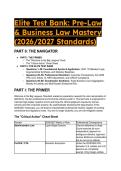
Elite Test Bank: Pre-Law
& Business Law Mastery
(2026/2027 Standards)
PART 0: THE NAVIGATOR
● PART I: THE PRIMER
○ The "Welcome to the Big Leagues" Hook
○ The "Critical Action" Cheat Sheet
● PART II: THE ELITE TEST BANK
○ Questions 1–28: Foundational Syntax & Application: LSAT 170-Breaker Logic,
Argumentative Synthesis, and Statutory Baselines.
○ Questions 29–58: Professional Simulation: Corporate Transparency Act (2026
IFR), UCC Article 12, HSR Adjustments, and CIRCIA Compliance.
○ Questions 59–88: Grandmaster Synthesis: Texas Business Court Aggregation,
Mobley AI Liability, and Multi-System Enterprise Risk.
PART I: THE PRIMER
Welcome to the Big Leagues. Standard academic preparation rewards the rote memorization of
definitions; top-tier professional environments actively punish it. This test bank is engineered to
intercept high-stakes cognitive errors and forge the clinical judgment required by top law
schools and elite corporate practice. By systematically dissecting the legal physics of the
2026/2027 landscape, you will build an impenetrable professional intuition capable of averting
commercial and regulatory crises. You are no longer students; you are risk-mitigation assets.
The "Critical Action" Cheat Sheet
Domain 2026/2027 Metric or Rule Professional Consequence
Administrative Law Loper Bright Doctrine Chevron deference is dead.
Courts exercise de novo
independent judgment on
ambiguous statutes; agencies
receive Skidmore consideration
but do not win by default.
FinCEN / CTA Domestic Exemption Under the 2025/2026 IFR,
domestic U.S. entities and U.S.
persons are completely
exempt. Only foreign entities
,Domain 2026/2027 Metric or Rule Professional Consequence
registered in the U.S. report
BOI.
Secured Transactions UCC Article 12 A purchaser of a Controllable
Electronic Record (CER) takes
it free of claims. Perfection via
control definitively defeats
perfection via filing.
Texas Litigation Business Court (HB 40) $5 Million threshold for
"Qualified Transactions." You
may aggregate a "series of
related transactions."
Consumer disputes are
excluded.
Federal Reporting HSR Act & CIRCIA HSR threshold is $133.9M.
CIRCIA cyber reporting is 72
hours for an incident, 24 hours
for a ransom payment.
Texas DTPA $25M Business Exception Businesses with $25M+ in
assets lack "consumer"
standing. Mandatory 60-day
pre-filing notice is required for
all valid claims.
LSAT Logic The "170-Breaker" Rules "Most A are B" + "Most A are
C" = "Some B are C". "Some A
are B" + "Some A are C" yields
zero valid inferences.
PART II: THE ELITE TEST BANK
Questions 1–28: Foundational Syntax & Application
Q1: An LSAT candidate analyzes the following prompt: "Most executives hold MBAs. Most
executives are also board members." Which inference is the MOST ACCURATE strictly
according to formal logic principles? A) Most executives with MBAs are board members. B)
Some MBAs are board members. C) All board members possess MBAs. D) Some executives
do not hold MBAs.
● The Answer: B (Some MBAs are board members.)
● Distractor Analysis:
○ A is incorrect: "Most + Most" does not yield a "Most" overlap in the target groups,
only a "Some" overlap.
○ C is incorrect: Absolute statements cannot be derived from probabilistic "most"
premises.
○ D is incorrect: While likely true in reality, it is not a strictly valid deduction from the
provided text, which allows for 100% inclusion.
The Mentor's Analysis: This is a classic 170-breaker logic trap. When two "Most" statements
share the exact same sufficient condition (Executives), they mathematically force an intersection
,between their necessary conditions (MBAs and Board Members). If over 50% are X, and over
50% are Y, at least one must be both X and Y. Professional Intuition: Never extrapolate
magnitude from intersecting majorities; restrict your conclusion to the verifiable minimum
("Some").
Q2: A student evaluating a 2026 LSAT Argumentative Writing prompt is presented with four
distinct perspectives on corporate tax reform. The student agrees with Perspective 1 but
acknowledges a strong counter-argument in Perspective 3. What is the BEST INITIAL strategic
approach for their 35-minute drafting phase? A) Ignore Perspective 3 entirely to avoid
weakening the primary thesis. B) Devote the entire essay to disproving Perspective 3, leaving
Perspective 1 implied. C) Validate the core truth in Perspective 3, then systematically resolve
the tension by explaining why Perspective 1's long-term benefits outweigh the costs. D) Draft a
neutral summary of all four perspectives to demonstrate objective analytical breadth.
● The Answer: C (Validate the core truth in Perspective 3, then systematically resolve the
tension by explaining why Perspective 1's long-term benefits outweigh the costs.)
● Distractor Analysis:
○ A is incorrect: Ignoring counter-arguments violates the grading criteria for synthesis
and defensive writing.
○ B is incorrect: An essay solely attacking a distractor fails to establish an affirmative
original thesis.
○ D is incorrect: The prompt explicitly requires the candidate to take a position, not
act as a neutral reporter.
The Mentor's Analysis: Top-tier legal writing does not hide from hostile facts; it metabolizes
them. The "Acknowledge and Resolve" technique demonstrates mature cognitive control. By
briefly validating the opposing view, you strip it of its rhetorical power before pivoting back to
your dominant framework. Professional Intuition: A concession safely boxed in is a weapon
disarmed.
Q3: Following the Supreme Court ruling in Loper Bright Enterprises v. Raimondo, a federal
agency issues a new interpretation of an ambiguous environmental statute. A corporate client
asks if the agency's interpretation will automatically hold up in court. What is the MOST
APPROPRIATE response? A) Yes, because courts must defer to the agency if the interpretation
is "reasonable." B) No, the court will exercise independent judgment without granting automatic
deference to the agency. C) Yes, provided the agency executed standard notice-and-comment
rulemaking. D) No, ambiguous statutes are now immediately voided under the major questions
doctrine.
● The Answer: B (No, the court will exercise independent judgment without granting
automatic deference to the agency.)
● Distractor Analysis:
○ A is incorrect: This relies on the dead Chevron doctrine.
○ C is incorrect: Notice-and-comment no longer shields the agency from de novo
judicial review of statutory meaning.
○ D is incorrect: Ambiguity does not void a statute; it simply transfers interpretive
authority squarely back to the judiciary.
The Mentor's Analysis: The death of Chevron is the seismic shift of the 2020s. Agencies no
longer enjoy a home-field advantage on statutory interpretation. You must read the statute as a
judge would, not as an agency regulator wishes it to be. Professional Intuition: When the text
is ambiguous, the battle is won through raw statutory interpretation, not administrative
deference.
Q4: Under the Financial Crimes Enforcement Network's (FinCEN) 2026 Interim Final Rule
, regarding the Corporate Transparency Act (CTA), which entity is STRICTLY REQUIRED to file a
Beneficial Ownership Information (BOI) report? A) A limited liability company formed in Texas in
2025 by two U.S. citizens. B) A U.S.-based holding company with $30 million in domestic
assets. C) A German manufacturing corporation that registered to do business with the New
York Secretary of State in 2026. D) An individual U.S. citizen who owns a 30% stake in a foreign
pooled investment vehicle.
● The Answer: C (A German manufacturing corporation that registered to do business with
the New York Secretary of State in 2026.)
● Distractor Analysis:
○ A is incorrect: Domestic reporting companies are entirely exempt under the
2025/2026 IFR.
○ B is incorrect: Domestic entities are exempt regardless of size.
○ D is incorrect: U.S. persons are specifically exempted from BOI reporting
requirements under the new rule.
The Mentor's Analysis: The CTA underwent a radical contraction. The regulatory burden has
shifted entirely away from Main Street USA and onto foreign entities leveraging the U.S. legal
system. If the entity was birthed domestically, the BOI reporting obligation is dead. Professional
Intuition: Origin dictates obligation. Domestic creation equals CTA exemption.
Q5: In June 2026, a New York-based fintech firm seeks to perfect a security interest in a
Controllable Electronic Record (CER). They file a standard UCC-1 financing statement. A week
later, a rival creditor obtains direct digital "control" over the same CER. In a priority dispute, who
wins and why? A) The fintech firm, because their UCC-1 filing was first-in-time. B) The rival
creditor, because under UCC Article 12, perfection by control always defeats perfection by filing.
C) The fintech firm, because digital assets remain classified strictly as "general intangibles" in
New York. D) Neither; CERs cannot be used as collateral under the 2022 UCC amendments.
● The Answer: B (The rival creditor, because under UCC Article 12, perfection by control
always defeats perfection by filing.)
● Distractor Analysis:
○ A is incorrect: While first-in-time governs standard collateral, Article 12 explicitly
elevates "control" over chronological filing.
○ C is incorrect: New York adopted the Article 12 amendments effective June 3, 2026,
legally recognizing CERs.
○ D is incorrect: CERs are explicitly designed to serve as functional collateral.
The Mentor's Analysis: Article 12 bridges the gap between decentralized ledgers and secured
transactions. Filing a UCC-1 for a digital asset is permissible, but it is a weak shield. "Control" is
the digital equivalent of physical possession, granting super-priority. Professional Intuition: In
the digital asset space, control is not just nine-tenths of the law; it is the entire law of priority.
Q6: Under the 2026 adjustments to the Hart-Scott-Rodino (HSR) Act, a client is acquiring a
competitor. The transaction value is $130 million. Does this transaction meet the INITIAL
baseline threshold for mandatory HSR notification? A) Yes, because it exceeds the legacy
$126.4 million threshold. B) No, because the 2026 baseline threshold has been raised to $133.9
million. C) Yes, because any transaction over $100 million involving competitors is automatically
reviewable. D) No, because the filing fee threshold begins at $189.6 million.
● The Answer: B (No, because the 2026 baseline threshold has been raised to $133.9
million.)
● Distractor Analysis:
○ A is incorrect: $126.4M is the outdated 2024/2025 figure.
○ C is incorrect: There is no automatic $100M competitor trigger; HSR thresholds are
& Business Law Mastery
(2026/2027 Standards)
PART 0: THE NAVIGATOR
● PART I: THE PRIMER
○ The "Welcome to the Big Leagues" Hook
○ The "Critical Action" Cheat Sheet
● PART II: THE ELITE TEST BANK
○ Questions 1–28: Foundational Syntax & Application: LSAT 170-Breaker Logic,
Argumentative Synthesis, and Statutory Baselines.
○ Questions 29–58: Professional Simulation: Corporate Transparency Act (2026
IFR), UCC Article 12, HSR Adjustments, and CIRCIA Compliance.
○ Questions 59–88: Grandmaster Synthesis: Texas Business Court Aggregation,
Mobley AI Liability, and Multi-System Enterprise Risk.
PART I: THE PRIMER
Welcome to the Big Leagues. Standard academic preparation rewards the rote memorization of
definitions; top-tier professional environments actively punish it. This test bank is engineered to
intercept high-stakes cognitive errors and forge the clinical judgment required by top law
schools and elite corporate practice. By systematically dissecting the legal physics of the
2026/2027 landscape, you will build an impenetrable professional intuition capable of averting
commercial and regulatory crises. You are no longer students; you are risk-mitigation assets.
The "Critical Action" Cheat Sheet
Domain 2026/2027 Metric or Rule Professional Consequence
Administrative Law Loper Bright Doctrine Chevron deference is dead.
Courts exercise de novo
independent judgment on
ambiguous statutes; agencies
receive Skidmore consideration
but do not win by default.
FinCEN / CTA Domestic Exemption Under the 2025/2026 IFR,
domestic U.S. entities and U.S.
persons are completely
exempt. Only foreign entities
,Domain 2026/2027 Metric or Rule Professional Consequence
registered in the U.S. report
BOI.
Secured Transactions UCC Article 12 A purchaser of a Controllable
Electronic Record (CER) takes
it free of claims. Perfection via
control definitively defeats
perfection via filing.
Texas Litigation Business Court (HB 40) $5 Million threshold for
"Qualified Transactions." You
may aggregate a "series of
related transactions."
Consumer disputes are
excluded.
Federal Reporting HSR Act & CIRCIA HSR threshold is $133.9M.
CIRCIA cyber reporting is 72
hours for an incident, 24 hours
for a ransom payment.
Texas DTPA $25M Business Exception Businesses with $25M+ in
assets lack "consumer"
standing. Mandatory 60-day
pre-filing notice is required for
all valid claims.
LSAT Logic The "170-Breaker" Rules "Most A are B" + "Most A are
C" = "Some B are C". "Some A
are B" + "Some A are C" yields
zero valid inferences.
PART II: THE ELITE TEST BANK
Questions 1–28: Foundational Syntax & Application
Q1: An LSAT candidate analyzes the following prompt: "Most executives hold MBAs. Most
executives are also board members." Which inference is the MOST ACCURATE strictly
according to formal logic principles? A) Most executives with MBAs are board members. B)
Some MBAs are board members. C) All board members possess MBAs. D) Some executives
do not hold MBAs.
● The Answer: B (Some MBAs are board members.)
● Distractor Analysis:
○ A is incorrect: "Most + Most" does not yield a "Most" overlap in the target groups,
only a "Some" overlap.
○ C is incorrect: Absolute statements cannot be derived from probabilistic "most"
premises.
○ D is incorrect: While likely true in reality, it is not a strictly valid deduction from the
provided text, which allows for 100% inclusion.
The Mentor's Analysis: This is a classic 170-breaker logic trap. When two "Most" statements
share the exact same sufficient condition (Executives), they mathematically force an intersection
,between their necessary conditions (MBAs and Board Members). If over 50% are X, and over
50% are Y, at least one must be both X and Y. Professional Intuition: Never extrapolate
magnitude from intersecting majorities; restrict your conclusion to the verifiable minimum
("Some").
Q2: A student evaluating a 2026 LSAT Argumentative Writing prompt is presented with four
distinct perspectives on corporate tax reform. The student agrees with Perspective 1 but
acknowledges a strong counter-argument in Perspective 3. What is the BEST INITIAL strategic
approach for their 35-minute drafting phase? A) Ignore Perspective 3 entirely to avoid
weakening the primary thesis. B) Devote the entire essay to disproving Perspective 3, leaving
Perspective 1 implied. C) Validate the core truth in Perspective 3, then systematically resolve
the tension by explaining why Perspective 1's long-term benefits outweigh the costs. D) Draft a
neutral summary of all four perspectives to demonstrate objective analytical breadth.
● The Answer: C (Validate the core truth in Perspective 3, then systematically resolve the
tension by explaining why Perspective 1's long-term benefits outweigh the costs.)
● Distractor Analysis:
○ A is incorrect: Ignoring counter-arguments violates the grading criteria for synthesis
and defensive writing.
○ B is incorrect: An essay solely attacking a distractor fails to establish an affirmative
original thesis.
○ D is incorrect: The prompt explicitly requires the candidate to take a position, not
act as a neutral reporter.
The Mentor's Analysis: Top-tier legal writing does not hide from hostile facts; it metabolizes
them. The "Acknowledge and Resolve" technique demonstrates mature cognitive control. By
briefly validating the opposing view, you strip it of its rhetorical power before pivoting back to
your dominant framework. Professional Intuition: A concession safely boxed in is a weapon
disarmed.
Q3: Following the Supreme Court ruling in Loper Bright Enterprises v. Raimondo, a federal
agency issues a new interpretation of an ambiguous environmental statute. A corporate client
asks if the agency's interpretation will automatically hold up in court. What is the MOST
APPROPRIATE response? A) Yes, because courts must defer to the agency if the interpretation
is "reasonable." B) No, the court will exercise independent judgment without granting automatic
deference to the agency. C) Yes, provided the agency executed standard notice-and-comment
rulemaking. D) No, ambiguous statutes are now immediately voided under the major questions
doctrine.
● The Answer: B (No, the court will exercise independent judgment without granting
automatic deference to the agency.)
● Distractor Analysis:
○ A is incorrect: This relies on the dead Chevron doctrine.
○ C is incorrect: Notice-and-comment no longer shields the agency from de novo
judicial review of statutory meaning.
○ D is incorrect: Ambiguity does not void a statute; it simply transfers interpretive
authority squarely back to the judiciary.
The Mentor's Analysis: The death of Chevron is the seismic shift of the 2020s. Agencies no
longer enjoy a home-field advantage on statutory interpretation. You must read the statute as a
judge would, not as an agency regulator wishes it to be. Professional Intuition: When the text
is ambiguous, the battle is won through raw statutory interpretation, not administrative
deference.
Q4: Under the Financial Crimes Enforcement Network's (FinCEN) 2026 Interim Final Rule
, regarding the Corporate Transparency Act (CTA), which entity is STRICTLY REQUIRED to file a
Beneficial Ownership Information (BOI) report? A) A limited liability company formed in Texas in
2025 by two U.S. citizens. B) A U.S.-based holding company with $30 million in domestic
assets. C) A German manufacturing corporation that registered to do business with the New
York Secretary of State in 2026. D) An individual U.S. citizen who owns a 30% stake in a foreign
pooled investment vehicle.
● The Answer: C (A German manufacturing corporation that registered to do business with
the New York Secretary of State in 2026.)
● Distractor Analysis:
○ A is incorrect: Domestic reporting companies are entirely exempt under the
2025/2026 IFR.
○ B is incorrect: Domestic entities are exempt regardless of size.
○ D is incorrect: U.S. persons are specifically exempted from BOI reporting
requirements under the new rule.
The Mentor's Analysis: The CTA underwent a radical contraction. The regulatory burden has
shifted entirely away from Main Street USA and onto foreign entities leveraging the U.S. legal
system. If the entity was birthed domestically, the BOI reporting obligation is dead. Professional
Intuition: Origin dictates obligation. Domestic creation equals CTA exemption.
Q5: In June 2026, a New York-based fintech firm seeks to perfect a security interest in a
Controllable Electronic Record (CER). They file a standard UCC-1 financing statement. A week
later, a rival creditor obtains direct digital "control" over the same CER. In a priority dispute, who
wins and why? A) The fintech firm, because their UCC-1 filing was first-in-time. B) The rival
creditor, because under UCC Article 12, perfection by control always defeats perfection by filing.
C) The fintech firm, because digital assets remain classified strictly as "general intangibles" in
New York. D) Neither; CERs cannot be used as collateral under the 2022 UCC amendments.
● The Answer: B (The rival creditor, because under UCC Article 12, perfection by control
always defeats perfection by filing.)
● Distractor Analysis:
○ A is incorrect: While first-in-time governs standard collateral, Article 12 explicitly
elevates "control" over chronological filing.
○ C is incorrect: New York adopted the Article 12 amendments effective June 3, 2026,
legally recognizing CERs.
○ D is incorrect: CERs are explicitly designed to serve as functional collateral.
The Mentor's Analysis: Article 12 bridges the gap between decentralized ledgers and secured
transactions. Filing a UCC-1 for a digital asset is permissible, but it is a weak shield. "Control" is
the digital equivalent of physical possession, granting super-priority. Professional Intuition: In
the digital asset space, control is not just nine-tenths of the law; it is the entire law of priority.
Q6: Under the 2026 adjustments to the Hart-Scott-Rodino (HSR) Act, a client is acquiring a
competitor. The transaction value is $130 million. Does this transaction meet the INITIAL
baseline threshold for mandatory HSR notification? A) Yes, because it exceeds the legacy
$126.4 million threshold. B) No, because the 2026 baseline threshold has been raised to $133.9
million. C) Yes, because any transaction over $100 million involving competitors is automatically
reviewable. D) No, because the filing fee threshold begins at $189.6 million.
● The Answer: B (No, because the 2026 baseline threshold has been raised to $133.9
million.)
● Distractor Analysis:
○ A is incorrect: $126.4M is the outdated 2024/2025 figure.
○ C is incorrect: There is no automatic $100M competitor trigger; HSR thresholds are

