

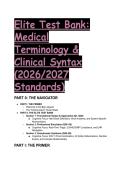
Elite Test Bank:
Medical
Terminology &
Clinical Syntax
(2026/2027
Standards)
PART 0: THE NAVIGATOR
● PART I: THE PRIMER
○ Welcome to the Big Leagues
○ The "Critical Action" Cheat Sheet
● PART II: THE ELITE TEST BANK
○ Section 1: Foundational Syntax & Application (Q1–Q28)
■ Cognitive Focus: Hard Deck Definitions, Word Anatomy, and System-Specific
Nomenclature.
○ Section 2: Professional Simulation (Q29–58)
■ Cognitive Focus: Real-Time Triage, JCAHO/ISMP Compliance, and EHR
Navigation.
○ Section 3: Grandmaster Synthesis (Q59–88)
■ Cognitive Focus: ICD-11 Post-Coordination, AI Scribe Hallucinations, Sentinel
Events, and Complex Multimorbidity.
PART I: THE PRIMER
,The "Welcome to the Big Leagues" Hook
The transition from an academic student to a top-tier practitioner requires more than rote
memorization; it demands the real-time synthesis of complex physiological data into immediate,
life-saving action. This test bank intercepts high-stakes errors before they reach the patient,
forging your vocabulary into a razor-sharp clinical instrument. You are not just learning to read a
chart—you are learning to command the room.
The "Critical Action" Cheat Sheet
To operate at an elite level, you must internalize the rigid standards governing clinical
documentation in 2026/2027. Below is the non-negotiable framework for avoiding Sentinel
Events and documentation failures.
Regulatory Standard Legacy Error (Do Not 2026/2027 Mandated Clinical Rationale
Use) Syntax
JCAHO U, IU, Q.D., Q.O.D. Unit, Int. Unit, Daily "U" is misread as zero,
Documentation causing lethal 10x
overdoses.
JCAHO Numerics 5.0 mg (Trailing zero) 5 mg Trailing zeros obscure
decimals, leading to
catastrophic overdoses.
ISMP Drug Names clonidine / clozapine cloNIDine / cloZAPine Tall Man Lettering
breaks visual pattern
fatigue for LASA drugs.
ICD-11 Syntax Pre-coordinated only Stem Code / Extension Post-coordination
clustering (using /)
captures laterality and
severity.
AI Scribe QA Auto-signing NLP notes Manual hallucination AI frequently confuses
audit acoustic equivalents
(e.g., dysphasia vs
dyspnea).
PART II: THE ELITE TEST BANK
Section 1: Foundational Syntax & Application
Q1: A practitioner is analyzing a complex medical term to decipher its meaning. According to
foundational medical terminology rules, which component acts as the core foundation of the
word, representing the primary organ or concept? A) The prefix B) The combining vowel C) The
word root D) The suffix
● The Answer: C (The word root)
● Distractor Analysis:
○ A is incorrect: The prefix modifies the core meaning by indicating number or
position but is not the foundation.
○ B is incorrect: The combining vowel links parts for pronunciation; it carries no
independent meaning.
, ○ D is incorrect: The suffix alters the word to indicate a condition but relies on the root
for context.
The Mentor's Analysis: Mastery begins with the "Hard Deck"—the word root. Stripping a
20-letter word down to its root instantly orientates you to the anatomical battleground.
Professional Intuition: Always isolate the root first; let prefixes and suffixes fill in operational
details.
Q2: When combining word parts, a practitioner must decide whether to retain the combining
vowel. Which rule dictates the CORRECT application of a combining vowel? A) It is used only
when connecting a prefix to a word root. B) It is used when the suffix that follows begins with a
consonant. C) It is dropped when linking two word roots together. D) It is always retained if the
suffix begins with a vowel.
● The Answer: B (It is used when the suffix that follows begins with a consonant.)
● Distractor Analysis:
○ A is incorrect: Combining vowels are never used between a prefix and a word root.
○ C is incorrect: When linking two roots, the combining vowel is always kept.
○ D is incorrect: If the suffix begins with a vowel, the combining vowel is dropped.
The Mentor's Analysis: Pronunciation dictates syntax. The combining vowel prevents
consonant crashes that slow down verbal communication during critical handoffs.
Q3: A 45-year-old patient presents with right upper quadrant pain. The ultrasound reveals
"cholelithiasis." Breaking down this term, what does the suffix -lithiasis indicate? A) An abnormal
condition of stones B) A surgical excision of the organ C) An acute inflammatory process D) A
malignant tumor development
● The Answer: A (An abnormal condition of stones)
● Distractor Analysis:
○ B is incorrect: Surgical excision is denoted by -ectomy.
○ C is incorrect: Inflammation is denoted by -itis.
○ D is incorrect: A tumor is denoted by -oma.
The Mentor's Analysis: Recognizing -lithiasis immediately shifts your clinical pathway toward
obstruction management rather than infection or oncology. Chole (bile/gall) + lithiasis =
gallstones.
Q4: A patient's chart indicates a history of "orthopnea." What does this term communicate to the
care team regarding the patient's respiratory status? A) The patient experiences an absence of
breathing during sleep. B) The patient has an abnormally rapid respiratory rate. C) The patient
can breathe comfortably only when in an upright position. D) The patient has deep, labored
respirations.
● The Answer: C (The patient can breathe comfortably only when in an upright position.)
● Distractor Analysis:
○ A is incorrect: Absence of breathing is apnea.
○ B is incorrect: Rapid breathing is tachypnea.
○ D is incorrect: Deep, labored breathing is Kussmaul respirations.
The Mentor's Analysis: Ortho- means straight or upright. If you see this, your operational reflex
must be to keep the head of the bed elevated. Lowering them flat will precipitate an acute
respiratory crisis.
Q5: During a shift change, the departing nurse reports the patient has profuse "rhinorrhea."
Which condition should the receiving practitioner anticipate? A) Severe bleeding from the nasal
cavity B) Purulent discharge from the ear C) A surgical repair of the nasal septum D)
Continuous fluid drainage from the nose
● The Answer: D (Continuous fluid drainage from the nose)
Medical
Terminology &
Clinical Syntax
(2026/2027
Standards)
PART 0: THE NAVIGATOR
● PART I: THE PRIMER
○ Welcome to the Big Leagues
○ The "Critical Action" Cheat Sheet
● PART II: THE ELITE TEST BANK
○ Section 1: Foundational Syntax & Application (Q1–Q28)
■ Cognitive Focus: Hard Deck Definitions, Word Anatomy, and System-Specific
Nomenclature.
○ Section 2: Professional Simulation (Q29–58)
■ Cognitive Focus: Real-Time Triage, JCAHO/ISMP Compliance, and EHR
Navigation.
○ Section 3: Grandmaster Synthesis (Q59–88)
■ Cognitive Focus: ICD-11 Post-Coordination, AI Scribe Hallucinations, Sentinel
Events, and Complex Multimorbidity.
PART I: THE PRIMER
,The "Welcome to the Big Leagues" Hook
The transition from an academic student to a top-tier practitioner requires more than rote
memorization; it demands the real-time synthesis of complex physiological data into immediate,
life-saving action. This test bank intercepts high-stakes errors before they reach the patient,
forging your vocabulary into a razor-sharp clinical instrument. You are not just learning to read a
chart—you are learning to command the room.
The "Critical Action" Cheat Sheet
To operate at an elite level, you must internalize the rigid standards governing clinical
documentation in 2026/2027. Below is the non-negotiable framework for avoiding Sentinel
Events and documentation failures.
Regulatory Standard Legacy Error (Do Not 2026/2027 Mandated Clinical Rationale
Use) Syntax
JCAHO U, IU, Q.D., Q.O.D. Unit, Int. Unit, Daily "U" is misread as zero,
Documentation causing lethal 10x
overdoses.
JCAHO Numerics 5.0 mg (Trailing zero) 5 mg Trailing zeros obscure
decimals, leading to
catastrophic overdoses.
ISMP Drug Names clonidine / clozapine cloNIDine / cloZAPine Tall Man Lettering
breaks visual pattern
fatigue for LASA drugs.
ICD-11 Syntax Pre-coordinated only Stem Code / Extension Post-coordination
clustering (using /)
captures laterality and
severity.
AI Scribe QA Auto-signing NLP notes Manual hallucination AI frequently confuses
audit acoustic equivalents
(e.g., dysphasia vs
dyspnea).
PART II: THE ELITE TEST BANK
Section 1: Foundational Syntax & Application
Q1: A practitioner is analyzing a complex medical term to decipher its meaning. According to
foundational medical terminology rules, which component acts as the core foundation of the
word, representing the primary organ or concept? A) The prefix B) The combining vowel C) The
word root D) The suffix
● The Answer: C (The word root)
● Distractor Analysis:
○ A is incorrect: The prefix modifies the core meaning by indicating number or
position but is not the foundation.
○ B is incorrect: The combining vowel links parts for pronunciation; it carries no
independent meaning.
, ○ D is incorrect: The suffix alters the word to indicate a condition but relies on the root
for context.
The Mentor's Analysis: Mastery begins with the "Hard Deck"—the word root. Stripping a
20-letter word down to its root instantly orientates you to the anatomical battleground.
Professional Intuition: Always isolate the root first; let prefixes and suffixes fill in operational
details.
Q2: When combining word parts, a practitioner must decide whether to retain the combining
vowel. Which rule dictates the CORRECT application of a combining vowel? A) It is used only
when connecting a prefix to a word root. B) It is used when the suffix that follows begins with a
consonant. C) It is dropped when linking two word roots together. D) It is always retained if the
suffix begins with a vowel.
● The Answer: B (It is used when the suffix that follows begins with a consonant.)
● Distractor Analysis:
○ A is incorrect: Combining vowels are never used between a prefix and a word root.
○ C is incorrect: When linking two roots, the combining vowel is always kept.
○ D is incorrect: If the suffix begins with a vowel, the combining vowel is dropped.
The Mentor's Analysis: Pronunciation dictates syntax. The combining vowel prevents
consonant crashes that slow down verbal communication during critical handoffs.
Q3: A 45-year-old patient presents with right upper quadrant pain. The ultrasound reveals
"cholelithiasis." Breaking down this term, what does the suffix -lithiasis indicate? A) An abnormal
condition of stones B) A surgical excision of the organ C) An acute inflammatory process D) A
malignant tumor development
● The Answer: A (An abnormal condition of stones)
● Distractor Analysis:
○ B is incorrect: Surgical excision is denoted by -ectomy.
○ C is incorrect: Inflammation is denoted by -itis.
○ D is incorrect: A tumor is denoted by -oma.
The Mentor's Analysis: Recognizing -lithiasis immediately shifts your clinical pathway toward
obstruction management rather than infection or oncology. Chole (bile/gall) + lithiasis =
gallstones.
Q4: A patient's chart indicates a history of "orthopnea." What does this term communicate to the
care team regarding the patient's respiratory status? A) The patient experiences an absence of
breathing during sleep. B) The patient has an abnormally rapid respiratory rate. C) The patient
can breathe comfortably only when in an upright position. D) The patient has deep, labored
respirations.
● The Answer: C (The patient can breathe comfortably only when in an upright position.)
● Distractor Analysis:
○ A is incorrect: Absence of breathing is apnea.
○ B is incorrect: Rapid breathing is tachypnea.
○ D is incorrect: Deep, labored breathing is Kussmaul respirations.
The Mentor's Analysis: Ortho- means straight or upright. If you see this, your operational reflex
must be to keep the head of the bed elevated. Lowering them flat will precipitate an acute
respiratory crisis.
Q5: During a shift change, the departing nurse reports the patient has profuse "rhinorrhea."
Which condition should the receiving practitioner anticipate? A) Severe bleeding from the nasal
cavity B) Purulent discharge from the ear C) A surgical repair of the nasal septum D)
Continuous fluid drainage from the nose
● The Answer: D (Continuous fluid drainage from the nose)

