Escrito por estudiantes que aprobaron Inmediatamente disponible después del pago Leer en línea o como PDF ¿Documento equivocado? Cámbialo gratis 4,6 TrustPilot
logo-home
Examen

Galen NUR 210 Final Exam 2026/2027 | Principles of Pharmacology | Complete Study Guide with Q&A | Pharmacokinetics, Antibiotics, Cardiac, CNS & Endocrine Drugs | Verified Answers with Rationales | Grade A+ | Downloadable PDF

Puntuación
-
Vendido
-
Páginas
30
Grado
A+
Subido en
26-03-2026
Escrito en
2025/2026

INSTANT PDF DOWNLOAD—This comprehensive study guide is specifically designed for Galen College of Nursing students preparing for the NUR 210 Principles of Pharmacology Final Exam for the 2026/2027 academic year. Based on verified exam materials from top-selling student resources, this resource contains expertly verified practice questions and 100% correct answers with detailed rationales to help you master core pharmacology concepts and achieve a top score (Grade A+). This comprehensive guide covers all major topics tested on the NUR 210 Final Exam : Pharmacokinetics & Pharmacodynamics : The four phases—absorption, distribution, metabolism, excretion. First-pass effect (oral drugs undergo hepatic metabolism) . Protein binding (only unbound drug is active) . Half-life determines dosing interval. Therapeutic index—narrow therapeutic window drugs require monitoring (lithium, digoxin, warfarin) . Agonist vs. antagonist . Medication Safety : Rights of medication administration (right patient, drug, dose, route, time, documentation) . High-alert medications require independent double-check . Medication reconciliation prevents errors . Adverse drug reactions vs. side effects . Anaphylaxis management (epinephrine, airway, oxygen) . Autonomic Nervous System Drugs : Adrenergic agonists (epinephrine)—anaphylaxis, cardiac arrest; side effects: tachycardia, hypertension. Beta-2 agonists (albuterol)—bronchodilation; side effects: tachycardia, tremors. Beta blockers (metoprolol)—never stop abruptly; contraindicated in asthma (non-selective) . Cholinergic agonists (bethanechol)—urinary retention; side effects: bradycardia, increased secretions. Anticholinergics (atropine)—preoperative, bradycardia; side effects: "dry them out" (dry mouth, blurred vision, constipation, urinary retention) . Cardiovascular Drugs : Digoxin —cardiac glycoside; hold if HR 60; toxicity: yellow/green halos, bradycardia, nausea; hypokalemia increases toxicity risk; therapeutic range 0.5-2 ng/mL. Loop diuretics (furosemide) —monitor K+, ototoxicity. Thiazide diuretics (HCTZ) —K+ wasting, hyperglycemia. ACE inhibitors (lisinopril) —dry cough, hyperkalemia. ARBs (losartan) —no cough . Calcium channel blockers (amlodipine) —flushing, ankle edema . Antibiotics & Anti-Infectives : Cephalosporins —monitor for superinfection . Vancomycin —MRSA treatment; red-man syndrome; monitor peak/trough, nephrotoxicity, ototoxicity . Aminoglycosides (gentamicin) —peak 45-60 min after dose, trough before next dose . TMP-SMZ —increase fluid intake to prevent crystalluria . Tetracyclines —avoid dairy, antacids; not for children 8 years (teeth staining) . Macrolides —photosensitivity . Metronidazole —avoid alcohol (disulfiram reaction) . Nitrofurantoin —drowsiness, brown urine . Antivirals & Antifungals : Acyclovir —genital herpes; increase fluids, oral hygiene . Oseltamivir (Tamiflu) —influenza; start within 48 hours . Nystatin —oral candidiasis; swish and swallow . Influenza vaccine —assess for egg allergy . CNS & Psychiatric Drugs : Phenytoin (Dilantin) —seizures; therapeutic range 10-20 mcg/mL; gingival hyperplasia . Valproic acid —hepatotoxicity monitoring . Antipsychotics —EPS, tardive dyskinesia (AIMS scale) , NMS . Clozapine —agranulocytosis (ANC monitoring) . SSRIs —2-6 week onset; serotonin syndrome; sexual dysfunction . MAOIs —tyramine restriction (hypertensive crisis) . Bupropion —no sexual side effects; seizure risk . Benzodiazepines —GABA; flumazenil antidote; dependence risk . Zolpidem (Ambien) —sleep aid, short-term use . Antidiabetics & Endocrine Drugs : Insulin —regular (clear), NPH (cloudy); mixing sequence: clear to cloudy; glargine has no peak . Metformin —GI upset; hold for contrast dye (renal risk) . Levothyroxine —hypothyroidism; take before breakfast; never stop abruptly . Propylthiouracil —hyperthyroidism; monitor for agranulocytosis . Alendronate —upright for 30 min after dose (esophageal irritation) . Respiratory Drugs : Albuterol —bronchodilator; tachycardia side effect . Metered-dose inhaler —hold breath 10 seconds; bronchodilator first, then corticosteroid (wait 5 min) . Guaifenesin —expectorant; increase fluids . Diphenhydramine —antihistamine; sedation (avoid driving) . Pain Management : Opioid analgesics—respiratory depression risk; naloxone antidote . NSAIDs—GI bleeding risk; COX-2 inhibitors (celecoxib) reduce GI effects but increase cardiovascular risk . Acetaminophen—hepatotoxicity, max 4 g/day . Sample Questions Include : "What are the four phases of pharmacokinetics?" → Absorption, distribution, metabolism, excretion "A patient taking furosemide reports muscle weakness and cramps. What electrolyte imbalance is most likely?" → Hypokalemia "What is the most important teaching for a patient starting alendronate (Fosamax)?" → Remain upright for 30 minutes after taking "A patient on isoniazid (INH) reports numbness and tingling in fingers. What intervention is needed?" → Pyridoxine (Vitamin B6) supplementation "What should the nurse teach a patient taking TMP-SMZ for UTI?" → Increase fluid intake to prevent crystalluria "What adverse effect requires immediate discontinuation of clozapine?" → Fever (possible agranulocytosis or myocarditis) "What is the therapeutic range for phenytoin (Dilantin)?" → 10-20 mcg/mL "What is the priority assessment before administering digoxin?" → Apical pulse for 1 full minute "What foods must patients on MAOIs avoid?" → Aged cheese, cured meats, red wine (tyramine-rich foods) "What is the correct sequence for mixing regular and NPH insulin?" → Draw regular (clear) first, then NPH (cloudy) All questions include complete rationales based on current evidence-based practice, pharmacology standards, and Galen College curriculum requirements . DOCUMENT ACCESS: This study guide is available as an instant digital download (PDF) immediately upon purchase. Fully text-searchable, printable, and accessible anytime through your user account. 100% satisfaction guarantee. Trusted by thousands of Galen nursing students for NUR 210 final exam preparation and mastering pharmacology competencies .

Mostrar más Leer menos
Institución
Grado

Vista previa del contenido

1|Page


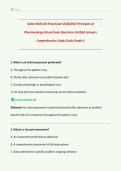
Galen NUR 210 Final Exam 2026/2027 Principles of

Pharmacology Actual Exam Questions Verified Answers

Comprehensive Study Guide Grade A


1. When is an initial assessment performed?

A. Throughout the patient's stay

B. Shortly after admission to establish baseline data

C. During a physiologic or psychological crisis

D. For long-term care patients comparing current status to baseline

Correct Answer: B

Rationale: An initial assessment is performed shortly after admission to establish

baseline data for comparison throughout the patient's stay.


2. What is a focused assessment?

A. An assessment performed at admission

B. A comprehensive assessment of all body systems

C. Data collected for a specific problem; ongoing collection

,2|Page


D. An assessment during a physiologic crisis

Correct Answer: C

Rationale: A focused assessment collects data for a specific problem and involves

ongoing collection related to that problem.


3. When is an emergency assessment performed?

A. At admission

B. During long-term care

C. During a physiologic or psychological crisis

D. For routine check-ups

Correct Answer: C

Rationale: An emergency assessment is performed during a physiologic or psychological

crisis to identify life-threatening conditions.


4. What is a time-lapsed assessment?

A. Initial assessment at admission

B. Focused assessment for a specific problem

C. Assessment for long-term care patients comparing current status to baseline

D. Emergency assessment during crisis

, 3|Page


Correct Answer: C

Rationale: A time-lapsed assessment is used for long-term care patients to compare

current status to baseline data.


5. What is objective data?

A. What the patient tells us

B. Information from family members

C. What we measure or observe

D. Patient's past medical history

Correct Answer: C

Rationale: Objective data is measurable information that the nurse observes or collects

through examination.


6. What is subjective data?

A. What the nurse observes

B. Laboratory results

C. What the patient tells us

D. Vital sign measurements

Correct Answer: C

Escuela, estudio y materia

Institución
Grado

Información del documento

Subido en
26 de marzo de 2026
Número de páginas
30
Escrito en
2025/2026
Tipo
Examen
Contiene
Preguntas y respuestas

Temas

$12.49
Accede al documento completo:

¿Documento equivocado? Cámbialo gratis Dentro de los 14 días posteriores a la compra y antes de descargarlo, puedes elegir otro documento. Puedes gastar el importe de nuevo.
Escrito por estudiantes que aprobaron
Inmediatamente disponible después del pago
Leer en línea o como PDF


Documento también disponible en un lote

Conoce al vendedor

Seller avatar
Los indicadores de reputación están sujetos a la cantidad de artículos vendidos por una tarifa y las reseñas que ha recibido por esos documentos. Hay tres niveles: Bronce, Plata y Oro. Cuanto mayor reputación, más podrás confiar en la calidad del trabajo del vendedor.
ExamitorMagnus Massachusetts Institute Of Technology
Seguir Necesitas iniciar sesión para seguir a otros usuarios o asignaturas
Vendido
117
Miembro desde
2 año
Número de seguidores
7
Documentos
1756
Última venta
1 semana hace
Top Score

I am a professional writer with knowledge across diverse academic fields. I provide quality work and I guarantee superb, timely and original content. I know the pain of getting a shoddy work, and I would never wish this on any client! I guarantee a topnotch paper, with a fast High-score turnaround. I provide quality work guaranteed to give you an exemplary grade. Furthermore, I am a tutor of Research paper, Dissertation, proposal, management studies, economics, educational studies, sociology and psychology, marketing, Geography, History, Management, English, Literature, Education. Medical studies, Health Care studies and Nursing, Biology, Economics among other subjects.

Lee mas Leer menos
3.5

22 reseñas

5
8
4
3
3
6
2
2
1
3

Por qué los estudiantes eligen Stuvia

Creado por compañeros estudiantes, verificado por reseñas

Calidad en la que puedes confiar: escrito por estudiantes que aprobaron y evaluado por otros que han usado estos resúmenes.

¿No estás satisfecho? Elige otro documento

¡No te preocupes! Puedes elegir directamente otro documento que se ajuste mejor a lo que buscas.

Paga como quieras, empieza a estudiar al instante

Sin suscripción, sin compromisos. Paga como estés acostumbrado con tarjeta de crédito y descarga tu documento PDF inmediatamente.

Student with book image

“Comprado, descargado y aprobado. Así de fácil puede ser.”

Alisha Student

Preguntas frecuentes