Escrito por estudiantes que aprobaron Inmediatamente disponible después del pago Leer en línea o como PDF ¿Documento equivocado? Cámbialo gratis 4,6 TrustPilot
logo-home
Examen

NURS 660 Psychopharmacology & Advanced Mental Health Exam 3 2026/2027 | Maryville Actual Questions with Verified Answers & Detailed Rationales | Grade A Study Guide.

Puntuación
-
Vendido
2
Páginas
26
Grado
A+
Subido en
26-03-2026
Escrito en
2025/2026

INSTANT PDF DOWNLOAD—This comprehensive study guide is specifically designed for Maryville University graduate nursing students (PMHNP, FNP) preparing for NURS 660 Psychopharmacology and Advanced Mental Health Exam 3 for the 2026/2027 academic year. Based on verified exam materials from top-selling student resources, this resource contains expertly verified practice questions and 100% correct answers with detailed rationales to help you master core psychopharmacology concepts and achieve a top score (Grade A+) . This comprehensive guide covers all major topics tested on NURS 660 Exam 3 : Neuroanatomy of Anxiety & Fear: Amygdala (fear response, memory of stimuli, glutaminergic neurotransmission, NMDA receptors) , hippocampus (memory coding/retrieval, re-experiencing in PTSD, internal fearmongering) , parabrachial nucleus (respiratory response: shortness of breath, asthma, sense of being smothered) , periaqueductal gray (motor response: fight/flight/freeze) , locus coeruleus (cardiovascular response: increased norepinephrine, HR, BP) , hypothalamus (sleep-wake switch, histamine/GABA regulation) , prefrontal cortex (worry circuit, CSTC loop, dopamine, serotonin, GABA) . Pain Pathways & Neurophysiology: A-beta fibers (small movements, light touch, vibrations) ; A-delta fibers (noxious mechanical stimuli, subnoxious thermal stimuli) ; C-fibers (bare nerve endings activated by noxious mechanical, thermal, chemical stimuli) ; allodynia (pain from non-painful stimulus) ; hyperalgesia (increased pain from normally painful stimulus) ; nociceptive pain (actual or threatened tissue damage) ; neuropathic pain (lesion or disease of somatosensory nervous system) ; central sensitization (increased CNS responsiveness) ; peripheral neuropathy (diabetic neuropathy, postherpetic neuralgia) ; chronic pain pathophysiology (changes in ascending/descending pathways, grey matter loss, central sensitization) . Benzodiazepines & Anxiety Treatment: MOA (binds to GABA-A receptors, PAM, increases frequency of chloride channel opening) ; indications for GAD and panic disorder; contraindications (alcohol, opioids, sedating antihistamines) ; pregnancy risk (contraindicated) ; overdose treatment (Flumazenil – GABA receptor antagonist) ; benzodiazepine anxiolytics (Xanax, Valium, Ativan) ; monitoring labs (liver function, CBC with long-term use) . Non-Benzodiazepine Anxiolytics: Buspirone (Buspar) MOA (5HT1A partial agonist at pre- and post-synaptic receptors, does not affect GABA) ; enhanced serotonergic activity in amygdala, PFC, striatum, thalamus; side effects (lightheadedness, headache, insomnia, nausea, nervousness) ; adverse reactions (akathisia, serotonin syndrome) ; contraindications (panic attacks, severe hepatic/renal disease) . Hypnotics & Sleep Disorders: Medications for falling asleep (short half-life: Ramelteon, Rozerem, Sonata for middle insomnia) ; medications for staying asleep (Zolpidem ER, temazepam, Belsomra, eszopiclone/Lunesta) ; Zolpidem (Ambien) MOA (selective GABA a1 subunit agonist) ; Eszopiclone (Lunesta) MOA (a1 isoform selective agonist of GABA-A) ; Ramelteon (Rozerem) MOA (melatonin receptor agonist M1/M2, MT1/MT2) ; Suvorexant (Belsomra) MOA (dual orexin receptor antagonist) ; brain areas involved in sleep (pituitary gland, pineal gland/melatonin, suprachiasmatic nucleus, ventrolateral preoptic area, tuberomammillary nucleus) . Pain Management Medications: Pregabalin (Lyrica) – binds to open VSCC, used for fibromyalgia, neuropathic pain; Milnacipran (Savella) – SNRI, heavier on NET, treats fibromyalgia pain and cognitive symptoms (fibro-fog) ; Duloxetine (Cymbalta) – SNRI, inhibits SERT and NE reuptake; Amitriptyline (Elavil) – TCA, anticholinergic effects, requires baseline EKG; Duloxetine side effects (N/V/D, dry mouth, headache, constipation, sedation, sexual dysfunction, HTN) ; adverse effects (serotonin syndrome, life-threatening seizures, discontinuation syndrome) . Neurotransmitters Involved in Wakefulness: Histamine, dopamine, norepinephrine, acetylcholine, serotonin . Sleep/Wake Switch: Histamine from tuberomammillary nucleus (TMN) promotes wakefulness; GABA from ventrolateral preoptic area (VLPO) promotes sleep . Sample Questions Include : "What is the role of the amygdala in anxiety?" → Plays a role in fear response; remembers stimuli that lead to anxiety; increases efficiency of glutaminergic neurotransmission in lateral amygdala; strengthens fear conditioning at NMDA receptors "What is the response of the parabrachial nucleus to fear?" → Respiratory response: increased respiration, shortness of breath, asthma, sense of being smothered "What is the motor response of the periaqueductal gray to fear?" → Fight, flight, or freeze response "What type of fibers are activated by noxious mechanical, thermal, or chemical stimuli?" → C-fibers "How do benzodiazepines help with anxiety?" → Target GABA neurotransmission via positive allosteric modulation (PAM); bind to GABA-A receptors; increase frequency of chloride channel opening "What is the antidote for benzodiazepine overdose?" → Flumazenil (Romazicon) "What is the mechanism of action of Buspirone (Buspar)?" → 5HT1A partial agonist; does not affect GABA; enhances serotonergic activity in amygdala, PFC, striatum, and thalamus "Which medications are best for problems staying asleep?" → Zolpidem ER, temazepam, Belsomra, eszopiclone (Lunesta) "What is the mechanism of action of Pregabalin (Lyrica)?" → Binds to open voltage-sensitive calcium channels (VSCC) to stop pain receptors "What is the difference between allodynia and hyperalgesia?" → Allodynia: pain from a stimulus that does not normally provoke pain; Hyperalgesia: increased pain from a stimulus that normally provokes pain All questions include complete rationales based on current evidence-based practice, psychopharmacology standards, and Maryville University curriculum requirements . DOCUMENT ACCESS: This study guide is available as an instant digital download (PDF) immediately upon purchase. Fully text-searchable, printable, and accessible anytime through your user account. 100% satisfaction guarantee. Trusted by thousands of Maryville graduate nursing students for NURS 660 exam preparation and mastering psychopharmacology competencies .

Mostrar más Leer menos
Institución
NURS 660/ NURS660
Grado
NURS 660/ NURS660

Vista previa del contenido

1|Page


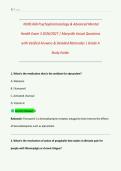
NURS 660 Psychopharmacology & Advanced Mental

Health Exam 3 2026/2027 | Maryville Actual Questions

with Verified Answers & Detailed Rationales | Grade A

Study Guide.


1. What is the medication that is the antidote for alprazolam?

A. Naloxone

B. Flumazenil

C. Activated charcoal

D. Vitamin K

Correct Answer: B

Rationale: Flumazenil is a benzodiazepine receptor antagonist that reverses the effects

of benzodiazepines such as alprazolam.


2. What is the mechanism of action of pregabalin that makes it alleviate pain for

people with fibromyalgia or chronic fatigue?

,2|Page


A. Binds to GABA-A receptors

B. Binds to the alpha-2-delta subunits of voltage-sensitive calcium channels

C. Blocks sodium channels

D. Inhibits serotonin reuptake

Correct Answer: B

Rationale: Pregabalin binds to the alpha-2-delta subunit of voltage-sensitive calcium

channels, reducing neurotransmitter release and alleviating neuropathic pain.


3. What is an antagonist of caffeine?

A. Dopamine

B. Adenosine

C. Norepinephrine

D. Serotonin

Correct Answer: B

Rationale: Caffeine is an adenosine receptor antagonist, blocking the sedative effects of

adenosine.


4. Diagnose this patient: Patient comes in with a chief complaint of anxiety. She has

been excessively worrying, increased arousal, increased tiredness, and irritability.

, 3|Page


What is the primary and least likely diagnosis?

A. Generalized Anxiety Disorder (GAD); Panic Disorder

B. Panic Disorder; Generalized Anxiety Disorder (GAD)

C. Social Anxiety Disorder; Specific Phobia

D. Agoraphobia; GAD

Correct Answer: A

Rationale: Excessive worry, increased arousal, tiredness, and irritability are

characteristic of GAD. Panic disorder is less likely without recurrent panic attacks.


5. Somebody with anxiety worries about having a panic attack, and in addition has

mood changes to avoid things in order to not have a panic attack. What is the

diagnosis?

A. Generalized Anxiety Disorder

B. Social Anxiety Disorder

C. Panic Disorder

D. Agoraphobia

Correct Answer: C

Rationale: Panic disorder is characterized by recurrent unexpected panic attacks

Escuela, estudio y materia

Institución
NURS 660/ NURS660
Grado
NURS 660/ NURS660

Información del documento

Subido en
26 de marzo de 2026
Número de páginas
26
Escrito en
2025/2026
Tipo
Examen
Contiene
Preguntas y respuestas

Temas

$12.49
Accede al documento completo:

¿Documento equivocado? Cámbialo gratis Dentro de los 14 días posteriores a la compra y antes de descargarlo, puedes elegir otro documento. Puedes gastar el importe de nuevo.
Escrito por estudiantes que aprobaron
Inmediatamente disponible después del pago
Leer en línea o como PDF


Documento también disponible en un lote

Conoce al vendedor

Seller avatar
Los indicadores de reputación están sujetos a la cantidad de artículos vendidos por una tarifa y las reseñas que ha recibido por esos documentos. Hay tres niveles: Bronce, Plata y Oro. Cuanto mayor reputación, más podrás confiar en la calidad del trabajo del vendedor.
ExamitorMagnus Massachusetts Institute Of Technology
Seguir Necesitas iniciar sesión para seguir a otros usuarios o asignaturas
Vendido
117
Miembro desde
2 año
Número de seguidores
7
Documentos
1756
Última venta
1 semana hace
Top Score

I am a professional writer with knowledge across diverse academic fields. I provide quality work and I guarantee superb, timely and original content. I know the pain of getting a shoddy work, and I would never wish this on any client! I guarantee a topnotch paper, with a fast High-score turnaround. I provide quality work guaranteed to give you an exemplary grade. Furthermore, I am a tutor of Research paper, Dissertation, proposal, management studies, economics, educational studies, sociology and psychology, marketing, Geography, History, Management, English, Literature, Education. Medical studies, Health Care studies and Nursing, Biology, Economics among other subjects.

Lee mas Leer menos
3.5

22 reseñas

5
8
4
3
3
6
2
2
1
3

Por qué los estudiantes eligen Stuvia

Creado por compañeros estudiantes, verificado por reseñas

Calidad en la que puedes confiar: escrito por estudiantes que aprobaron y evaluado por otros que han usado estos resúmenes.

¿No estás satisfecho? Elige otro documento

¡No te preocupes! Puedes elegir directamente otro documento que se ajuste mejor a lo que buscas.

Paga como quieras, empieza a estudiar al instante

Sin suscripción, sin compromisos. Paga como estés acostumbrado con tarjeta de crédito y descarga tu documento PDF inmediatamente.

Student with book image

“Comprado, descargado y aprobado. Así de fácil puede ser.”

Alisha Student

Preguntas frecuentes