

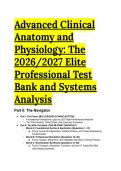
Advanced Clinical
Anatomy and
Physiology: The
2026/2027 Elite
Professional Test
Bank and Systems
Analysis
Part 0: The Navigator
● Part I: The Primer (BIG LEAGUES & PANIC BUTTON)
○ Foundational Professional Logic for 2027 High-Performance Medicine
○ The "Panic Button" Cheat Sheet: Vital Laws and Constants
● Part II: The Elite Test Bank (THE 66-POINT GAUNTLET)
○ Block A: Foundational Syntax & Application (Questions 1–15)
■ Focus: Levels of Organization, Cellular Kinetics, and Tissue Engineering
Fundamentals
○ Block B: Professional Simulation (Questions 16–40)
■ Focus: Support, Movement, and Integrated Sensing in Clinical Practice
○ Block C: Grandmaster Synthesis (Questions 41–66)
■ Focus: Transport, Absorption, Excretion, and the UT Austin/Dell Med
Value-Based Synthesis
,Part I: The Primer
Mastering human anatomy and physiology is not merely an academic hurdle; it is the
construction of a high-resolution mental map that allows the elite practitioner to predict systemic
failure before it manifests as a symptom. In the 2026/2027 clinical landscape, professional
success belongs to those who can synthesize the molecular mechanics of the Hole’s tradition
with the data-driven imperatives of precision diagnostics and value-based care.
The "Panic Button" Cheat Sheet
Law/Formula Physiological Relevance LaTeX Mathematical
Expression
Boyle's Law Ventilation Mechanics P_1V_1 = P_2V_2
Fick's Law Gas Diffusion Gradient V_{gas} = \frac{A \cdot D \cdot
(P_1 - P_2)}{T}
Starling's Law Cardiac Output Preload SV \propto EDV
Henderson-Hasselbalch Acid-Base Equilibrium pH = pK_a +
\log\left(\frac{[HCO_3^-]}{0.03
\cdot PCO_2}\right)
Glomerular Filtration Renal Clearance Logic GFR = K_f \cdot
Part II: The Elite Test Bank
Q1: A practitioner is evaluating a patient in the 2027 remote monitoring program for chronic
hypertension. The patient's home sensors indicate a sudden, sustained increase in peripheral
resistance. According to the core principles of homeostatic negative feedback loops, which of
the following represents the MOST ACCURATE description of the "Control Center's" immediate
logical requirement to maintain equilibrium? A) The baroreceptors must increase their firing rate
to directly dilate the arterioles. B) The medulla oblongata must process the sensory input and
signal the cardiac effectors to decrease heart rate and stroke volume. C) The effector muscles
in the heart must independently decide to reduce the force of contraction to lower pressure. D)
The external environment must be modified to reduce stress before the internal sensors can
reset the set point.
● The Answer: B (The medulla oblongata must process the sensory input and signal the
cardiac effectors to decrease heart rate and stroke volume.)
● Distractor Analysis:
○ A is incorrect: Baroreceptors are receptors (sensors), not the control center. They
do not "directly" dilate vessels but provide the data for the medulla to act.
○ C is incorrect: Effectors (muscles/glands) lack the analytical capacity to "decide" on
a course of action; they only respond to efferent signals.
○ D is incorrect: While environmental modification is a 2027 social determinant of
health goal, it is not a component of the internal biological feedback loop.
The Mentor's Analysis: Mastery of the feedback loop is the foundation of clinical intuition. In
high-performance medicine, the practitioner views the Medulla as the "CPU" of the autonomic
system. If the sensor (baroreceptor) provides "noisy" or incorrect data due to pathology, the
CPU will execute a response that is logically sound but physiologically destructive.
Professional Intuition: Always identify the "integrator" in any systemic crisis; a failure in the
control center is more dangerous than a failure in the sensor.
, Q2: During a precision tissue-engineering procedure at a UT Austin-affiliated lab, researchers
are attempting to increase the rate of protein secretion in a synthetic cell line. Which organelle
must be PRIMARILY up-regulated to ensure that secreted proteins are properly modified,
packaged, and tagged for their correct destination? A) Smooth Endoplasmic Reticulum (SER)
B) Golgi Apparatus C) Peroxisomes D) Lysosomes
● The Answer: B (Golgi Apparatus)
● Distractor Analysis:
○ A is incorrect: The SER is primarily involved in lipid synthesis and detoxification, not
protein modification.
○ C is incorrect: Peroxisomes handle oxidative breakdown of fatty acids and do not
participate in the secretory pathway.
○ D is incorrect: Lysosomes are degradative organelles; up-regulating them would
likely destroy the proteins intended for secretion.
The Mentor's Analysis: Think of the Golgi Apparatus as the "Distribution Center" of the cell. In
2027, as we move toward customized cell therapies, understanding the "Post-Translational
Modification" (PTM) capacity of the Golgi is critical. If the Golgi is overwhelmed, the cell will
secrete "junk" proteins that are non-functional or immunogenic. Professional Intuition: In
cellular kinetics, the bottleneck is rarely the production of raw material (ribosomes); it is the
logistics of the packaging plant (Golgi).
Q3: A 68-year-old patient presents with symptoms of extreme fatigue and muscle weakness.
Laboratory analysis reveals a significant defect in the patient's mitochondrial "Electron Transport
Chain" (ETC). According to 2026 metabolic standards, which molecule acts as the FINAL
ELECTRON ACCEPTOR in this process, and what is its immediate product? A) Carbon
Dioxide, producing Bicarbonate B) Oxygen, producing Water C) Pyruvate, producing Lactic Acid
D) NAD+, producing NADH
● The Answer: B (Oxygen, producing Water)
● Distractor Analysis:
○ A is incorrect: CO_2 is a waste product of the Citric Acid Cycle, not the final
acceptor of the ETC.
○ C is incorrect: Pyruvate acting as an acceptor is the hallmark of anaerobic
fermentation, which is highly inefficient.
○ D is incorrect: NAD+ is an electron carrier that delivers electrons to the start of the
chain, not the end.
The Mentor's Analysis: Aerobic respiration is the only way to meet the energy demands of a
high-performance human system. The requirement for Oxygen (O_2) is purely to act as the
"drain" for the electrons. If the drain is clogged (hypoxia) or the final pump is broken
(cyanide/mitochondrial disease), the whole turbine stops. Professional Intuition: Oxygen is not
"fuel"; it is the "exhaust cleaner" that allows the fuel to burn completely.
Q4: In the context of 2027 precision oncology, a tumor's ability to spread is often linked to the
breakdown of specialized cell-to-cell junctions. Which type of junction is MOST CRITICAL for
creating a waterproof seal that prevents the "leaking" of substances between adjacent epithelial
cells? A) Gap Junctions B) Desmosomes C) Tight Junctions D) Hemidesmosomes
● The Answer: C (Tight Junctions)
● Distractor Analysis:
○ A is incorrect: Gap junctions are "tunnels" for communication, not seals.
○ B is incorrect: Desmosomes provide mechanical strength (like rivets) but do not
prevent fluid passage.
○ D is incorrect: Hemidesmosomes anchor cells to the basement membrane, not to
Anatomy and
Physiology: The
2026/2027 Elite
Professional Test
Bank and Systems
Analysis
Part 0: The Navigator
● Part I: The Primer (BIG LEAGUES & PANIC BUTTON)
○ Foundational Professional Logic for 2027 High-Performance Medicine
○ The "Panic Button" Cheat Sheet: Vital Laws and Constants
● Part II: The Elite Test Bank (THE 66-POINT GAUNTLET)
○ Block A: Foundational Syntax & Application (Questions 1–15)
■ Focus: Levels of Organization, Cellular Kinetics, and Tissue Engineering
Fundamentals
○ Block B: Professional Simulation (Questions 16–40)
■ Focus: Support, Movement, and Integrated Sensing in Clinical Practice
○ Block C: Grandmaster Synthesis (Questions 41–66)
■ Focus: Transport, Absorption, Excretion, and the UT Austin/Dell Med
Value-Based Synthesis
,Part I: The Primer
Mastering human anatomy and physiology is not merely an academic hurdle; it is the
construction of a high-resolution mental map that allows the elite practitioner to predict systemic
failure before it manifests as a symptom. In the 2026/2027 clinical landscape, professional
success belongs to those who can synthesize the molecular mechanics of the Hole’s tradition
with the data-driven imperatives of precision diagnostics and value-based care.
The "Panic Button" Cheat Sheet
Law/Formula Physiological Relevance LaTeX Mathematical
Expression
Boyle's Law Ventilation Mechanics P_1V_1 = P_2V_2
Fick's Law Gas Diffusion Gradient V_{gas} = \frac{A \cdot D \cdot
(P_1 - P_2)}{T}
Starling's Law Cardiac Output Preload SV \propto EDV
Henderson-Hasselbalch Acid-Base Equilibrium pH = pK_a +
\log\left(\frac{[HCO_3^-]}{0.03
\cdot PCO_2}\right)
Glomerular Filtration Renal Clearance Logic GFR = K_f \cdot
Part II: The Elite Test Bank
Q1: A practitioner is evaluating a patient in the 2027 remote monitoring program for chronic
hypertension. The patient's home sensors indicate a sudden, sustained increase in peripheral
resistance. According to the core principles of homeostatic negative feedback loops, which of
the following represents the MOST ACCURATE description of the "Control Center's" immediate
logical requirement to maintain equilibrium? A) The baroreceptors must increase their firing rate
to directly dilate the arterioles. B) The medulla oblongata must process the sensory input and
signal the cardiac effectors to decrease heart rate and stroke volume. C) The effector muscles
in the heart must independently decide to reduce the force of contraction to lower pressure. D)
The external environment must be modified to reduce stress before the internal sensors can
reset the set point.
● The Answer: B (The medulla oblongata must process the sensory input and signal the
cardiac effectors to decrease heart rate and stroke volume.)
● Distractor Analysis:
○ A is incorrect: Baroreceptors are receptors (sensors), not the control center. They
do not "directly" dilate vessels but provide the data for the medulla to act.
○ C is incorrect: Effectors (muscles/glands) lack the analytical capacity to "decide" on
a course of action; they only respond to efferent signals.
○ D is incorrect: While environmental modification is a 2027 social determinant of
health goal, it is not a component of the internal biological feedback loop.
The Mentor's Analysis: Mastery of the feedback loop is the foundation of clinical intuition. In
high-performance medicine, the practitioner views the Medulla as the "CPU" of the autonomic
system. If the sensor (baroreceptor) provides "noisy" or incorrect data due to pathology, the
CPU will execute a response that is logically sound but physiologically destructive.
Professional Intuition: Always identify the "integrator" in any systemic crisis; a failure in the
control center is more dangerous than a failure in the sensor.
, Q2: During a precision tissue-engineering procedure at a UT Austin-affiliated lab, researchers
are attempting to increase the rate of protein secretion in a synthetic cell line. Which organelle
must be PRIMARILY up-regulated to ensure that secreted proteins are properly modified,
packaged, and tagged for their correct destination? A) Smooth Endoplasmic Reticulum (SER)
B) Golgi Apparatus C) Peroxisomes D) Lysosomes
● The Answer: B (Golgi Apparatus)
● Distractor Analysis:
○ A is incorrect: The SER is primarily involved in lipid synthesis and detoxification, not
protein modification.
○ C is incorrect: Peroxisomes handle oxidative breakdown of fatty acids and do not
participate in the secretory pathway.
○ D is incorrect: Lysosomes are degradative organelles; up-regulating them would
likely destroy the proteins intended for secretion.
The Mentor's Analysis: Think of the Golgi Apparatus as the "Distribution Center" of the cell. In
2027, as we move toward customized cell therapies, understanding the "Post-Translational
Modification" (PTM) capacity of the Golgi is critical. If the Golgi is overwhelmed, the cell will
secrete "junk" proteins that are non-functional or immunogenic. Professional Intuition: In
cellular kinetics, the bottleneck is rarely the production of raw material (ribosomes); it is the
logistics of the packaging plant (Golgi).
Q3: A 68-year-old patient presents with symptoms of extreme fatigue and muscle weakness.
Laboratory analysis reveals a significant defect in the patient's mitochondrial "Electron Transport
Chain" (ETC). According to 2026 metabolic standards, which molecule acts as the FINAL
ELECTRON ACCEPTOR in this process, and what is its immediate product? A) Carbon
Dioxide, producing Bicarbonate B) Oxygen, producing Water C) Pyruvate, producing Lactic Acid
D) NAD+, producing NADH
● The Answer: B (Oxygen, producing Water)
● Distractor Analysis:
○ A is incorrect: CO_2 is a waste product of the Citric Acid Cycle, not the final
acceptor of the ETC.
○ C is incorrect: Pyruvate acting as an acceptor is the hallmark of anaerobic
fermentation, which is highly inefficient.
○ D is incorrect: NAD+ is an electron carrier that delivers electrons to the start of the
chain, not the end.
The Mentor's Analysis: Aerobic respiration is the only way to meet the energy demands of a
high-performance human system. The requirement for Oxygen (O_2) is purely to act as the
"drain" for the electrons. If the drain is clogged (hypoxia) or the final pump is broken
(cyanide/mitochondrial disease), the whole turbine stops. Professional Intuition: Oxygen is not
"fuel"; it is the "exhaust cleaner" that allows the fuel to burn completely.
Q4: In the context of 2027 precision oncology, a tumor's ability to spread is often linked to the
breakdown of specialized cell-to-cell junctions. Which type of junction is MOST CRITICAL for
creating a waterproof seal that prevents the "leaking" of substances between adjacent epithelial
cells? A) Gap Junctions B) Desmosomes C) Tight Junctions D) Hemidesmosomes
● The Answer: C (Tight Junctions)
● Distractor Analysis:
○ A is incorrect: Gap junctions are "tunnels" for communication, not seals.
○ B is incorrect: Desmosomes provide mechanical strength (like rivets) but do not
prevent fluid passage.
○ D is incorrect: Hemidesmosomes anchor cells to the basement membrane, not to

