Hip Complex
Learning Objectives
1. Describe the articulating surfaces and articular congruence of the coxofemoral joint and knee
complex.
2. Describe the osteology, ligamentous, and muscular contributors to the hip and knee regional
stability.
3. Recall the degrees of motion, axis, and joint type of the hip and knee complexes.
4. Analyze normal hip stability and mobility in weight-bearing and in non-weight-bearing
positions.
5. Describe pelvifemoral rhythm in various positions.
6. Analyze the relationship between muscle force vectors acting on and around the hip and knee
complexes.
7. Explain the changes in compressive forces acting on the hip and knee complexes with
varying levels of water submersion.
8. Recall Archimedes' principles and buoyancy as they relate to hydrotherapy treatments for the
hip and knee complexes.
9. Compare and contrast the angles of torsion and angles of inclination formed by the femoral
neck.
10. Identify all structures that contribute to multidirectional stability of the hip and knee
complexes.
11. Describe the Osteokinematics and arthrokinematics changes at the coxofemoral joint.
Ligaments
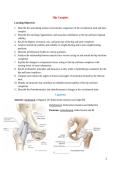
Anterior: Iliofemoral or Bigalow (Y) limits/resist extension and slight ER.
Pubofemoral, limits/resist extension and Abduction
Posterior: Ischiofemoral, limits flexion and IR.
1
, The ligament of the head of the femur, or the
ligamentum teres, is an intra-articular but
extrasynovial accessory joint structure. The ligament is
a triangular band that attaches to the peripheral edge of
the acetabular notch. The ligament then passes under
the transverse acetabular ligament (with which it
blends) to attach at its other end to the fovea of the
femur.
The ligamentum teres has been shown to provide
restraint of hip medial and lateral rotation when the
hip is positioned greater than 90° of flexion.
The anterior capsuloligamentous structures tend to be stronger (stiffer and withstanding greater
force at failure) than the posterior structures.
The primary stabilizing component of the anterior hip joint is the iliofemoral ligament. This
ligament is capable of providing resistance to excessive lateral rotation. In particular, the more
lateral portion of the iliofemoral ligament is the most significant restraint to lateral rotation when
the hip is in neutral position and flexed.
The pubofemoral ligament controls lateral rotation in an extended position.
The posteriorly located ischiofemoral ligament is the primary restraint to medial rotation of the
hip regardless of hip position in flexion or extension.
Dynamic and Static Mobilizers of the Hip
Flexion/Extention Flexion - Iliopsoas
Anterior/Posterior stability Extension - Glut max
ADBuctors Gluteus Medius and minimus
Lateral stability
ADDuctors Pectineus
Medial stability Gracilis
ADDuctor group
• Brevis, longus, magnus
IR No technical prime movers
Ant-Medial stability Anterior fibers of glut med/min
Tensor fascia lata
ADDuctors, except for gracilis
ER Piriformis
Post-Lateral Obturator externus and internus
Superior and inferior gemelli
Quadratus femoris
2
, Adductors assist maintain alignment of the shaft of the femur, while prime moves of hip flexion
are activated.
CKC
Gluteus Medius and Minimus
Functions to stabilize the ipsilateral hip while contralateral hip is in motion
Lateral stabilizer in the coronal plane
Examples:
Tall and half Kneeling
Maintaining an upright typical posture
Single Limb Sanding
OKC
Functions to mobilize ipsilateral hip into ABD
Examples:
Side stepping
Side kicks
Lateral transfers into/out of a car
Maneuvering tight spaces
Trendelenburg gait
During the normal gait, each lower limb
typically bears half of the body weight in
some part of the stance phase. When one
lower limb is lifted in the swing phase,
the other bears the entire weight. In the
stance phase, the pelvis normally tilts
downwards on the weight-bearing
extremity and hikes up on the non-weight
bearing extremity. However, in the
presence of hip abductor weakness, an
atypical response occurs: the pelvis tilts
downwards on the non-weight bearing
extremity instead of upwards. In an
attempt to compensate for this effect, the
3
Learning Objectives
1. Describe the articulating surfaces and articular congruence of the coxofemoral joint and knee
complex.
2. Describe the osteology, ligamentous, and muscular contributors to the hip and knee regional
stability.
3. Recall the degrees of motion, axis, and joint type of the hip and knee complexes.
4. Analyze normal hip stability and mobility in weight-bearing and in non-weight-bearing
positions.
5. Describe pelvifemoral rhythm in various positions.
6. Analyze the relationship between muscle force vectors acting on and around the hip and knee
complexes.
7. Explain the changes in compressive forces acting on the hip and knee complexes with
varying levels of water submersion.
8. Recall Archimedes' principles and buoyancy as they relate to hydrotherapy treatments for the
hip and knee complexes.
9. Compare and contrast the angles of torsion and angles of inclination formed by the femoral
neck.
10. Identify all structures that contribute to multidirectional stability of the hip and knee
complexes.
11. Describe the Osteokinematics and arthrokinematics changes at the coxofemoral joint.
Ligaments
Anterior: Iliofemoral or Bigalow (Y) limits/resist extension and slight ER.
Pubofemoral, limits/resist extension and Abduction
Posterior: Ischiofemoral, limits flexion and IR.
1
, The ligament of the head of the femur, or the
ligamentum teres, is an intra-articular but
extrasynovial accessory joint structure. The ligament is
a triangular band that attaches to the peripheral edge of
the acetabular notch. The ligament then passes under
the transverse acetabular ligament (with which it
blends) to attach at its other end to the fovea of the
femur.
The ligamentum teres has been shown to provide
restraint of hip medial and lateral rotation when the
hip is positioned greater than 90° of flexion.
The anterior capsuloligamentous structures tend to be stronger (stiffer and withstanding greater
force at failure) than the posterior structures.
The primary stabilizing component of the anterior hip joint is the iliofemoral ligament. This
ligament is capable of providing resistance to excessive lateral rotation. In particular, the more
lateral portion of the iliofemoral ligament is the most significant restraint to lateral rotation when
the hip is in neutral position and flexed.
The pubofemoral ligament controls lateral rotation in an extended position.
The posteriorly located ischiofemoral ligament is the primary restraint to medial rotation of the
hip regardless of hip position in flexion or extension.
Dynamic and Static Mobilizers of the Hip
Flexion/Extention Flexion - Iliopsoas
Anterior/Posterior stability Extension - Glut max
ADBuctors Gluteus Medius and minimus
Lateral stability
ADDuctors Pectineus
Medial stability Gracilis
ADDuctor group
• Brevis, longus, magnus
IR No technical prime movers
Ant-Medial stability Anterior fibers of glut med/min
Tensor fascia lata
ADDuctors, except for gracilis
ER Piriformis
Post-Lateral Obturator externus and internus
Superior and inferior gemelli
Quadratus femoris
2
, Adductors assist maintain alignment of the shaft of the femur, while prime moves of hip flexion
are activated.
CKC
Gluteus Medius and Minimus
Functions to stabilize the ipsilateral hip while contralateral hip is in motion
Lateral stabilizer in the coronal plane
Examples:
Tall and half Kneeling
Maintaining an upright typical posture
Single Limb Sanding
OKC
Functions to mobilize ipsilateral hip into ABD
Examples:
Side stepping
Side kicks
Lateral transfers into/out of a car
Maneuvering tight spaces
Trendelenburg gait
During the normal gait, each lower limb
typically bears half of the body weight in
some part of the stance phase. When one
lower limb is lifted in the swing phase,
the other bears the entire weight. In the
stance phase, the pelvis normally tilts
downwards on the weight-bearing
extremity and hikes up on the non-weight
bearing extremity. However, in the
presence of hip abductor weakness, an
atypical response occurs: the pelvis tilts
downwards on the non-weight bearing
extremity instead of upwards. In an
attempt to compensate for this effect, the
3