

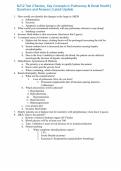
N212 Test 2 Review_ Key Concepts in Pulmonary & Renal Health |
Questions and Answers | Latest Update
1. How would you identify the changes in the lungs in ARDS
a. Inflammation
b. Necrosis
c. Apoptosis (cellular damage to the epithelium)
2. What would you recommend somebody with any pulmonary disease to stop doing?
a. Smoking cessation
3. Increase fluid intake to thin secretions (Just know this I guess)
4. A common cause of cirrhosis is chronic alcoholic
a. Higher risk for injury; clotting factor will be prolonged increasing the risk for
bleeding because vitamin K is decreased
b. Serum sodium level is increased due to fluid retention causing hepatic
encephalopathy
c. Restrict fluid intake & sodium intake
d. Due to the liver’s inability to detoxify the blood, the patient can be affected
neurologically because of hepatic encephalopathy
5. Dehydration; hypotension & Diabetes
a. The priority is to administer fluids to rapidly hydrate the patient
b. Know urine specific gravity level
c. When evaluating, which characteristic indicates improvement in treatment?
6. Renal tubulopathy; Bartter syndrome
a. What are the complications?
i. Loss of potassium. How do you treat?
1. Potassium supplements/diet, Potassium-sparing diuretics
(Aldactone)
b. Which electrolytes will be affected?
i. Hypokalemia
ii. Hypochloremia
iii. Hypernatremia
iv. Hypocalcemia
v. Hypomagnesemia
c. Low protein diet
d. Increase fluid intake
7. Elderly patients are at highest risk for mortality with polypharmacy (Just know I guess)
8. DKA; what is the priority?
a. Restore volume to hydrate organs (IV Fluids)
b. Blood glucose will be at least over 300
c. Type 1 diabetes is more at risk because of no insulin production
d. Patient teaching
i. What symptoms should patients report?
1. 3 P’s
2. Fruity Breath (acetone)
3. Kussmaul’s Respirations (rapid,shallow breathing)
Questions and Answers | Latest Update
1. How would you identify the changes in the lungs in ARDS
a. Inflammation
b. Necrosis
c. Apoptosis (cellular damage to the epithelium)
2. What would you recommend somebody with any pulmonary disease to stop doing?
a. Smoking cessation
3. Increase fluid intake to thin secretions (Just know this I guess)
4. A common cause of cirrhosis is chronic alcoholic
a. Higher risk for injury; clotting factor will be prolonged increasing the risk for
bleeding because vitamin K is decreased
b. Serum sodium level is increased due to fluid retention causing hepatic
encephalopathy
c. Restrict fluid intake & sodium intake
d. Due to the liver’s inability to detoxify the blood, the patient can be affected
neurologically because of hepatic encephalopathy
5. Dehydration; hypotension & Diabetes
a. The priority is to administer fluids to rapidly hydrate the patient
b. Know urine specific gravity level
c. When evaluating, which characteristic indicates improvement in treatment?
6. Renal tubulopathy; Bartter syndrome
a. What are the complications?
i. Loss of potassium. How do you treat?
1. Potassium supplements/diet, Potassium-sparing diuretics
(Aldactone)
b. Which electrolytes will be affected?
i. Hypokalemia
ii. Hypochloremia
iii. Hypernatremia
iv. Hypocalcemia
v. Hypomagnesemia
c. Low protein diet
d. Increase fluid intake
7. Elderly patients are at highest risk for mortality with polypharmacy (Just know I guess)
8. DKA; what is the priority?
a. Restore volume to hydrate organs (IV Fluids)
b. Blood glucose will be at least over 300
c. Type 1 diabetes is more at risk because of no insulin production
d. Patient teaching
i. What symptoms should patients report?
1. 3 P’s
2. Fruity Breath (acetone)
3. Kussmaul’s Respirations (rapid,shallow breathing)

