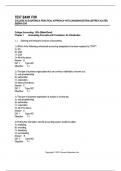
2026/2027 ELITE
TEST BANK:
Pharmacology for
Nurses - A
Pathophysiologic
Approach
PART 0: THE NAVIGATOR
● PART I: THE PRIMER
○ The "Welcome to the Big Leagues" Hook
○ The "Panic Button" Cheat Sheet
● PART II: THE ELITE TEST BANK
○ Section A: Foundational Syntax & Application (Questions 1–15)
○ Section B: Professional Simulation (Questions 16–40)
○ Section C: Grandmaster Synthesis (Questions 41–66)
PART I: THE PRIMER
You are no longer memorizing drug classes to pass a mid-term; you are mastering the
biochemical levers of human survival to prevent catastrophic failure in the clinical arena.
Excellence in pharmacology is the absolute demarcation between an amateur who follows
orders and an A-level clinical architect who intercepts disaster before it strikes.
● The Pharmacokinetic Anchor: Absorption determines onset; metabolism determines
duration; excretion determines toxicity.
● The 2026 Beers Mandate: "Less is more." In geriatrics, eliminate sedative-hypnotics and
, anticholinergics; prioritize sleep hygiene and cognitive behavioral interventions.
● The CYP450 Law: Inducers decrease the efficacy of co-administered drugs; inhibitors
amplify their toxicity. Know your substrates.
● The Autonomy Absolute: Patient autonomy supersedes beneficence. Chemical restraint
of a competent patient is an intentional tort (false imprisonment).
● The Quadruple Aim: High-performance evidence-based practice (EBP) simultaneously
enhances quality, improves outcomes, cuts costs, and eliminates clinician burnout.
PART II: THE ELITE TEST BANK
Section A: Foundational Syntax & Application
Q1: A practitioner is initiating a client on an oral maintenance dose of a
narrow-therapeutic-index medication with a half-life of 24 hours. Which pharmacokinetic
principle BEST predicts when the client will achieve a steady-state serum concentration? A)
Steady state will be achieved after the first pass effect is saturated. B) Steady state is achieved
after approximately 4 to 5 half-lives of the drug. C) Steady state will occur immediately if a
loading dose is bypassed. D) Steady state is solely dependent on the glomerular filtration rate
(GFR).
● The Answer: B (Steady state is achieved after approximately 4 to 5 half-lives of the
drug.)
● Distractor Analysis:
○ A is incorrect: First-pass effect dictates bioavailability, not the time to steady state.
○ C is incorrect: Bypassing a loading dose delays the therapeutic peak; it does not
accelerate steady state.
○ D is incorrect: While GFR affects elimination, the universal mathematical rule for
steady state is based on the half-life multiplier, not renal rate alone.
The Mentor's Analysis: A drug accumulates until the amount administered equals the amount
eliminated. Mathematically, this equilibrium occurs at roughly 4 to 5 half-lives, regardless of the
dose size.
Half-Life Multiplier Percentage of Steady State Reached
1 Half-Life 50%
2 Half-Lives 75%
3 Half-Lives 87.5%
4 Half-Lives ~94% (Clinical Steady State)
Professional Intuition: Never draw peak/trough levels for maintenance efficacy before the 4th
half-life; you are merely measuring an incomplete curve.
Q2: A client with severe hepatic cirrhosis is prescribed a highly lipophilic medication known for a
profound first-pass effect. How must the practitioner IMMEDIATELY adapt the pharmacological
approach? A) Increase the oral dose to compensate for rapid hepatic degradation. B) Switch to
a transdermal or intravenous route to bypass the portal circulation. C) Administer the medication
with a high-fat meal to enhance gastrointestinal absorption. D) Co-administer a potent CYP450
inducer to stabilize hepatic metabolism.
● The Answer: B (Switch to a transdermal or intravenous route to bypass the portal
circulation.)
● Distractor Analysis:
○ A is incorrect: In cirrhosis, the liver's metabolic capacity is diminished, meaning the
, first-pass effect is actually reduced. Increasing the dose would cause lethal toxicity.
○ C is incorrect: Lipophilic absorption is irrelevant if the liver cannot process the drug
or if the goal is bypassing the liver.
○ D is incorrect: A failing liver cannot respond to enzymatic induction.
The Mentor's Analysis: The first-pass effect is the liver's toll booth for oral medications. In
hepatic failure, the toll booth is broken. If you give a standard oral dose of a high first-pass drug
to a cirrhotic patient, it dumps directly into systemic circulation at toxic levels. Professional
Intuition: Always change the route before changing the dose when portal hypertension and
cirrhosis are present.
Q3: During a comprehensive medication review, it is discovered that a client taking warfarin has
recently been prescribed rifampin for latent tuberculosis. Which pathophysiological outcome is
MOST LIKELY to occur if the regimen is not adjusted? A) Profound hemorrhage due to
synergistic anticoagulation. B) Deep vein thrombosis due to CYP450 induction accelerating
warfarin metabolism. C) Acute hepatotoxicity secondary to competitive protein binding. D)
Complete nullification of the rifampin due to delayed gastric emptying.
● The Answer: B (Deep vein thrombosis due to CYP450 induction accelerating warfarin
metabolism.)
● Distractor Analysis:
○ A is incorrect: Rifampin is an inducer, meaning it destroys warfarin faster. It
decreases bleeding risk but increases clotting risk.
○ C is incorrect: Warfarin and rifampin do not compete for protein binding in a way
that directly causes acute hepatotoxicity.
○ D is incorrect: Warfarin does not alter gastric emptying.
The Mentor's Analysis: Rifampin is the ultimate hepatic engine revver (CYP450 inducer). It
commands the liver to metabolize substrates rapidly. Warfarin is the substrate. The liver chews
up the warfarin, leaving the patient un-anticoagulated and at critical risk for a catastrophic clot.
Professional Intuition: Inducers decrease substrate efficacy. Inhibitors increase substrate
toxicity.
Q4: A client receives an injection of naloxone for a suspected opioid overdose. Naloxone
possesses high affinity for the mu-opioid receptor but lacks intrinsic activity. Which
pharmacological classification BEST describes this agent? A) Partial agonist. B) Competitive
antagonist. C) Noncompetitive antagonist. D) Inverse agonist.
● The Answer: B (Competitive antagonist.)
● Distractor Analysis:
○ A is incorrect: Partial agonists have some intrinsic activity. Naloxone has zero.
○ C is incorrect: Noncompetitive antagonists bind to allosteric sites. Naloxone
competes directly for the main receptor site.
○ D is incorrect: Inverse agonists produce the opposite pharmacological effect
intrinsically; antagonists simply block the receptor.
The Mentor's Analysis: Affinity is the ability to dock at the receptor; intrinsic activity is the
ability to turn the receptor "on." Naloxone docks flawlessly but does absolutely nothing except
block the actual opioid from docking. Professional Intuition: Antagonists are pharmacological
bouncers; they don't enjoy the party, they just stop others from getting in.
Q5: The clinical team is evaluating a new therapeutic agent. The drug has an ED50 of 10 mg
and an LD50 of 100 mg. Which statement represents the MOST ACCURATE clinical application
of this data? A) The drug has a Therapeutic Index of 10, indicating it requires intensive peak
and trough monitoring. B) The drug has a Therapeutic Index of 10, indicating a relatively wide
margin of safety. C) The drug has a Therapeutic Index of 0.1, making it highly lethal in standard
TEST BANK:
Pharmacology for
Nurses - A
Pathophysiologic
Approach
PART 0: THE NAVIGATOR
● PART I: THE PRIMER
○ The "Welcome to the Big Leagues" Hook
○ The "Panic Button" Cheat Sheet
● PART II: THE ELITE TEST BANK
○ Section A: Foundational Syntax & Application (Questions 1–15)
○ Section B: Professional Simulation (Questions 16–40)
○ Section C: Grandmaster Synthesis (Questions 41–66)
PART I: THE PRIMER
You are no longer memorizing drug classes to pass a mid-term; you are mastering the
biochemical levers of human survival to prevent catastrophic failure in the clinical arena.
Excellence in pharmacology is the absolute demarcation between an amateur who follows
orders and an A-level clinical architect who intercepts disaster before it strikes.
● The Pharmacokinetic Anchor: Absorption determines onset; metabolism determines
duration; excretion determines toxicity.
● The 2026 Beers Mandate: "Less is more." In geriatrics, eliminate sedative-hypnotics and
, anticholinergics; prioritize sleep hygiene and cognitive behavioral interventions.
● The CYP450 Law: Inducers decrease the efficacy of co-administered drugs; inhibitors
amplify their toxicity. Know your substrates.
● The Autonomy Absolute: Patient autonomy supersedes beneficence. Chemical restraint
of a competent patient is an intentional tort (false imprisonment).
● The Quadruple Aim: High-performance evidence-based practice (EBP) simultaneously
enhances quality, improves outcomes, cuts costs, and eliminates clinician burnout.
PART II: THE ELITE TEST BANK
Section A: Foundational Syntax & Application
Q1: A practitioner is initiating a client on an oral maintenance dose of a
narrow-therapeutic-index medication with a half-life of 24 hours. Which pharmacokinetic
principle BEST predicts when the client will achieve a steady-state serum concentration? A)
Steady state will be achieved after the first pass effect is saturated. B) Steady state is achieved
after approximately 4 to 5 half-lives of the drug. C) Steady state will occur immediately if a
loading dose is bypassed. D) Steady state is solely dependent on the glomerular filtration rate
(GFR).
● The Answer: B (Steady state is achieved after approximately 4 to 5 half-lives of the
drug.)
● Distractor Analysis:
○ A is incorrect: First-pass effect dictates bioavailability, not the time to steady state.
○ C is incorrect: Bypassing a loading dose delays the therapeutic peak; it does not
accelerate steady state.
○ D is incorrect: While GFR affects elimination, the universal mathematical rule for
steady state is based on the half-life multiplier, not renal rate alone.
The Mentor's Analysis: A drug accumulates until the amount administered equals the amount
eliminated. Mathematically, this equilibrium occurs at roughly 4 to 5 half-lives, regardless of the
dose size.
Half-Life Multiplier Percentage of Steady State Reached
1 Half-Life 50%
2 Half-Lives 75%
3 Half-Lives 87.5%
4 Half-Lives ~94% (Clinical Steady State)
Professional Intuition: Never draw peak/trough levels for maintenance efficacy before the 4th
half-life; you are merely measuring an incomplete curve.
Q2: A client with severe hepatic cirrhosis is prescribed a highly lipophilic medication known for a
profound first-pass effect. How must the practitioner IMMEDIATELY adapt the pharmacological
approach? A) Increase the oral dose to compensate for rapid hepatic degradation. B) Switch to
a transdermal or intravenous route to bypass the portal circulation. C) Administer the medication
with a high-fat meal to enhance gastrointestinal absorption. D) Co-administer a potent CYP450
inducer to stabilize hepatic metabolism.
● The Answer: B (Switch to a transdermal or intravenous route to bypass the portal
circulation.)
● Distractor Analysis:
○ A is incorrect: In cirrhosis, the liver's metabolic capacity is diminished, meaning the
, first-pass effect is actually reduced. Increasing the dose would cause lethal toxicity.
○ C is incorrect: Lipophilic absorption is irrelevant if the liver cannot process the drug
or if the goal is bypassing the liver.
○ D is incorrect: A failing liver cannot respond to enzymatic induction.
The Mentor's Analysis: The first-pass effect is the liver's toll booth for oral medications. In
hepatic failure, the toll booth is broken. If you give a standard oral dose of a high first-pass drug
to a cirrhotic patient, it dumps directly into systemic circulation at toxic levels. Professional
Intuition: Always change the route before changing the dose when portal hypertension and
cirrhosis are present.
Q3: During a comprehensive medication review, it is discovered that a client taking warfarin has
recently been prescribed rifampin for latent tuberculosis. Which pathophysiological outcome is
MOST LIKELY to occur if the regimen is not adjusted? A) Profound hemorrhage due to
synergistic anticoagulation. B) Deep vein thrombosis due to CYP450 induction accelerating
warfarin metabolism. C) Acute hepatotoxicity secondary to competitive protein binding. D)
Complete nullification of the rifampin due to delayed gastric emptying.
● The Answer: B (Deep vein thrombosis due to CYP450 induction accelerating warfarin
metabolism.)
● Distractor Analysis:
○ A is incorrect: Rifampin is an inducer, meaning it destroys warfarin faster. It
decreases bleeding risk but increases clotting risk.
○ C is incorrect: Warfarin and rifampin do not compete for protein binding in a way
that directly causes acute hepatotoxicity.
○ D is incorrect: Warfarin does not alter gastric emptying.
The Mentor's Analysis: Rifampin is the ultimate hepatic engine revver (CYP450 inducer). It
commands the liver to metabolize substrates rapidly. Warfarin is the substrate. The liver chews
up the warfarin, leaving the patient un-anticoagulated and at critical risk for a catastrophic clot.
Professional Intuition: Inducers decrease substrate efficacy. Inhibitors increase substrate
toxicity.
Q4: A client receives an injection of naloxone for a suspected opioid overdose. Naloxone
possesses high affinity for the mu-opioid receptor but lacks intrinsic activity. Which
pharmacological classification BEST describes this agent? A) Partial agonist. B) Competitive
antagonist. C) Noncompetitive antagonist. D) Inverse agonist.
● The Answer: B (Competitive antagonist.)
● Distractor Analysis:
○ A is incorrect: Partial agonists have some intrinsic activity. Naloxone has zero.
○ C is incorrect: Noncompetitive antagonists bind to allosteric sites. Naloxone
competes directly for the main receptor site.
○ D is incorrect: Inverse agonists produce the opposite pharmacological effect
intrinsically; antagonists simply block the receptor.
The Mentor's Analysis: Affinity is the ability to dock at the receptor; intrinsic activity is the
ability to turn the receptor "on." Naloxone docks flawlessly but does absolutely nothing except
block the actual opioid from docking. Professional Intuition: Antagonists are pharmacological
bouncers; they don't enjoy the party, they just stop others from getting in.
Q5: The clinical team is evaluating a new therapeutic agent. The drug has an ED50 of 10 mg
and an LD50 of 100 mg. Which statement represents the MOST ACCURATE clinical application
of this data? A) The drug has a Therapeutic Index of 10, indicating it requires intensive peak
and trough monitoring. B) The drug has a Therapeutic Index of 10, indicating a relatively wide
margin of safety. C) The drug has a Therapeutic Index of 0.1, making it highly lethal in standard