1|Page
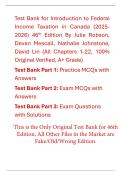
Accredited Test Bank Solution For
Introduction to Federal Income Taxation
in Canada, 45th Edition by Nathalie
Johnstone [All Lessons Included]
Complete Chapter Solution
Manual
are Included (Ch.1 to Ch.22)
Rapid Download
Quick Turnaround
Complete Chapters Provided
, Table of Contents are Given Below
"Introduction to Federal Income Taxation in Canada, 45th Edition (2024-2025)" by Nathalie
Johnstone comprises
the following chapters:
Chapter Topic Title Question Range
Introduction Questions 1 – 20
1
Liability for Tax Questions 21 – 32
2
Employment Income Questions 33 – 44
3
Income from Business: General Concepts and Rules Questions 45 – 56
4
The Capital Cost Allowance System for Depreciable Property, Questions 57 – 68
5 Including Intangibles
Income from Property Questions 69 – 80
6
,2|Page
Capital Gains: Personal Questions 81 – 92
7
Non-Arm’s Length Transfers and Other Special Circumstances Questions 93 – 104
8
Other Sources of Income and Deductions in Computing Income Questions 105 – 116
9
Computation of Taxable Income and Taxes Payable for Questions 117 – 128
10 Individuals
Computation of Taxable Income and Tax After General Questions 129 – 140
11 Reductions for Corporations
Integration for Business and Investment Income of the Private Questions 141 – 152
12 Corporation
Shareholder-Manager Remuneration and Tax Planning for the Questions 153 – 164
13 Owner-Manager
Rights and Obligations Under the Income Tax Act Questions 165 – 176
14
Purchase and Sale of a Business – Share Transactions Questions 177 – 188
15
Corporate Distributions, Asset Sales, and Winding-Up Questions 189 – 200
16
Tax Deferred Transactions: Section 85, Section 86, Estate Freeze Questions 201 – 212
17 Transactions, Amalgamations, and Wind Ups
The Sustainability Landscape and Tax Questions 213 – 224
18
Partnerships, Trusts, and Death of a Taxpayer Questions 225 – 236
19
International Taxation in Canada Questions 237 – 248
20
Goods and Services Tax (GST)/Harmonized Sales Tax (HST) Questions 249 – 260
21
Data Analytics and Information Systems in Tax Questions 261 – 272
22
TOPIC 1: INTRODUCTION (QUESTIONS 1–20)
QUESTION 1
Which administrative body is primarily responsible for the administration and
enforcement of the federal Income Tax Act?
A. Department of Finance
,3|Page
B. Canadian Tax Foundation
C. Supreme Court of Canada
D. Canada Revenue Agency (CRA)
CORRECT ANSWER ✓ ✓: D. Canada Revenue Agency (CRA)
EXPERT RATIONALE: The CRA administers and enforces federal tax laws, including the
Income Tax Act, collects taxes, and delivers benefit programs.
QUESTION 2
If a taxpayer disagrees with an assessment from the CRA, what is the first step in
disputing it?
A. Filing a notice of appeal directly to the Tax Court of Canada
B. Submitting an Objection to the CRA’s Appeals Division
C. Appealing to the Federal Court of Appeal
D. Requesting relief from the Supreme Court of Canada
CORRECT ANSWER ✓ ✓: B. Submitting an Objection to the CRA’s Appeals Division
EXPERT RATIONALE: The first step after receiving a Notice of Assessment or
Reassessment is to file a Notice of Objection with the CRA’s Appeals Division.
QUESTION 3
The Canadian federal income tax system is based on which of the following?
A. A purely regressive tax system
B. A consumption-based tax system
C. A progressive tax rate structure
D. A uniform single tax rate
CORRECT ANSWER ✓ ✓: C. A progressive tax rate structure
EXPERT RATIONALE: Canada uses a progressive tax rate structure, meaning the rate
of taxation increases as the taxable income increases.
QUESTION 4
Which of the following best describes the principle of “self-assessment” in the
Canadian tax system?
A. Taxpayers calculate their own tax liability and file returns accordingly.
B. CRA calculates the taxpayer’s tax liability and sends a bill.
C. Tax is only paid if the taxpayer decides it is necessary.
D. Income is taxed only after a formal audit has been completed.
CORRECT ANSWER ✓ ✓: A. Taxpayers calculate their own tax liability and file returns
accordingly.
, 4|Page
EXPERT RATIONALE: Canada’s self-assessment system relies on taxpayers to report
their income and calculate their taxes accurately, subject to CRA review.
QUESTION 5
Which of the following courts generally hears initial tax disputes between taxpayers
and the CRA?
A. Tax Court of Canada
B. Federal Court of Canada
C. Supreme Court of Canada
D. Provincial superior courts
CORRECT ANSWER ✓ ✓: A. Tax Court of Canada
EXPERT RATIONALE: The Tax Court of Canada is a specialized court that hears income
tax, goods and services tax (GST/HST), and other tax-related disputes.
QUESTION 6
Which of the following statements about the Income Tax Act is true?
A. It only applies to corporations.
B. It is updated once every decade.
C. It applies to individuals and corporations.
D. It never undergoes amendments.
CORRECT ANSWER ✓ ✓: C. It applies to individuals and corporations.
EXPERT RATIONALE: The Income Tax Act applies to individuals (including trusts) and
corporations, with extensive and frequent amendments by Parliament.
QUESTION 7
Which of the following sources holds the highest legal authority for Canadian federal
income tax?
A. Canada Revenue Agency (CRA) Interpretation Bulletins
B. Income Tax Act (ITA)
C. CRA Information Circulars
D. Income Tax Folios
CORRECT ANSWER ✓ ✓: B. Income Tax Act (ITA)
EXPERT RATIONALE: The Income Tax Act (ITA) passed by Parliament is the primary
authority for federal income tax law in Canada. CRA documents (Interpretation
Bulletins, Folios, etc.) provide administrative guidance but do not override the
legislation.
QUESTION 8
A sole proprietor operates an unincorporated consulting business. For income tax
purposes, the net income from this business would be reported under which income
Accredited Test Bank Solution For
Introduction to Federal Income Taxation
in Canada, 45th Edition by Nathalie
Johnstone [All Lessons Included]
Complete Chapter Solution
Manual
are Included (Ch.1 to Ch.22)
Rapid Download
Quick Turnaround
Complete Chapters Provided
, Table of Contents are Given Below
"Introduction to Federal Income Taxation in Canada, 45th Edition (2024-2025)" by Nathalie
Johnstone comprises
the following chapters:
Chapter Topic Title Question Range
Introduction Questions 1 – 20
1
Liability for Tax Questions 21 – 32
2
Employment Income Questions 33 – 44
3
Income from Business: General Concepts and Rules Questions 45 – 56
4
The Capital Cost Allowance System for Depreciable Property, Questions 57 – 68
5 Including Intangibles
Income from Property Questions 69 – 80
6
,2|Page
Capital Gains: Personal Questions 81 – 92
7
Non-Arm’s Length Transfers and Other Special Circumstances Questions 93 – 104
8
Other Sources of Income and Deductions in Computing Income Questions 105 – 116
9
Computation of Taxable Income and Taxes Payable for Questions 117 – 128
10 Individuals
Computation of Taxable Income and Tax After General Questions 129 – 140
11 Reductions for Corporations
Integration for Business and Investment Income of the Private Questions 141 – 152
12 Corporation
Shareholder-Manager Remuneration and Tax Planning for the Questions 153 – 164
13 Owner-Manager
Rights and Obligations Under the Income Tax Act Questions 165 – 176
14
Purchase and Sale of a Business – Share Transactions Questions 177 – 188
15
Corporate Distributions, Asset Sales, and Winding-Up Questions 189 – 200
16
Tax Deferred Transactions: Section 85, Section 86, Estate Freeze Questions 201 – 212
17 Transactions, Amalgamations, and Wind Ups
The Sustainability Landscape and Tax Questions 213 – 224
18
Partnerships, Trusts, and Death of a Taxpayer Questions 225 – 236
19
International Taxation in Canada Questions 237 – 248
20
Goods and Services Tax (GST)/Harmonized Sales Tax (HST) Questions 249 – 260
21
Data Analytics and Information Systems in Tax Questions 261 – 272
22
TOPIC 1: INTRODUCTION (QUESTIONS 1–20)
QUESTION 1
Which administrative body is primarily responsible for the administration and
enforcement of the federal Income Tax Act?
A. Department of Finance
,3|Page
B. Canadian Tax Foundation
C. Supreme Court of Canada
D. Canada Revenue Agency (CRA)
CORRECT ANSWER ✓ ✓: D. Canada Revenue Agency (CRA)
EXPERT RATIONALE: The CRA administers and enforces federal tax laws, including the
Income Tax Act, collects taxes, and delivers benefit programs.
QUESTION 2
If a taxpayer disagrees with an assessment from the CRA, what is the first step in
disputing it?
A. Filing a notice of appeal directly to the Tax Court of Canada
B. Submitting an Objection to the CRA’s Appeals Division
C. Appealing to the Federal Court of Appeal
D. Requesting relief from the Supreme Court of Canada
CORRECT ANSWER ✓ ✓: B. Submitting an Objection to the CRA’s Appeals Division
EXPERT RATIONALE: The first step after receiving a Notice of Assessment or
Reassessment is to file a Notice of Objection with the CRA’s Appeals Division.
QUESTION 3
The Canadian federal income tax system is based on which of the following?
A. A purely regressive tax system
B. A consumption-based tax system
C. A progressive tax rate structure
D. A uniform single tax rate
CORRECT ANSWER ✓ ✓: C. A progressive tax rate structure
EXPERT RATIONALE: Canada uses a progressive tax rate structure, meaning the rate
of taxation increases as the taxable income increases.
QUESTION 4
Which of the following best describes the principle of “self-assessment” in the
Canadian tax system?
A. Taxpayers calculate their own tax liability and file returns accordingly.
B. CRA calculates the taxpayer’s tax liability and sends a bill.
C. Tax is only paid if the taxpayer decides it is necessary.
D. Income is taxed only after a formal audit has been completed.
CORRECT ANSWER ✓ ✓: A. Taxpayers calculate their own tax liability and file returns
accordingly.
, 4|Page
EXPERT RATIONALE: Canada’s self-assessment system relies on taxpayers to report
their income and calculate their taxes accurately, subject to CRA review.
QUESTION 5
Which of the following courts generally hears initial tax disputes between taxpayers
and the CRA?
A. Tax Court of Canada
B. Federal Court of Canada
C. Supreme Court of Canada
D. Provincial superior courts
CORRECT ANSWER ✓ ✓: A. Tax Court of Canada
EXPERT RATIONALE: The Tax Court of Canada is a specialized court that hears income
tax, goods and services tax (GST/HST), and other tax-related disputes.
QUESTION 6
Which of the following statements about the Income Tax Act is true?
A. It only applies to corporations.
B. It is updated once every decade.
C. It applies to individuals and corporations.
D. It never undergoes amendments.
CORRECT ANSWER ✓ ✓: C. It applies to individuals and corporations.
EXPERT RATIONALE: The Income Tax Act applies to individuals (including trusts) and
corporations, with extensive and frequent amendments by Parliament.
QUESTION 7
Which of the following sources holds the highest legal authority for Canadian federal
income tax?
A. Canada Revenue Agency (CRA) Interpretation Bulletins
B. Income Tax Act (ITA)
C. CRA Information Circulars
D. Income Tax Folios
CORRECT ANSWER ✓ ✓: B. Income Tax Act (ITA)
EXPERT RATIONALE: The Income Tax Act (ITA) passed by Parliament is the primary
authority for federal income tax law in Canada. CRA documents (Interpretation
Bulletins, Folios, etc.) provide administrative guidance but do not override the
legislation.
QUESTION 8
A sole proprietor operates an unincorporated consulting business. For income tax
purposes, the net income from this business would be reported under which income