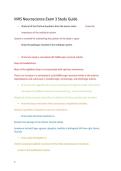
MHS Neuroscience Exam 3 Study Guide
• Study all of the Practice Questions from the lecture notes Know the
importance of the vestibular system.
System is essential for maintaining the position of the body in space
Know the pathways involved in the vestibular system.
• Know how sleep is associated with GABA-ergic neuronal activity.
Sleep and wakefulness.
Most of the nighttime sleep is not associated with rapid eye movements.
There is an increase in y aminobutyric acid (GABA)-ergic neuronal activity in the anterior
hypothalamus and a decrease in noradrenergic, serotonergic, and cholinergic activity.
• Know how the regulation of sensory transmission through the nuclei of the dorsal
corresponds to different aspects of movement (e.g., muscle contractions).
Magnitude of the muscular contraction in relation to the force exerted upon an object.
• Know the basic mechanism that characterizes a hypokinetic disorder.
Reduced quantities of dopamine onto the neostriatum
Know what Gerstman Syndrome is.
Results from damage to the Inferior Parietal Lobule
Symptoms include Finger agnosia, Agraphia, Inability to distinguish left from right, Alexia,
Acaculia
• Know what hemiballism is.
Violent involuntary ballistic movement of the limbs contralateral to the lesion.
Lesion in the Subthalamic nucleus
1.
, Loss of Excitatory input to the medial (internal) pallidal segment
• Know some of the treatments for Parkinson’s disease.
L-dopa
Carbidopa
Sinemet
• Know how and where cardiovascular, lungs, and gastrointestinal functions are.
controlled.
-Cardiovascular: Sympathetic preganglionic neurons (T1-T4)
Post ganglionic innervation arises from thoracic ganglia.
Innervate all regions of the heart: SA node, atria, AV node and ventricles.
(Mediated in the Ventrolateral medulla)
-Lungs: Sympathetic chain (T1-T4)
Post ganglionic innervate smooth muscle of bronchial tree.
Sympathetic: Bronchodilation
Parasympathetic: Pre dorsal motor nucleus of vagus
Parasympathetic: Bronchoconstriction
-Gi Tract: Sympathetic preganglionic (T5-T9)
Synapse on celiac ganglion
• Know what mediates ascending pain signals.
The neospinothalamic tract/ spinothalamic
Arises from nucleus propus
Brainstem or the spinal cord
1.
• Study all of the Practice Questions from the lecture notes Know the
importance of the vestibular system.
System is essential for maintaining the position of the body in space
Know the pathways involved in the vestibular system.
• Know how sleep is associated with GABA-ergic neuronal activity.
Sleep and wakefulness.
Most of the nighttime sleep is not associated with rapid eye movements.
There is an increase in y aminobutyric acid (GABA)-ergic neuronal activity in the anterior
hypothalamus and a decrease in noradrenergic, serotonergic, and cholinergic activity.
• Know how the regulation of sensory transmission through the nuclei of the dorsal
corresponds to different aspects of movement (e.g., muscle contractions).
Magnitude of the muscular contraction in relation to the force exerted upon an object.
• Know the basic mechanism that characterizes a hypokinetic disorder.
Reduced quantities of dopamine onto the neostriatum
Know what Gerstman Syndrome is.
Results from damage to the Inferior Parietal Lobule
Symptoms include Finger agnosia, Agraphia, Inability to distinguish left from right, Alexia,
Acaculia
• Know what hemiballism is.
Violent involuntary ballistic movement of the limbs contralateral to the lesion.
Lesion in the Subthalamic nucleus
1.
, Loss of Excitatory input to the medial (internal) pallidal segment
• Know some of the treatments for Parkinson’s disease.
L-dopa
Carbidopa
Sinemet
• Know how and where cardiovascular, lungs, and gastrointestinal functions are.
controlled.
-Cardiovascular: Sympathetic preganglionic neurons (T1-T4)
Post ganglionic innervation arises from thoracic ganglia.
Innervate all regions of the heart: SA node, atria, AV node and ventricles.
(Mediated in the Ventrolateral medulla)
-Lungs: Sympathetic chain (T1-T4)
Post ganglionic innervate smooth muscle of bronchial tree.
Sympathetic: Bronchodilation
Parasympathetic: Pre dorsal motor nucleus of vagus
Parasympathetic: Bronchoconstriction
-Gi Tract: Sympathetic preganglionic (T5-T9)
Synapse on celiac ganglion
• Know what mediates ascending pain signals.
The neospinothalamic tract/ spinothalamic
Arises from nucleus propus
Brainstem or the spinal cord
1.