

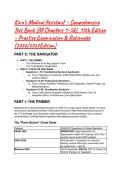
Kinn’s Medical Assistant – Comprehensive
Test Bank (All Chapters 1–58), 15th Edition
– Practice Examination & Rationales
(2026/2027Edition)
PART 0: THE NAVIGATOR
● PART I: THE PRIMER
○ The "Welcome to the Big Leagues" Hook
○ The "Panic Button" Cheat Sheet
● PART II: THE ELITE TEST BANK
○ Questions 1–15: Foundational Syntax & Application
■ Focus: Regulatory Compliance, 2026 HIPAA/OSHA, Medical Law, and
Anatomy Basics.
○ Questions 16–40: Professional Simulation
■ Focus: Clinical Workflow, Phlebotomy, EKG Diagnostics, Patient Triage, and
Billing Mechanics.
○ Questions 41–66: Grandmaster Synthesis
■ Focus: High-Stakes Emergency Response, Multi-System Crisis, AI
Integration Ethics, and Revenue Cycle Optimization.
PART I: THE PRIMER
Mastering the medical assisting ecosystem in 2026 is no longer about clerical speed; it is about
becoming an operational architect of the patient encounter. High-level professional success in
the UT Cambridge circuit demands a lethal combination of clinical precision and a nuanced
understanding of shifting federal regulations that safeguard practice viability.
The "Panic Button" Cheat Sheet
Category 2026/2027 Regulatory & Clinical Standards
HIPAA 2026 MANDATORY signed attestation for
Reproductive Health PHI requests; SUD Part 2
records require explicit NPP updates.
OSHA 2026 GHS Revision 7 mandatory for chemical
labeling; annual 300A injury summaries must
be posted Feb 1–April 30.
Medicare 2026 Part B Deductible: $283.00; POS 10 (Home) vs.
POS 02 (Facility) for Telehealth.
,Category 2026/2027 Regulatory & Clinical Standards
Clinical Math Dosage: \frac{\text{Desired}}{\text{Have}} \times
\text{Vehicle} = \text{Amount to Administer}.
CPT 2026 418 changes; 288 new codes; AI-driven cardiac
plaque assessment (75577) and 10-minute
RPM thresholds.
PART II: THE ELITE TEST BANK
Questions 1–15: Foundational Syntax & Application
Q1: A local law enforcement officer presents a warrant requesting the immediate release of a
patient’s medical records related to a "legal investigation into reproductive health services."
According to the 2026 HIPAA Reproductive Health Information (RHI) Privacy Rule, what is the
FIRST document the Medical Assistant (MA) must secure before processing this request? A) A
signed Business Associate Agreement (BAA) from the police department. B) A plain-language,
signed, and dated written attestation from the requester confirming the request is not for a
prohibited purpose. C) A verbal confirmation from the attending physician that the patient is
stable. D) A copy of the patient’s most recent specialist copayment receipt.
● The Answer: B (A plain-language, signed, and dated written attestation from the
requester confirming the request is not for a prohibited purpose.)
● Distractor Analysis:
○ A is incorrect: BAAs govern relationships with third-party vendors (like AI scribes or
billing companies), not law enforcement interactions.
○ C is incorrect: Clinical stability is irrelevant to the legal mandates of PHI disclosure
under the 2026 RHI rule.
○ D is incorrect: Financial records are not a prerequisite for legal privacy compliance
under the RHI framework.
The Mentor's Analysis: In the 2026 regulatory environment, the RHI Privacy Rule has created
a "hard deck" for disclosures. You are the frontline defender of patient privacy. An attestation is
"defective" if it contains incomplete information or if you, as the practitioner, have reason to
believe the stated purpose is a pretext for a prohibited investigation. Relying on a defective
document transfers the liability of a federal HIPAA violation directly from the law enforcement
agency to your facility. Professional Intuition: Always verify the validity of an attestation at the
exact moment of PHI transmission. Do not assume a badge bypasses federal privacy law.
Q2: During a safety audit of the clinical laboratory, the MA discovers several disinfectant
containers labeled under the older GHS Revision 3 standards. Under the MANDATED 2026
OSHA Global Harmonized System (GHS) Revision 7, which action is required to maintain
compliance? A) Dispose of all containers immediately in the biohazard waste. B) Update the
container labels to reflect the current GHS Revision 7 pictograms, signal words, and hazard
statements. C) Place the containers in a locked cabinet and only use them after hours. D) No
action is required as long as the chemicals were purchased before 2025.
● The Answer: B (Update the container labels to reflect the current GHS Revision 7
pictograms, signal words, and hazard statements.)
● Distractor Analysis:
○ A is incorrect: Disposal is only necessary if the chemical is expired or no longer
needed; labeling is the compliance fix.
○ C is incorrect: Restricted access does not substitute for accurate hazard
, communication.
○ D is incorrect: Legacy "grandfathering" of non-compliant labels is not permitted
under 2026/2027 OSHA enforcement protocols.
The Mentor's Analysis: Hazard Communication (HazCom) is about the "Right to Understand."
GHS Revision 7 introduces more granular classifications for flammable gases and aerosols. If
an inspector sees an old Revision 3 label, they see a practice that is non-compliant with the
most current safety language. This isn't just paperwork; it’s about ensuring that in an
emergency, every staff member knows the exact lethality of the substances they handle.
Professional Intuition: If the label on the bottle doesn't match the Safety Data Sheet (SDS) on
the digital portal, the chemical is a liability, not a tool.
Q3: A patient is diagnosed with rhinorrhea and epiphora during a seasonal allergy evaluation.
When documenting these findings in the Electronic Health Record (EHR), the MA understands
these terms correspond to which clinical observations? A) Inflammation of the middle ear and
excessive drooling. B) Discharge of mucus from the nose and excessive tearing of the eyes. C)
Difficulty swallowing and increased intraocular pressure. D) Redness of the skin and a
persistent dry cough.
● The Answer: B (Discharge of mucus from the nose and excessive tearing of the eyes.)
● Distractor Analysis:
○ A is incorrect: Middle ear inflammation is otitis media; excessive drooling is
hypersalivation.
○ C is incorrect: Swallowing difficulty is dysphagia.
○ D is incorrect: Skin redness is erythema.
The Mentor's Analysis: Medical terminology is the universal language of the clinic. "Rhino-"
refers to the nose, and "-rrhea" signifies a flow or discharge. "Epiphora" is the specific clinical
term for an overflow of tears. Using these precise terms in the Objective section of a SOAP note
prevents "diagnostic drift" and ensures the provider has an accurate picture before they even
enter the room. Professional Intuition: Precise terminology is the bedrock of accurate coding.
If you document 'runny nose,' the biller has to guess; if you document 'rhinorrhea,' the ICD-10
link is absolute.
Q4: A 65-year-old patient with Medicare Part B presents for their first visit of 2026. The MA
notes that the patient has not yet met their annual deductible. According to 2026 Medicare
standards, what is the APPROXIMATE amount the patient must pay out-of-pocket before
coverage begins? A) $100.00 B) $283.00 C) $500.00 D) $1,200.00
● The Answer: B ($283.00)
● Distractor Analysis:
○ A is incorrect: This was the deductible level from many years ago.
○ C is incorrect: This is higher than the standard 2026 Part B deductible.
○ D is incorrect: This resembles a Part A (Hospital) deductible rather than Part B
(Outpatient).
The Mentor's Analysis: The 2026 Medicare Part B deductible of approximately $283 is a
critical piece of front-office intelligence. Discovering a lapsed policy or an unmet deductible after
the encounter is performed leads to "revenue leakage" and unrecoverable write-offs.
Professional Intuition: Revenue cycle management (RCM) starts at the check-in desk, not the
billing office. Always verify 'Deductible Met' status in real-time using your 2026-integrated EHR
tools.
Q5: An MA is preparing to perform an EKG on a patient with Situs Inversus (Dextrocardia). To
ensure a diagnostic-quality tracing, what is the MANDATORY modification to standard lead
placement? A) Place all precordial leads (V1-V6) on the right side of the chest in a mirror image
Test Bank (All Chapters 1–58), 15th Edition
– Practice Examination & Rationales
(2026/2027Edition)
PART 0: THE NAVIGATOR
● PART I: THE PRIMER
○ The "Welcome to the Big Leagues" Hook
○ The "Panic Button" Cheat Sheet
● PART II: THE ELITE TEST BANK
○ Questions 1–15: Foundational Syntax & Application
■ Focus: Regulatory Compliance, 2026 HIPAA/OSHA, Medical Law, and
Anatomy Basics.
○ Questions 16–40: Professional Simulation
■ Focus: Clinical Workflow, Phlebotomy, EKG Diagnostics, Patient Triage, and
Billing Mechanics.
○ Questions 41–66: Grandmaster Synthesis
■ Focus: High-Stakes Emergency Response, Multi-System Crisis, AI
Integration Ethics, and Revenue Cycle Optimization.
PART I: THE PRIMER
Mastering the medical assisting ecosystem in 2026 is no longer about clerical speed; it is about
becoming an operational architect of the patient encounter. High-level professional success in
the UT Cambridge circuit demands a lethal combination of clinical precision and a nuanced
understanding of shifting federal regulations that safeguard practice viability.
The "Panic Button" Cheat Sheet
Category 2026/2027 Regulatory & Clinical Standards
HIPAA 2026 MANDATORY signed attestation for
Reproductive Health PHI requests; SUD Part 2
records require explicit NPP updates.
OSHA 2026 GHS Revision 7 mandatory for chemical
labeling; annual 300A injury summaries must
be posted Feb 1–April 30.
Medicare 2026 Part B Deductible: $283.00; POS 10 (Home) vs.
POS 02 (Facility) for Telehealth.
,Category 2026/2027 Regulatory & Clinical Standards
Clinical Math Dosage: \frac{\text{Desired}}{\text{Have}} \times
\text{Vehicle} = \text{Amount to Administer}.
CPT 2026 418 changes; 288 new codes; AI-driven cardiac
plaque assessment (75577) and 10-minute
RPM thresholds.
PART II: THE ELITE TEST BANK
Questions 1–15: Foundational Syntax & Application
Q1: A local law enforcement officer presents a warrant requesting the immediate release of a
patient’s medical records related to a "legal investigation into reproductive health services."
According to the 2026 HIPAA Reproductive Health Information (RHI) Privacy Rule, what is the
FIRST document the Medical Assistant (MA) must secure before processing this request? A) A
signed Business Associate Agreement (BAA) from the police department. B) A plain-language,
signed, and dated written attestation from the requester confirming the request is not for a
prohibited purpose. C) A verbal confirmation from the attending physician that the patient is
stable. D) A copy of the patient’s most recent specialist copayment receipt.
● The Answer: B (A plain-language, signed, and dated written attestation from the
requester confirming the request is not for a prohibited purpose.)
● Distractor Analysis:
○ A is incorrect: BAAs govern relationships with third-party vendors (like AI scribes or
billing companies), not law enforcement interactions.
○ C is incorrect: Clinical stability is irrelevant to the legal mandates of PHI disclosure
under the 2026 RHI rule.
○ D is incorrect: Financial records are not a prerequisite for legal privacy compliance
under the RHI framework.
The Mentor's Analysis: In the 2026 regulatory environment, the RHI Privacy Rule has created
a "hard deck" for disclosures. You are the frontline defender of patient privacy. An attestation is
"defective" if it contains incomplete information or if you, as the practitioner, have reason to
believe the stated purpose is a pretext for a prohibited investigation. Relying on a defective
document transfers the liability of a federal HIPAA violation directly from the law enforcement
agency to your facility. Professional Intuition: Always verify the validity of an attestation at the
exact moment of PHI transmission. Do not assume a badge bypasses federal privacy law.
Q2: During a safety audit of the clinical laboratory, the MA discovers several disinfectant
containers labeled under the older GHS Revision 3 standards. Under the MANDATED 2026
OSHA Global Harmonized System (GHS) Revision 7, which action is required to maintain
compliance? A) Dispose of all containers immediately in the biohazard waste. B) Update the
container labels to reflect the current GHS Revision 7 pictograms, signal words, and hazard
statements. C) Place the containers in a locked cabinet and only use them after hours. D) No
action is required as long as the chemicals were purchased before 2025.
● The Answer: B (Update the container labels to reflect the current GHS Revision 7
pictograms, signal words, and hazard statements.)
● Distractor Analysis:
○ A is incorrect: Disposal is only necessary if the chemical is expired or no longer
needed; labeling is the compliance fix.
○ C is incorrect: Restricted access does not substitute for accurate hazard
, communication.
○ D is incorrect: Legacy "grandfathering" of non-compliant labels is not permitted
under 2026/2027 OSHA enforcement protocols.
The Mentor's Analysis: Hazard Communication (HazCom) is about the "Right to Understand."
GHS Revision 7 introduces more granular classifications for flammable gases and aerosols. If
an inspector sees an old Revision 3 label, they see a practice that is non-compliant with the
most current safety language. This isn't just paperwork; it’s about ensuring that in an
emergency, every staff member knows the exact lethality of the substances they handle.
Professional Intuition: If the label on the bottle doesn't match the Safety Data Sheet (SDS) on
the digital portal, the chemical is a liability, not a tool.
Q3: A patient is diagnosed with rhinorrhea and epiphora during a seasonal allergy evaluation.
When documenting these findings in the Electronic Health Record (EHR), the MA understands
these terms correspond to which clinical observations? A) Inflammation of the middle ear and
excessive drooling. B) Discharge of mucus from the nose and excessive tearing of the eyes. C)
Difficulty swallowing and increased intraocular pressure. D) Redness of the skin and a
persistent dry cough.
● The Answer: B (Discharge of mucus from the nose and excessive tearing of the eyes.)
● Distractor Analysis:
○ A is incorrect: Middle ear inflammation is otitis media; excessive drooling is
hypersalivation.
○ C is incorrect: Swallowing difficulty is dysphagia.
○ D is incorrect: Skin redness is erythema.
The Mentor's Analysis: Medical terminology is the universal language of the clinic. "Rhino-"
refers to the nose, and "-rrhea" signifies a flow or discharge. "Epiphora" is the specific clinical
term for an overflow of tears. Using these precise terms in the Objective section of a SOAP note
prevents "diagnostic drift" and ensures the provider has an accurate picture before they even
enter the room. Professional Intuition: Precise terminology is the bedrock of accurate coding.
If you document 'runny nose,' the biller has to guess; if you document 'rhinorrhea,' the ICD-10
link is absolute.
Q4: A 65-year-old patient with Medicare Part B presents for their first visit of 2026. The MA
notes that the patient has not yet met their annual deductible. According to 2026 Medicare
standards, what is the APPROXIMATE amount the patient must pay out-of-pocket before
coverage begins? A) $100.00 B) $283.00 C) $500.00 D) $1,200.00
● The Answer: B ($283.00)
● Distractor Analysis:
○ A is incorrect: This was the deductible level from many years ago.
○ C is incorrect: This is higher than the standard 2026 Part B deductible.
○ D is incorrect: This resembles a Part A (Hospital) deductible rather than Part B
(Outpatient).
The Mentor's Analysis: The 2026 Medicare Part B deductible of approximately $283 is a
critical piece of front-office intelligence. Discovering a lapsed policy or an unmet deductible after
the encounter is performed leads to "revenue leakage" and unrecoverable write-offs.
Professional Intuition: Revenue cycle management (RCM) starts at the check-in desk, not the
billing office. Always verify 'Deductible Met' status in real-time using your 2026-integrated EHR
tools.
Q5: An MA is preparing to perform an EKG on a patient with Situs Inversus (Dextrocardia). To
ensure a diagnostic-quality tracing, what is the MANDATORY modification to standard lead
placement? A) Place all precordial leads (V1-V6) on the right side of the chest in a mirror image

