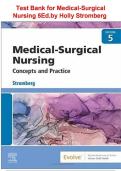
, TESTBANK FOR
Medical-Surgical Nursing 8th Edition Linton
Important Notes
The file includes the complete test bank, organized chapter by chapter.
A sample of selected pages has been provided for preview.
All available appendices and Excel files (if included in the original resources) are
provided.
We continuously update our files to ensure you receive the latest and most accurate
editions.
New editions are added regularly – stay connected for updates!
Purchase Guarantee
If you believe you have purchased the wrong file, don’t worry. Contact us anytime and we
will gladly replace it with the correct version.
Contact Email:
,Chapter 01: Aspects of Medical-Surgical Nursing
Linton: Medical-Surgical Nursing, 8th Edition
MULTIPLE CHOICE
1. Which item in a medical record provides direction for individualized care and assures the
delivery of accurate, safe care through a definitive pathway that promotes the client’s and the
support persons’ progress toward positive outcomes?
a. Physician’s orders
b. Progress notes
c. Nursing care plan
d. Client health history
ANS: C
The nursing care plan provides direction for individualized care and assures the delivery of
accurate, safe care through a definitive pathway that promotes the client’s and the support
persons’ progress toward positive outcomes.
DIF: Cognitive Level: Comprehension OBJ: 1 TOP: Nursing Care Plan
KEY: Nursing Process Step: Planning
MSC: NCLEX: Physiological Integrity: Reduction of Risk
2. The nurse is performing behaviors and actions that assist clients and significant others in
meeting their needs and the identified outcomes of the plan of care. Which term is correct for
these nursing behaviors?
a. Assessments
b. Interventions
c. Planning
d. Evaluation
ANS: B
Caring interventions are those nursing behaviors and actions that assist clients and significant
others in meeting their needs and the identified outcomes of the plan of care.
DIF: Cognitive Level: Knowledge OBJ: 1 TOP: Interventions
KEY: Nursing Process Step: Planning
MSC: NCLEX: Physiological Integrity: Reduction of Risk
3. The nurse understands the importance of being answerable for all actions and the possibility
of being called on to explain or justify them. Which term best describes this concept?
a. Reliability
b. Maturity
c. Accountability
d. Liability
ANS: C
Accountability means that a person is answerable for his or her actions and may be called on
to explain or justify them.
DIF: Cognitive Level: Knowledge OBJ: 1 TOP: Accountability
KEY: Nursing Process Step: N/A
, MSC: NCLEX: Physiological Integrity: Reduction of Risk
MULTIPLE RESPONSE
1. Which modes of conflict resolution should be addressed when providing an inservice about
conflict resolution? (Select all that apply.)
a. Suppression
b. Accommodation
c. Compromise
d. Avoidance
e. Collaboration
f. Competition
ANS: B, C, D, E, F
The modes of conflict resolution include accommodation, collaboration, compromise,
avoidance, and competition.
DIF: Cognitive Level: Knowledge OBJ: 5 TOP: Conflict Resolution
KEY: Nursing Process Step: N/A MSC: NCLEX: N/A
2. Which characteristics describe an effective leader? (Select all that apply.)
a. Effective communication
b. Rigid rules and regulations
c. Delegates appropriately
d. Acts as a role model
e. Consistently handles conflict
f. Focuses on individual development
ANS: A, C, D, E
Characteristics of an effective leader include effective communication, consistency in
managing conflict, knowledge and competency in all aspects of delivery of care, effective role
model for staff, uses participatory approach in decision making, shows appreciation for a job
well done, delegates work appropriately, sets objectives and guides staff, displays caring,
understanding, and empathy for others, motivates and empowers others, is proactive and
flexible, and focuses on team development.
DIF: Cognitive Level: Comprehension OBJ: 5 TOP: Leadership
KEY: Nursing Process Step: N/A MSC: NCLEX: N/A
COMPLETION
1. _________ is defined as the process by which information is exchanged between individuals
verbally, nonverbally, and/or in writing or through information technology.
ANS:
Communication
Communication is defined as the process by which information is exchanged between
individuals verbally, nonverbally, and/or in writing or through information technology.
, DIF: Cognitive Level: Knowledge OBJ: 2 TOP: Communication
KEY: Nursing Process Step: N/A MSC: NCLEX: N/A
2. _________ is the collection and processing of relevant data for the purpose of appraising the
client’s health status.
ANS:
Assessment
Assessment is the collection and processing of relevant data for the purpose of appraising the
client’s health status.
DIF: Cognitive Level: Knowledge OBJ: 1 TOP: Assessment
KEY: Nursing Process Step: N/A MSC: NCLEX: N/A
3. _________ is concerned with the ethical questions that arise in the context of health care.
ANS:
Bioethics
Bioethics is concerned with the ethical questions that arise in the context of health care.
DIF: Cognitive Level: Knowledge OBJ: 3 TOP: Bioethics
KEY: Nursing Process Step: N/A MSC: NCLEX: N/A
,Chapter 02: Medical-Surgical Practice Settings
Linton: Medical-Surgical Nursing, 8th Edition
MULTIPLE CHOICE
1. While a home health nurse is making the entry to a service assessment on a homebound
patient, the spouse of the patient asks whether Medicare will cover the patient’s ventilator
therapy and insulin injections. Which response by the nurse is the best response?
a. “Yes, Medicare will cover both the ventilator therapy and the insulin injections.”
b. “No, Medicare will not cover either of these ongoing therapies.”
c. “Medicare will cover the ventilator therapy, but it does not cover the insulin
injections.”
d. “Medicare will cover the ongoing insulin therapy, but it does not cover a highly
technical skill such as ventilator therapy.”
ANS: C
Medicare will cover skilled nursing tasks such as ventilator therapy, but common tasks that
can be taught to the family or the patient are not covered.
DIF: Cognitive Level: Application OBJ: 3
TOP: Medicare Coverage for Home Health
KEY: Nursing Process Step: Implementation
MSC: NCLEX: Safe, Effective Care Environment: Coordinated Care
2. The wife of a patient asks the nurse whether her husband would be considered for placement
in a skilled nursing care facility when he is discharged from the general hospital. The patient
is incontinent, has mild dementia but is able to ambulate with a walker, and must have help to
eat and dress himself. Which is the most appropriate response?
a. “Yes, your husband would qualify for a skilled care facility because of his inability
to feed and dress himself.”
b. “No, your husband’s disabilities would not qualify him for a skilled facility.”
c. “Yes, your husband qualifies for placement in a skilled care facility because of his
dementia.”
d. “Yes, anyone who is willing to pay can be placed in a skilled nursing facility.”
ANS: B
Placement in a skilled nursing facility must be authorized by a physician. A clear need for
rehabilitation must be evident, or severe deficits in self-care that have a potential for
improvement and require the services of a registered nurse, a physical therapist, or a speech
therapist must exist.
DIF: Cognitive Level: Analysis OBJ: 9
TOP: Placement Qualifications for Skilled Nursing Facility
KEY: Nursing Process Step: Implementation
MSC: NCLEX: Safe, Effective Care Environment
3. A nurse has noted that a newly admitted resident to an extended care facility stays in her
room, does not take active part in activities, and leaves the meal table after having eaten very
little. Which type of relocation response is the resident exhibiting?
a. regression.
, b. social withdrawal.
c. depersonalization.
d. passive aggressive.
ANS: B
Social withdrawal is a frequent response to relocation.
DIF: Cognitive Level: Comprehension OBJ: 10 TOP: Relocation Response
KEY: Nursing Process Step: Assessment
MSC: NCLEX: Psychosocial Integrity: Coping and Adaptation
4. A nurse clarifies to a new patient in a rehabilitation center what rehabilitation means. Which
statement made by the patient indicates a correct understanding?
a. “I will return to my previous level of functioning.”
b. “I will be counseled into a new career.”
c. “I will develop better coping skills to accept his disability.”
d. “I will attain the greatest degree of independence possible.”
ANS: D
The rehabilitation process works to promote independence at whatever level the patient is
capable of achieving.
DIF: Cognitive Level: Comprehension OBJ: 7 TOP: Rehabilitation Goals
KEY: Nursing Process Step: Implementation
MSC: NCLEX: Health Promotion and Maintenance: Coordinated Care
5. A nurse assesses a patient who needs to be reminded to take premeasured oral medications,
wash, go to meals, and undress and come to bed at night, but coming and going as he pleases
is considered safe for him. Which type of facility placement would be most appropriate for
this patient?
a. Skilled care
b. Intermediate care
c. Sheltered housing
d. Domiciliary care
ANS: D
Domiciliary care provides room, board, and supervision, and residents may come and go as
they please. Sheltered housing does not provide 24-hour care.
DIF: Cognitive Level: Comprehension OBJ: 3
TOP: “Levels of Care, Criteria for Domiciliary Residence”
KEY: Nursing Process Step: Assessment
MSC: NCLEX: Safe, Effective Care Environment: Coordinated Care
6. A nurse is making a list of the members of the rehabilitation team, so the different types of
services available to patients may be taught to a group of families. Which lists should be
used?
a. Physical therapist, nurse, family members, and personal physician
b. Occupational therapist, dietitian, nurse, and patient
c. Rehabilitation physician, laboratory technician, patient, and family
d. Vocational rehabilitation specialist, patient, and psychiatrist
, ANS: A
The rehabilitation team usually consists of all of the choices except the laboratory technician,
dietitian, and psychiatrist. (The mental health role is represented by the psychologist.)
DIF: Cognitive Level: Comprehension OBJ: 7
TOP: Rehabilitation Team Members KEY: Nursing Process Step: Planning
MSC: NCLEX: Safe, Effective Care Environment: Coordinated Care
7. A nurse explains the level of disability to a patient who was injured in a construction accident
that resulted in the loss of both his right arm and right leg. This loss has affected his quality of
life and ability to return to previous employment. Which level should the client be classified
as being disabled?
a. I
b. II
c. III
d. IV
ANS: B
The patient is limited in the use of his right arm for feeding himself, dressing himself, and
driving his car, which are three main activities of daily living. Therefore Level II is
appropriate. He may be able to work if workplace modifications are made.
DIF: Cognitive Level: Application OBJ: N/A TOP: Levels of Disability
KEY: Nursing Process Step: Implementation
MSC: NCLEX: Safe, Effective Care Environment: Coordinated Care
8. A nurse explains that in 1990, the Americans with Disabilities Act (ADA) was passed. Which
extended services for the disabled persons did this act provide?
a. Covering the costs for the rehabilitation of disabled World War I servicemen by
providing job training
b. Extending protection to the disabled in the military sector, such as wheelchair
ramps on military bases
c. Extending protection to the disabled in private areas, such as accessibility to public
restaurant bathrooms and telephones
d. Affording disabled persons full access to all health care services
ANS: C
The ADA of 1990 extended the previous legislative Acts of 1920, 1935, and 1973. The ADA
now covers private sector individuals and public businesses in particular.
DIF: Cognitive Level: Comprehension OBJ: 8
TOP: Americans with Disabilities Act (ADA) of 1990
KEY: Nursing Process Step: Assessment
MSC: NCLEX: Safe, Effective Care Environment: Coordinated Care
9. A frail patient in a long-term care facility asks the nurse if a bath is to be given this morning.
Which reply is best to encourage independence and give the patient the most flexibility?
a. “Based on your room number, you get bathed on Monday, Wednesday, and Friday.
Today is Tuesday.”
b. “If you want to eat breakfast in the dining room with the others, you may sponge
yourself off in your bathroom.”
, c. “When your daughter comes this evening, ask her if she can give you a bath.”
d. “I will bring a basin of water for a sponge off for right now. After breakfast, we
will talk about a bath schedule.”
ANS: D
The resident should be provided as much flexibility as possible and support for independence.
DIF: Cognitive Level: Application OBJ: 11
TOP: Maintenance of Autonomy in Extended Care Facility
KEY: Nursing Process Step: Implementation
MSC: NCLEX: Physiological Integrity: Basic Care and Comfort
10. A computer programmer who lost both legs is being retained by his employer, who has made
arrangements for a ramp and a special desk to accommodate the patient’s wheelchair. Which
disability level applies to this computer programmer?
a. I
b. II
c. III
d. IV
ANS: B
Level II allows for workplace accommodation, which is the desk modification in this case.
DIF: Cognitive Level: Analysis OBJ: N/A TOP: Reasonable Accommodation
KEY: Nursing Process Step: N/A MSC: NCLEX: N/A
11. A partially paralyzed forklift operator is to be retrained by vocational rehabilitation services
for less demanding office work. Which law provides for this rehabilitation?
a. Vocational Rehabilitation Act of 1920
b. Social Security Act of 1935
c. Rehabilitation Act of 1973
d. Americans with Disabilities Act of 1990
ANS: C
The Rehabilitation Act of 1973 provided a comprehensive approach and expanded resources
for public vocational training.
DIF: Cognitive Level: Knowledge OBJ: 8 TOP: Rehabilitation Legislation
KEY: Nursing Process Step: Implementation
MSC: NCLEX: Safe, Effective Care Environment: Coordinated Care
12. The home health care nurse performs all the following actions. Which action is the only action
that is reimbursable under Medicare payment rules?
a. Observing a spouse cleaning and changing a dressing
b. Taking a frail couple for a walk to provide exercise
c. Watching a patient measure out all medications
d. Teaching a patient to self-administer insulin
ANS: D
Medicare reimburses skilled techniques that are clearly spelled out; these include teaching but
not return demonstration–type actions by patient or family.
, DIF: Cognitive Level: Comprehension OBJ: 4
TOP: Medicare Reimbursable Actions KEY: Nursing Process Step: Assessment
MSC: NCLEX: Safe, Effective Care Environment: Coordinated Care
13. Which assessment is correct for a patient with multiple sclerosis who requires being fed,
bathed, and dressed?
a. Disabled
b. Disadvantaged
c. Handicapped
d. Impaired
ANS: D
Feeding oneself, dressing, and bathing are activities of daily living. The patient is impaired in
this scenario.
DIF: Cognitive Level: Analysis OBJ: N/A
TOP: Principles of Rehabilitation, Defining Levels of Loss of Functioning Independently
KEY: Nursing Process Step: Implementation
MSC: NCLEX: Physiological Integrity
14. Which law initially provided for rehabilitation of disabled Americans?
a. Vocational Rehabilitation Act of 1920
b. Social Security Act of 1935
c. Rehabilitation Act of 1973
d. Americans with Disabilities Act of 1990
ANS: A
The U.S. government has passed four pieces of legislation to identify and meet the needs of
disabled individuals with each one being more inclusive. The first one was passed in 1920.
DIF: Cognitive Level: Knowledge OBJ: 8 TOP: Rehabilitation Legislation
KEY: Nursing Process Step: N/A MSC: NCLEX: N/A
15. A client was admitted to a long-term residential care facility. Which information should the
admitting nurse provide to the family to determine the basis for the concepts of long-term
care?
a. Amount of activities the resident can do for herself
b. Maintenance care with an emphasis on incontinence
c. Successful adaptation to the regulations of the home
d. Maintenance of as much function as possible
ANS: D
Maintenance of function and encouraging autonomy and independence are some of the basic
concepts of long-term care.
DIF: Cognitive Level: Comprehension OBJ: 11
TOP: Principles of Nursing Home Care KEY: Nursing Process Step: Implementation
MSC: NCLEX: Safe, Effective Care Environment: Coordinated Care
16. A 58-year-old patient with diabetes is recuperating from a broken hip and is concerned about
how to pay for rehabilitation. Which resource would provide funds for rehabilitation for this
patient?
Medical-Surgical Nursing 8th Edition Linton
Important Notes
The file includes the complete test bank, organized chapter by chapter.
A sample of selected pages has been provided for preview.
All available appendices and Excel files (if included in the original resources) are
provided.
We continuously update our files to ensure you receive the latest and most accurate
editions.
New editions are added regularly – stay connected for updates!
Purchase Guarantee
If you believe you have purchased the wrong file, don’t worry. Contact us anytime and we
will gladly replace it with the correct version.
Contact Email:
,Chapter 01: Aspects of Medical-Surgical Nursing
Linton: Medical-Surgical Nursing, 8th Edition
MULTIPLE CHOICE
1. Which item in a medical record provides direction for individualized care and assures the
delivery of accurate, safe care through a definitive pathway that promotes the client’s and the
support persons’ progress toward positive outcomes?
a. Physician’s orders
b. Progress notes
c. Nursing care plan
d. Client health history
ANS: C
The nursing care plan provides direction for individualized care and assures the delivery of
accurate, safe care through a definitive pathway that promotes the client’s and the support
persons’ progress toward positive outcomes.
DIF: Cognitive Level: Comprehension OBJ: 1 TOP: Nursing Care Plan
KEY: Nursing Process Step: Planning
MSC: NCLEX: Physiological Integrity: Reduction of Risk
2. The nurse is performing behaviors and actions that assist clients and significant others in
meeting their needs and the identified outcomes of the plan of care. Which term is correct for
these nursing behaviors?
a. Assessments
b. Interventions
c. Planning
d. Evaluation
ANS: B
Caring interventions are those nursing behaviors and actions that assist clients and significant
others in meeting their needs and the identified outcomes of the plan of care.
DIF: Cognitive Level: Knowledge OBJ: 1 TOP: Interventions
KEY: Nursing Process Step: Planning
MSC: NCLEX: Physiological Integrity: Reduction of Risk
3. The nurse understands the importance of being answerable for all actions and the possibility
of being called on to explain or justify them. Which term best describes this concept?
a. Reliability
b. Maturity
c. Accountability
d. Liability
ANS: C
Accountability means that a person is answerable for his or her actions and may be called on
to explain or justify them.
DIF: Cognitive Level: Knowledge OBJ: 1 TOP: Accountability
KEY: Nursing Process Step: N/A
, MSC: NCLEX: Physiological Integrity: Reduction of Risk
MULTIPLE RESPONSE
1. Which modes of conflict resolution should be addressed when providing an inservice about
conflict resolution? (Select all that apply.)
a. Suppression
b. Accommodation
c. Compromise
d. Avoidance
e. Collaboration
f. Competition
ANS: B, C, D, E, F
The modes of conflict resolution include accommodation, collaboration, compromise,
avoidance, and competition.
DIF: Cognitive Level: Knowledge OBJ: 5 TOP: Conflict Resolution
KEY: Nursing Process Step: N/A MSC: NCLEX: N/A
2. Which characteristics describe an effective leader? (Select all that apply.)
a. Effective communication
b. Rigid rules and regulations
c. Delegates appropriately
d. Acts as a role model
e. Consistently handles conflict
f. Focuses on individual development
ANS: A, C, D, E
Characteristics of an effective leader include effective communication, consistency in
managing conflict, knowledge and competency in all aspects of delivery of care, effective role
model for staff, uses participatory approach in decision making, shows appreciation for a job
well done, delegates work appropriately, sets objectives and guides staff, displays caring,
understanding, and empathy for others, motivates and empowers others, is proactive and
flexible, and focuses on team development.
DIF: Cognitive Level: Comprehension OBJ: 5 TOP: Leadership
KEY: Nursing Process Step: N/A MSC: NCLEX: N/A
COMPLETION
1. _________ is defined as the process by which information is exchanged between individuals
verbally, nonverbally, and/or in writing or through information technology.
ANS:
Communication
Communication is defined as the process by which information is exchanged between
individuals verbally, nonverbally, and/or in writing or through information technology.
, DIF: Cognitive Level: Knowledge OBJ: 2 TOP: Communication
KEY: Nursing Process Step: N/A MSC: NCLEX: N/A
2. _________ is the collection and processing of relevant data for the purpose of appraising the
client’s health status.
ANS:
Assessment
Assessment is the collection and processing of relevant data for the purpose of appraising the
client’s health status.
DIF: Cognitive Level: Knowledge OBJ: 1 TOP: Assessment
KEY: Nursing Process Step: N/A MSC: NCLEX: N/A
3. _________ is concerned with the ethical questions that arise in the context of health care.
ANS:
Bioethics
Bioethics is concerned with the ethical questions that arise in the context of health care.
DIF: Cognitive Level: Knowledge OBJ: 3 TOP: Bioethics
KEY: Nursing Process Step: N/A MSC: NCLEX: N/A
,Chapter 02: Medical-Surgical Practice Settings
Linton: Medical-Surgical Nursing, 8th Edition
MULTIPLE CHOICE
1. While a home health nurse is making the entry to a service assessment on a homebound
patient, the spouse of the patient asks whether Medicare will cover the patient’s ventilator
therapy and insulin injections. Which response by the nurse is the best response?
a. “Yes, Medicare will cover both the ventilator therapy and the insulin injections.”
b. “No, Medicare will not cover either of these ongoing therapies.”
c. “Medicare will cover the ventilator therapy, but it does not cover the insulin
injections.”
d. “Medicare will cover the ongoing insulin therapy, but it does not cover a highly
technical skill such as ventilator therapy.”
ANS: C
Medicare will cover skilled nursing tasks such as ventilator therapy, but common tasks that
can be taught to the family or the patient are not covered.
DIF: Cognitive Level: Application OBJ: 3
TOP: Medicare Coverage for Home Health
KEY: Nursing Process Step: Implementation
MSC: NCLEX: Safe, Effective Care Environment: Coordinated Care
2. The wife of a patient asks the nurse whether her husband would be considered for placement
in a skilled nursing care facility when he is discharged from the general hospital. The patient
is incontinent, has mild dementia but is able to ambulate with a walker, and must have help to
eat and dress himself. Which is the most appropriate response?
a. “Yes, your husband would qualify for a skilled care facility because of his inability
to feed and dress himself.”
b. “No, your husband’s disabilities would not qualify him for a skilled facility.”
c. “Yes, your husband qualifies for placement in a skilled care facility because of his
dementia.”
d. “Yes, anyone who is willing to pay can be placed in a skilled nursing facility.”
ANS: B
Placement in a skilled nursing facility must be authorized by a physician. A clear need for
rehabilitation must be evident, or severe deficits in self-care that have a potential for
improvement and require the services of a registered nurse, a physical therapist, or a speech
therapist must exist.
DIF: Cognitive Level: Analysis OBJ: 9
TOP: Placement Qualifications for Skilled Nursing Facility
KEY: Nursing Process Step: Implementation
MSC: NCLEX: Safe, Effective Care Environment
3. A nurse has noted that a newly admitted resident to an extended care facility stays in her
room, does not take active part in activities, and leaves the meal table after having eaten very
little. Which type of relocation response is the resident exhibiting?
a. regression.
, b. social withdrawal.
c. depersonalization.
d. passive aggressive.
ANS: B
Social withdrawal is a frequent response to relocation.
DIF: Cognitive Level: Comprehension OBJ: 10 TOP: Relocation Response
KEY: Nursing Process Step: Assessment
MSC: NCLEX: Psychosocial Integrity: Coping and Adaptation
4. A nurse clarifies to a new patient in a rehabilitation center what rehabilitation means. Which
statement made by the patient indicates a correct understanding?
a. “I will return to my previous level of functioning.”
b. “I will be counseled into a new career.”
c. “I will develop better coping skills to accept his disability.”
d. “I will attain the greatest degree of independence possible.”
ANS: D
The rehabilitation process works to promote independence at whatever level the patient is
capable of achieving.
DIF: Cognitive Level: Comprehension OBJ: 7 TOP: Rehabilitation Goals
KEY: Nursing Process Step: Implementation
MSC: NCLEX: Health Promotion and Maintenance: Coordinated Care
5. A nurse assesses a patient who needs to be reminded to take premeasured oral medications,
wash, go to meals, and undress and come to bed at night, but coming and going as he pleases
is considered safe for him. Which type of facility placement would be most appropriate for
this patient?
a. Skilled care
b. Intermediate care
c. Sheltered housing
d. Domiciliary care
ANS: D
Domiciliary care provides room, board, and supervision, and residents may come and go as
they please. Sheltered housing does not provide 24-hour care.
DIF: Cognitive Level: Comprehension OBJ: 3
TOP: “Levels of Care, Criteria for Domiciliary Residence”
KEY: Nursing Process Step: Assessment
MSC: NCLEX: Safe, Effective Care Environment: Coordinated Care
6. A nurse is making a list of the members of the rehabilitation team, so the different types of
services available to patients may be taught to a group of families. Which lists should be
used?
a. Physical therapist, nurse, family members, and personal physician
b. Occupational therapist, dietitian, nurse, and patient
c. Rehabilitation physician, laboratory technician, patient, and family
d. Vocational rehabilitation specialist, patient, and psychiatrist
, ANS: A
The rehabilitation team usually consists of all of the choices except the laboratory technician,
dietitian, and psychiatrist. (The mental health role is represented by the psychologist.)
DIF: Cognitive Level: Comprehension OBJ: 7
TOP: Rehabilitation Team Members KEY: Nursing Process Step: Planning
MSC: NCLEX: Safe, Effective Care Environment: Coordinated Care
7. A nurse explains the level of disability to a patient who was injured in a construction accident
that resulted in the loss of both his right arm and right leg. This loss has affected his quality of
life and ability to return to previous employment. Which level should the client be classified
as being disabled?
a. I
b. II
c. III
d. IV
ANS: B
The patient is limited in the use of his right arm for feeding himself, dressing himself, and
driving his car, which are three main activities of daily living. Therefore Level II is
appropriate. He may be able to work if workplace modifications are made.
DIF: Cognitive Level: Application OBJ: N/A TOP: Levels of Disability
KEY: Nursing Process Step: Implementation
MSC: NCLEX: Safe, Effective Care Environment: Coordinated Care
8. A nurse explains that in 1990, the Americans with Disabilities Act (ADA) was passed. Which
extended services for the disabled persons did this act provide?
a. Covering the costs for the rehabilitation of disabled World War I servicemen by
providing job training
b. Extending protection to the disabled in the military sector, such as wheelchair
ramps on military bases
c. Extending protection to the disabled in private areas, such as accessibility to public
restaurant bathrooms and telephones
d. Affording disabled persons full access to all health care services
ANS: C
The ADA of 1990 extended the previous legislative Acts of 1920, 1935, and 1973. The ADA
now covers private sector individuals and public businesses in particular.
DIF: Cognitive Level: Comprehension OBJ: 8
TOP: Americans with Disabilities Act (ADA) of 1990
KEY: Nursing Process Step: Assessment
MSC: NCLEX: Safe, Effective Care Environment: Coordinated Care
9. A frail patient in a long-term care facility asks the nurse if a bath is to be given this morning.
Which reply is best to encourage independence and give the patient the most flexibility?
a. “Based on your room number, you get bathed on Monday, Wednesday, and Friday.
Today is Tuesday.”
b. “If you want to eat breakfast in the dining room with the others, you may sponge
yourself off in your bathroom.”
, c. “When your daughter comes this evening, ask her if she can give you a bath.”
d. “I will bring a basin of water for a sponge off for right now. After breakfast, we
will talk about a bath schedule.”
ANS: D
The resident should be provided as much flexibility as possible and support for independence.
DIF: Cognitive Level: Application OBJ: 11
TOP: Maintenance of Autonomy in Extended Care Facility
KEY: Nursing Process Step: Implementation
MSC: NCLEX: Physiological Integrity: Basic Care and Comfort
10. A computer programmer who lost both legs is being retained by his employer, who has made
arrangements for a ramp and a special desk to accommodate the patient’s wheelchair. Which
disability level applies to this computer programmer?
a. I
b. II
c. III
d. IV
ANS: B
Level II allows for workplace accommodation, which is the desk modification in this case.
DIF: Cognitive Level: Analysis OBJ: N/A TOP: Reasonable Accommodation
KEY: Nursing Process Step: N/A MSC: NCLEX: N/A
11. A partially paralyzed forklift operator is to be retrained by vocational rehabilitation services
for less demanding office work. Which law provides for this rehabilitation?
a. Vocational Rehabilitation Act of 1920
b. Social Security Act of 1935
c. Rehabilitation Act of 1973
d. Americans with Disabilities Act of 1990
ANS: C
The Rehabilitation Act of 1973 provided a comprehensive approach and expanded resources
for public vocational training.
DIF: Cognitive Level: Knowledge OBJ: 8 TOP: Rehabilitation Legislation
KEY: Nursing Process Step: Implementation
MSC: NCLEX: Safe, Effective Care Environment: Coordinated Care
12. The home health care nurse performs all the following actions. Which action is the only action
that is reimbursable under Medicare payment rules?
a. Observing a spouse cleaning and changing a dressing
b. Taking a frail couple for a walk to provide exercise
c. Watching a patient measure out all medications
d. Teaching a patient to self-administer insulin
ANS: D
Medicare reimburses skilled techniques that are clearly spelled out; these include teaching but
not return demonstration–type actions by patient or family.
, DIF: Cognitive Level: Comprehension OBJ: 4
TOP: Medicare Reimbursable Actions KEY: Nursing Process Step: Assessment
MSC: NCLEX: Safe, Effective Care Environment: Coordinated Care
13. Which assessment is correct for a patient with multiple sclerosis who requires being fed,
bathed, and dressed?
a. Disabled
b. Disadvantaged
c. Handicapped
d. Impaired
ANS: D
Feeding oneself, dressing, and bathing are activities of daily living. The patient is impaired in
this scenario.
DIF: Cognitive Level: Analysis OBJ: N/A
TOP: Principles of Rehabilitation, Defining Levels of Loss of Functioning Independently
KEY: Nursing Process Step: Implementation
MSC: NCLEX: Physiological Integrity
14. Which law initially provided for rehabilitation of disabled Americans?
a. Vocational Rehabilitation Act of 1920
b. Social Security Act of 1935
c. Rehabilitation Act of 1973
d. Americans with Disabilities Act of 1990
ANS: A
The U.S. government has passed four pieces of legislation to identify and meet the needs of
disabled individuals with each one being more inclusive. The first one was passed in 1920.
DIF: Cognitive Level: Knowledge OBJ: 8 TOP: Rehabilitation Legislation
KEY: Nursing Process Step: N/A MSC: NCLEX: N/A
15. A client was admitted to a long-term residential care facility. Which information should the
admitting nurse provide to the family to determine the basis for the concepts of long-term
care?
a. Amount of activities the resident can do for herself
b. Maintenance care with an emphasis on incontinence
c. Successful adaptation to the regulations of the home
d. Maintenance of as much function as possible
ANS: D
Maintenance of function and encouraging autonomy and independence are some of the basic
concepts of long-term care.
DIF: Cognitive Level: Comprehension OBJ: 11
TOP: Principles of Nursing Home Care KEY: Nursing Process Step: Implementation
MSC: NCLEX: Safe, Effective Care Environment: Coordinated Care
16. A 58-year-old patient with diabetes is recuperating from a broken hip and is concerned about
how to pay for rehabilitation. Which resource would provide funds for rehabilitation for this
patient?