Escrito por estudiantes que aprobaron Inmediatamente disponible después del pago Leer en línea o como PDF ¿Documento equivocado? Cámbialo gratis 4,6 TrustPilot
logo-home
Examen

Portage Learning Microbiology 171 Module 2 Exam Questions (80) – Metabolism, ATP Production, Glycolysis & Calvin Cycle | BIOD 171 Microbiology

Puntuación
-
Vendido
-
Páginas
6
Grado
A+
Subido en
07-03-2026
Escrito en
2025/2026

This document contains 80 exam-style questions with verified answers designed to help students prepare for the Module 2 exam in Portage Learning Microbiology (BIOD 171). The study material focuses on microbial metabolism, enzyme function, energy transfer through ATP, glucose catabolism pathways, photosynthesis, and metabolic enzyme classifications. The questions are presented in a structured question-and-answer format to reinforce fundamental biochemical processes that are frequently tested in microbiology and introductory biochemistry coursework. The study guide begins with basic metabolic concepts, including the definition of metabolism as the controlled set of biochemical reactions occurring in living organisms to sustain life. It also clarifies that enzymes function as biological catalysts that speed up chemical reactions, rather than slowing them down. Enzymes play a critical role in metabolic pathways by lowering activation energy and increasing reaction efficiency in cells (page 1). Another section explains the difference between catabolism and anabolism, two major categories of metabolic reactions. Catabolism refers to the breakdown of complex molecules into smaller molecules while releasing energy, whereas anabolism involves the synthesis of complex molecules during cell growth and repair processes. These two processes work together to maintain cellular homeostasis and energy balance (page 2). The material also discusses enzyme cofactors, which are non-protein molecules that assist enzymes during catalytic reactions. For example, certain metal ions serve as cofactors, helping enzymes stabilize substrates or facilitate electron transfer during metabolic processes (page 2). Another key topic covered is microbial energy acquisition strategies. The document explains that microorganisms that obtain energy from light are called phototrophs, while organisms that derive energy by removing electrons from inorganic substances such as sulfur are classified as lithotrophs. These classifications are important for understanding how microorganisms generate ATP in different environmental conditions (page 2). A major section of the study guide focuses on cellular energy transfer through ATP and ADP molecules. ATP serves as the primary energy currency of the cell because it stores energy within its phosphate bonds. When ATP loses a phosphate group, it becomes ADP and releases energy for cellular processes. Conversely, ADP can regain a phosphate group to regenerate ATP, enabling continuous energy cycling within cells (page 2). The study guide also reviews glucose catabolism pathways, which convert glucose into usable cellular energy. According to the material, glucose metabolism proceeds through three main stages: Glycolysis Fermentation or cellular respiration Electron transport chain (ETC) Among these stages, the electron transport chain produces the largest amount of ATP, generating approximately 34 ATP molecules, while glycolysis and fermentation yield significantly smaller amounts of energy (pages 3–4). Another important metabolic process covered is oxidative phosphorylation, which occurs in the mitochondria of chemotrophic eukaryotic cells. This process generates ATP using energy derived from electron transfer reactions in the electron transport chain (page 3). The document also explains the tricarboxylic acid (TCA) cycle, also known as the Krebs cycle. One of the main outcomes of the TCA cycle is the production of high-energy electron carriers such as NADH and FADH₂, which deliver electrons to the electron transport chain for ATP production (page 3). Another section addresses photosynthesis and photophosphorylation, the process by which light energy is converted into chemical energy. The light reactions of photosynthesis generate ATP and NADPH, creating a proton gradient across membranes that drives ATP synthesis. These reactions represent the first stage of photosynthesis and occur within membrane structures associated with photosynthetic organisms (page 4). The guide also explains the Calvin cycle (dark reactions), which represents the second stage of photosynthesis. These reactions can occur in both light and dark conditions because they rely on the energy molecules produced during the light reactions. The Calvin cycle uses ATP, CO₂, NADPH, and water to fix carbon and eventually produce glucose, and approximately six cycles are required to produce one glucose molecule (page 5). Additional sections review lipid and protein metabolism pathways, including β-oxidation, which breaks down fatty acids into smaller units for energy production. The guide also identifies enzymes involved in macromolecule breakdown, such as lipases and proteases, which digest lipids and proteins respectively during cellular metabolism (page 4). The final section of the document covers enzyme classification systems, including: Hydrolases – catalyze hydrolysis reactions Isomerases – rearrange molecular structures Ligases – join molecules together Lyases – break chemical bonds without hydrolysis or oxidation These enzyme classes help categorize metabolic reactions based on the type of chemical transformation they perform (page 6). This study material may be relevant for courses such as: Microbiology Microbial Physiology Biochemistry for Life Sciences Metabolism and Cellular Energy General Biology II Students enrolled in the following programs may benefit from this document: Microbiology Programs Biology and Biomedical Science Programs Pre-Medical and Pre-Health Programs Biotechnology and Molecular Biology Programs Nursing and Allied Health Programs Example course codes commonly associated with these subjects include: BIOD 171 – Microbiology BIO 220 – Microbial Physiology BIOCHEM 210 – Cellular Metabolism BIOL 240 – Molecular and Cellular Biology MLS 210 – Clinical Microbiology The concepts reviewed in this document closely align with foundational microbiology textbooks such as Microbiology: An Introduction by Gerard J. Tortora, Berdell R. Funke, and Christine L. Case, as well as Brock Biology of Microorganisms. These textbooks provide the theoretical background for microbial metabolism, energy generation pathways, enzyme function, and photosynthesis processes covered in this exam preparation guide. Overall, this document serves as a focused exam preparation resource for Portage Learning Microbiology Module 2, helping students review critical metabolic pathways, biochemical reactions, and energy production mechanisms required for success in microbiology coursework and examinations. Keywords portage learning microbio 171 module 2 exam questions, microbial metabolism study guide, ATP ADP energy transfer microbiology, glycolysis fermentation electron transport chain review, oxidative phosphorylation mitochondria ATP production, TCA krebs cycle NADH FADH2 metabolism, phototrophic lithotrophic microorganisms metabolism, calvin cycle carbon fixation photosynthesis, light reactions photophosphorylation ATP NADPH, beta oxidation fatty acid metabolism microbiology, enzyme cofactors metal ions catalysis, enzyme classification hydrolases isomerases ligases lyases, microbial energy production pathways study guide, microbiology metabolism exam preparation, portage learning BIOD 171 microbiology test bank

Mostrar más Leer menos
Institución
Grado

Vista previa del contenido

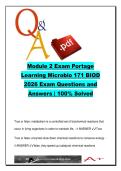
Module 2 Exam Portage
Learning Microbio 171 BIOD
2026 Exam Questions and
Answers | 100% Solved


True or false: metabolism is a controlled set of biochemical reactions that

occur in living organisms in order to maintain life. - 🧠 ANSWER ✔✔True


True or false: enzymes slow down chemical reactions to conserve energy -

🧠 ANSWER ✔✔false, they speed up (catalyze) chemical reactions

, The term for metal ions that assist enzymes during the catalysis reaction - 🧠

ANSWER ✔✔cofactors


What is catabolism? - 🧠 ANSWER ✔✔The process of breaking down larger

molecules into useful energy sources

Upon cellular injury, which metabolic process is involved during the growth

and repair phases of the cell. - 🧠 ANSWER ✔✔anabolism


An organism that obtains its energy (derives ATP) from photons of light is

called a __________________ - 🧠 ANSWER ✔✔phototrophic

microorganism

An organism that derives its energy by removing electrons from elemental

sulfur would be classified as a ____________ - 🧠 ANSWER ✔✔Lithotroph


Describe the energy transfer process relative to both ADP and ATP - 🧠

ANSWER ✔✔ATP has the energy (phosphate group) to donate, and ADP

can accept energy in the form of a phosphate group. Thus, ATP can be

dephosphorylated (ATP-----> ADP + Pi), while ADP can be

dephosphorylated into ATP (ADP + Pi -----> ATP)

Escuela, estudio y materia

Institución
Grado

Información del documento

Subido en
7 de marzo de 2026
Número de páginas
6
Escrito en
2025/2026
Tipo
Examen
Contiene
Preguntas y respuestas

Temas

$15.99
Accede al documento completo:

¿Documento equivocado? Cámbialo gratis Dentro de los 14 días posteriores a la compra y antes de descargarlo, puedes elegir otro documento. Puedes gastar el importe de nuevo.
Escrito por estudiantes que aprobaron
Inmediatamente disponible después del pago
Leer en línea o como PDF


Documento también disponible en un lote

Conoce al vendedor

Seller avatar
Los indicadores de reputación están sujetos a la cantidad de artículos vendidos por una tarifa y las reseñas que ha recibido por esos documentos. Hay tres niveles: Bronce, Plata y Oro. Cuanto mayor reputación, más podrás confiar en la calidad del trabajo del vendedor.
NinjaNerd Liberty University
Seguir Necesitas iniciar sesión para seguir a otros usuarios o asignaturas
Vendido
376
Miembro desde
2 año
Número de seguidores
6
Documentos
14742
Última venta
19 horas hace
NinjaNerd

Here You will All Documents and Package Deals Offered by Seller NinjaNerd.

3.5

74 reseñas

5
26
4
14
3
16
2
4
1
14

Por qué los estudiantes eligen Stuvia

Creado por compañeros estudiantes, verificado por reseñas

Calidad en la que puedes confiar: escrito por estudiantes que aprobaron y evaluado por otros que han usado estos resúmenes.

¿No estás satisfecho? Elige otro documento

¡No te preocupes! Puedes elegir directamente otro documento que se ajuste mejor a lo que buscas.

Paga como quieras, empieza a estudiar al instante

Sin suscripción, sin compromisos. Paga como estés acostumbrado con tarjeta de crédito y descarga tu documento PDF inmediatamente.

Student with book image

“Comprado, descargado y aprobado. Así de fácil puede ser.”

Alisha Student

Preguntas frecuentes