

Escrito por estudiantes que aprobaron Inmediatamente disponible después del pago Leer en línea o como PDF ¿Documento equivocado? Cámbialo gratis 4,6 TrustPilot
logo-home
Document preview thumbnail
Vista previa 4 fuera de 81 páginas
Examen

NBRC CRT/RRT Full Review Exam Questions (700+) – Ventilation, ABG Analysis, Airway Management | RESP 310 Respiratory Therapy | NBRC Certification

Document preview thumbnail
Vista previa 4 fuera de 81 páginas

This document contains 700+ comprehensive exam-style questions and answers designed for students preparing for the NBRC CRT (Certified Respiratory Therapist) and RRT (Registered Respiratory Therapist) certification examinations. The material functions as an extensive review covering respiratory therapy clinical concepts, patient assessment, diagnostic testing, airway management, mechanical ventilation, cardiopulmonary monitoring, and pharmacologic therapy used in respiratory care. The questions are organized in a structured question-and-answer format that reinforces essential exam knowledge while helping students prepare for respiratory therapy program tests and national board examinations. The study guide begins with clinical patient assessment and respiratory examination techniques, including interpretation of physical findings such as capillary refill, venous distention, abnormal breathing patterns, percussion findings, and auscultation results. Early sections explain conditions such as Cheyne-Stokes breathing, Biot’s respirations, Kussmaul breathing, and apneustic breathing, along with their associations with neurological injury, metabolic disorders, or increased intracranial pressure. These concepts form the foundation of respiratory patient assessment and are frequently tested on NBRC board examinations (pages 1–3). A large portion of the document focuses on airway management and respiratory support procedures, including oropharyngeal and nasopharyngeal airway insertion, laryngoscopy techniques, endotracheal tube placement verification, cuff pressure management, tracheostomy care, and extubation procedures. For example, the guide explains that endotracheal tube positioning should be approximately 2 cm above the carina at the level of the aortic arch, and that cuff pressures should typically remain around 20 mmHg (≈25 cmH₂O) to prevent mucosal ischemia (pages 9 and 24–25). The document also reviews diagnostic imaging and cardiopulmonary monitoring techniques used in respiratory care. Students study the interpretation and clinical uses of CT scans, MRI, V/Q scans, pulmonary angiography, bronchoscopy, echocardiography, EEG monitoring, and sputum diagnostic testing. The guide explains how these tests help diagnose conditions such as pulmonary embolism, bronchiectasis, pneumonia, tumors, and pulmonary vascular disease, emphasizing when each diagnostic method is most appropriate (pages 11–13). Another major section covers arterial blood gas (ABG) analysis and cardiopulmonary physiology, including oxygen-hemoglobin dissociation curve shifts, A-a gradient interpretation, PaO₂/FiO₂ ratio interpretation for ALI and ARDS, and the effects of sample handling errors on ABG results. The material also reviews laboratory equipment such as the Clark electrode (PaO₂), Severinghaus electrode (PaCO₂), and Sanz electrode (pH) used in blood gas analyzers (pages 50–52). Extensive coverage is given to mechanical ventilation strategies and ventilator management, including assist-control ventilation, SIMV, pressure control ventilation, and high-frequency ventilation techniques. The study guide also reviews ventilator settings for specific conditions such as ARDS, asthma, and neonatal respiratory distress, along with ventilator troubleshooting, weaning criteria, and ventilator alarm management. Concepts such as PEEP optimization, tidal volume adjustment, dead space ventilation, and permissive hypercapnia are emphasized because they are critical topics in respiratory therapy certification exams (pages 57–63). The document further explores respiratory pharmacology and emergency medications, including bronchodilators, corticosteroids, mucolytics, vasopressors, sedatives, analgesics, and neuromuscular blocking agents used in critical care. Drugs such as epinephrine, atropine, lidocaine, amiodarone, dopamine, and acetylcysteine (Mucomyst) are discussed in relation to their clinical uses in respiratory therapy and cardiopulmonary resuscitation protocols (pages 39–42). Additional sections address pulmonary function testing (PFT), aerosol therapy, airway clearance techniques, suctioning procedures, oxygen delivery systems, CPAP/BiPAP titration protocols, and cardiopulmonary resuscitation guidelines. The study guide explains how spirometry values such as FEV₁, FVC, FEF25-75%, and peak expiratory flow rate help differentiate obstructive and restrictive lung diseases, and how therapists interpret flow-volume loops during pulmonary diagnostics (pages 53–55). This study material may be relevant for courses such as: Respiratory Therapy Clinical Practice Cardiopulmonary Physiology and Diagnostics Mechanical Ventilation and Critical Care Respiratory Pharmacology Pulmonary Function Testing Students enrolled in the following programs may benefit from this document: Respiratory Therapy (CRT / RRT Programs) Cardiopulmonary Science Programs Allied Health Respiratory Care Programs Critical Care and Pulmonary Medicine Training Advanced Respiratory Therapy Certification Preparation Example course codes commonly associated with this subject include: RESP 310 – Advanced Respiratory Therapy RESP 220 – Mechanical Ventilation RESP 240 – Pulmonary Diagnostics RESP 260 – Respiratory Pharmacology RESP 320 – Critical Care Respiratory Therapy The material closely aligns with the curriculum presented in leading respiratory therapy textbooks such as Egan’s Fundamentals of Respiratory Care and Respiratory Care: Principles and Practice by Dean Hess. These textbooks provide the foundational knowledge for respiratory physiology, ventilator management, airway procedures, pulmonary diagnostics, and pharmacologic treatments that are reflected in the exam questions included in this study guide. Overall, this document functions as a comprehensive NBRC certification preparation resource and full respiratory therapy exam review guide, helping students reinforce key clinical concepts and improve readiness for CRT and RRT board examinations. Keywords NBRC CRT exam questions, NBRC RRT exam review, respiratory therapy certification study guide, ABG interpretation respiratory therapy, mechanical ventilation management study material, ventilator settings ARDS asthma neonatal, airway management endotracheal intubation review, respiratory pharmacology bronchodilators mucolytics, pulmonary function test interpretation FEV1 FVC, oxygen hemoglobin dissociation curve shifts, respiratory therapy suctioning procedures, CPAP BIPAP titration protocols, pulmonary embolism diagnostic tests VQ scan CT angiography, respiratory therapy board exam preparation, cardiopulmonary monitoring respiratory care, ventilator weaning criteria RSBI NIF, respiratory therapy clinical assessment techniques, aerosol therapy nebulizer MDI study guide

Vista previa del contenido

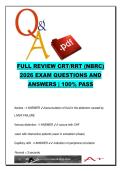
FULL REVIEW CRT/RRT (NBRC)
2026 EXAM QUESTIONS AND
ANSWERS | 100% PASS


Ascites - 🧠 ANSWER ✔✔accumulation of fluid in the abdomen caused by

LIVER FAILURE


Venous distention - 🧠 ANSWER ✔✔-occurs with CHF


-seen with obstructive patients (seen in exhalation phase)


Capillary refill - 🧠 ANSWER ✔✔-indication of peripheral circulation


-Normal < 3 seconds

,Jaundice skin color - 🧠 ANSWER ✔✔-increase in bilirubin.


-mostly in face and trunk


Bradypnea (oligopnea) - 🧠 ANSWER ✔✔-decreased respiratory rate

(<12bpm) variable depth and irregular rhythm


Hyperpnea - 🧠 ANSWER ✔✔-increased rate, depth, with regular rhythm


Cheyne-Stokes - 🧠 ANSWER ✔✔-gradually increasing then decreasing rate

and depth in a cycle lasting from 30 - 180 secs, with apnea up to 60 secs


-increased ICP, meningitis, overdose


Biots - 🧠 ANSWER ✔✔-increased rate and depth with irregular periods of

apnea


-CNS problem, head/brain injury


Kussmaul's - 🧠 ANSWER ✔✔-increased rate, depth, irregular rhythm,

breathing sounds labored

-Raspy voice

,Apneustic - 🧠 ANSWER ✔✔prolonged gasping inspiration followed by

extremely short, insufficient expiration


-respiratory center problems, trauma, tumor


cachectic - 🧠 ANSWER ✔✔muscle atrophy/loss of muscle tone


retractions - 🧠 ANSWER ✔✔-chest moves inward during inspiratory efforts

instead of outward

-blocked airway in adults = INTUBATE

-RDS in infants


Character of cough - 🧠 ANSWER ✔✔-dry, non-productive cough may

indicate tumor in the lungs or asthma

-productive cough may indicate infection


evidence of difficult airway - 🧠 ANSWER ✔✔-short receding mandible (chin)


-enlarged tongue (macroglossia)

-bull neck

-limited neck range-of-motion


COPYRIGHT©NINJANERD 2025/2026. YEAR PUBLISHED 2026. COMPANY REGISTRATION NUMBER: 619652435. TERMS OF USE. PRIVACY
STATEMENT. ALL RIGHTS RESERVED
3

, pulsus paradoxus - 🧠 ANSWER ✔✔-pulse/blood pressure varies with

respiration. may indicate severe air trapping (status asthmaticus or cardiac

tamponade)


tactile fremitus - 🧠 ANSWER ✔✔-vibrations felt by hand on chest wall


-vocal fremitus: voice vibrations on the chest wall

-pleural rub fremitus: grating sensation due to roughened pleural spaces

-Rhonchial fremitus(palpable rhonchi): secretions in airways


Crepitus - 🧠 ANSWER ✔✔-bubbles of air under skin that can be palpated

and indicates subcutaneous emphysema


Resonant percussion - 🧠 ANSWER ✔✔-hollow sound


-normal lungs


Flat percussion - 🧠 ANSWER ✔✔-heard over sternum, muscles, or areas of

atelectasis


Dull percussion - 🧠 ANSWER ✔✔-heard over fluid-filled organs such as

heart or liver (thudding)

-pleural effusion or pneumonia

Información del documento

Subido en
7 de marzo de 2026
Número de páginas
81
Escrito en
2025/2026
Tipo
Examen
Contiene
Preguntas y respuestas
$15.99

¿Documento equivocado? Cámbialo gratis Dentro de los 14 días posteriores a la compra y antes de descargarlo, puedes elegir otro documento. Puedes gastar el importe de nuevo.
Escrito por estudiantes que aprobaron
Inmediatamente disponible después del pago
Leer en línea o como PDF

Seller avatar
Los indicadores de reputación están sujetos a la cantidad de artículos vendidos por una tarifa y las reseñas que ha recibido por esos documentos. Hay tres niveles: Bronce, Plata y Oro. Cuanto mayor reputación, más podrás confiar en la calidad del trabajo del vendedor.
NinjaNerd
3.5
(75)
Vendido
391
Seguidores
6
Artículos
15109
Última venta
3 días hace


Por qué los estudiantes eligen Stuvia

Creado por compañeros estudiantes, verificado por reseñas

Calidad en la que puedes confiar: escrito por estudiantes que aprobaron y evaluado por otros que han usado estos resúmenes.

¿No estás satisfecho? Elige otro documento

¡No te preocupes! Puedes elegir directamente otro documento que se ajuste mejor a lo que buscas.

Paga como quieras, empieza a estudiar al instante

Sin suscripción, sin compromisos. Paga como estés acostumbrado con tarjeta de crédito y descarga tu documento PDF inmediatamente.

Student with book image

“Comprado, descargado y aprobado. Así de fácil puede ser.”

Alisha Student

Preguntas frecuentes
