PROBLEM 2. INCLUSION 1
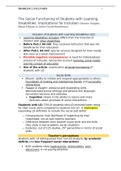
The Social Functioning of Students with Learning
Disabilities: Implications for Inclusion (Sharon Vaughn,
Batya Elbaum & Alison Gould Boardman)
Inclusion of students with Learning Disabilities (LD)
Learning disabilities inclusion differs from the inclusion of
children with other disabilities
Before Pub.L 94-142: they received instruction that was not
beneficial for their education
After Pub.L 94-142: special services designed for their needs,
was seen as a great improvement
Possible negative consequences need for individualized
process of inclusion, taking into account learning, social needs
and the context of education
Aim of the article: examination of social functioning of
students with LD.
Social Skills
Elksnin: ability to initiate and respond appropriately to others.
Foundation of making and maintaining friends and successful
interactions.
Haager & Vaughn: prosocial and responding skills
demonstrated across settings and persons like language,
nonverbal reactions and attitudes.
Cognition shown in the ability to reason and make
decisions about give/take of social interactions.
Students with LD: 75% of students with LD received lower rating
for their social skills compared to students w/o LD. Implication:
expanding LD definition to include the social skill deficit
→ Consequences: high likelihood of neglecting by their
classmates, not as well liked by teachers
→ Difference between their teacher-social skills and the skills
they show in non-academic social situations
→ Evidence: out of 125 studies, 25th percentiles in terms of social
skills
Teacher’s perceptions
Students with LD distinguished from non-LD students by academic
deficits and less frequent social interactions
8/10 students show hyperactivity, distractibility, poor
adjustment not paying attention
, PROBLEM 2. INCLUSION 2
They did not see behavior problems other than hyperactivity
and distractibility as contributors to the social skill difficulties
The Social Functioning of Students with Learning
Disabilities: Implications for Inclusion (Sharon Vaughn,
Batya Elbaum & Alison Gould Boardman)
Inclusion of students with Learning Disabilities (LD)
Learning disabilities inclusion differs from the inclusion of
children with other disabilities
Before Pub.L 94-142: they received instruction that was not
beneficial for their education
After Pub.L 94-142: special services designed for their needs,
was seen as a great improvement
Possible negative consequences need for individualized
process of inclusion, taking into account learning, social needs
and the context of education
Aim of the article: examination of social functioning of
students with LD.
Social Skills
Elksnin: ability to initiate and respond appropriately to others.
Foundation of making and maintaining friends and successful
interactions.
Haager & Vaughn: prosocial and responding skills
demonstrated across settings and persons like language,
nonverbal reactions and attitudes.
Cognition shown in the ability to reason and make
decisions about give/take of social interactions.
Students with LD: 75% of students with LD received lower rating
for their social skills compared to students w/o LD. Implication:
expanding LD definition to include the social skill deficit
→ Consequences: high likelihood of neglecting by their
classmates, not as well liked by teachers
→ Difference between their teacher-social skills and the skills
they show in non-academic social situations
→ Evidence: out of 125 studies, 25th percentiles in terms of social
skills
Teacher’s perceptions
Students with LD distinguished from non-LD students by academic
deficits and less frequent social interactions
8/10 students show hyperactivity, distractibility, poor
adjustment not paying attention
, PROBLEM 2. INCLUSION 2
They did not see behavior problems other than hyperactivity
and distractibility as contributors to the social skill difficulties