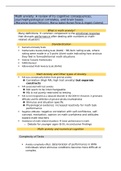
Math anxiety: A review of its cognitive consequences,
psychophysiological correlates, and brain bases
(Macarena Suarez Pellicioni, Marνa Isabel Nunez Pena & Angels Colome)
What is math anxiety?
Many definitions common component is the emotional response
that disrupts performance after dealing with numbers or math-
related situations
Standardization
Numerical Anxiety Scale
Mathematics Anxiety Rating Scale (MARS) : 98-item rating scale, where
rating were made in a 5-point Likert scale indicating how anxious
they feel in formal/informal math situations
Anxiety Towards Mathematics
MARS-Revised
Abbreviated Math Anxiety Scale (AMAS)
Math Anxiety and Other types of Anxiety
MA was conceptually distinct from general anxiety
Correlation (High MA, high trait anxiety) but separate
constructs
MA associated with test anxiety
Not seem to be interchangeable
MA is not purely restricted to testing
MA is not recognized as a separate disorder in the DSM-IV; However, it generates
difficulty and fits definition of genuine phobia (mathephobia)
Stimulus and situation specific
Physiological evidence: increased reactivity for math task
performance
Negative attitudes: negative correlation with self-confidence, self-
concept, motivation, opinion on math usefulness and attitudes
toward math teachers.
Avoidance of math related situations lower performance in math
o Debate for younger ages (6-9), inconclusive findings
Math anxiety and numerical cognition
Complexity of Tasks
Anxiety complexity effect: deterioration of performance in HMA
individuals when stimulus conditions become more difficult or
complex.
, Speed accuracy trade off: HMA show high error rates and higher
speed
Global avoidance effect less trained in math, failure of self-
terminating the process e.g. same time to solve a false carry
problem in complex additions
Local avoidance effect desire to complete the task as soon as
possible to leave the situation e.g. speed-accuracy trade off
Split effect
HMA showed larger flawed scores as the level of split increased
o Difference in decision or evaluation stage of
performance in HMAs
o HMAs spend more attentional resources and more time
when processing large-split tasks.
Explanations of Math anxiety
MA as task-related competition for WM resources
Processing efficiency theory (PET): worrying intrusive thoughts
consume limited attentional resources of the WM’s central
executive which are therefore less available for processing.
o HMAs have temporarily lower WM capacity in processing
poor performance in any task relying mainly on WM
(MA is a dual task procedure)
MA as a deficit in low-level numerical representation
Complex math deficits due to low-level numerical processing skills.
Maloney: two patterns of performance
1. Subitizing: HMA showed no difference
2. Counting: HMA performed significantly worse than LMA
o Against complexity-anxiety effect happens with
enumerating tasks(simple)
Maloney: numerical distance during two comparison tasks to show the
magnitude of the representations
o Larger effect of distance on RTs for HMA than for LMA
o Against WM role less precise representation of
numerical magnitude might contribute to MA
Psychophysiological evidence: P2 component with a larger amplitude
(sensitive to numbers’ distance) for HMAs.
Math anxiety as an inhibition/attentional-control deficit
A failure to inhibit attention to worrying thoughts reduction in WM resources.
psychophysiological correlates, and brain bases
(Macarena Suarez Pellicioni, Marνa Isabel Nunez Pena & Angels Colome)
What is math anxiety?
Many definitions common component is the emotional response
that disrupts performance after dealing with numbers or math-
related situations
Standardization
Numerical Anxiety Scale
Mathematics Anxiety Rating Scale (MARS) : 98-item rating scale, where
rating were made in a 5-point Likert scale indicating how anxious
they feel in formal/informal math situations
Anxiety Towards Mathematics
MARS-Revised
Abbreviated Math Anxiety Scale (AMAS)
Math Anxiety and Other types of Anxiety
MA was conceptually distinct from general anxiety
Correlation (High MA, high trait anxiety) but separate
constructs
MA associated with test anxiety
Not seem to be interchangeable
MA is not purely restricted to testing
MA is not recognized as a separate disorder in the DSM-IV; However, it generates
difficulty and fits definition of genuine phobia (mathephobia)
Stimulus and situation specific
Physiological evidence: increased reactivity for math task
performance
Negative attitudes: negative correlation with self-confidence, self-
concept, motivation, opinion on math usefulness and attitudes
toward math teachers.
Avoidance of math related situations lower performance in math
o Debate for younger ages (6-9), inconclusive findings
Math anxiety and numerical cognition
Complexity of Tasks
Anxiety complexity effect: deterioration of performance in HMA
individuals when stimulus conditions become more difficult or
complex.
, Speed accuracy trade off: HMA show high error rates and higher
speed
Global avoidance effect less trained in math, failure of self-
terminating the process e.g. same time to solve a false carry
problem in complex additions
Local avoidance effect desire to complete the task as soon as
possible to leave the situation e.g. speed-accuracy trade off
Split effect
HMA showed larger flawed scores as the level of split increased
o Difference in decision or evaluation stage of
performance in HMAs
o HMAs spend more attentional resources and more time
when processing large-split tasks.
Explanations of Math anxiety
MA as task-related competition for WM resources
Processing efficiency theory (PET): worrying intrusive thoughts
consume limited attentional resources of the WM’s central
executive which are therefore less available for processing.
o HMAs have temporarily lower WM capacity in processing
poor performance in any task relying mainly on WM
(MA is a dual task procedure)
MA as a deficit in low-level numerical representation
Complex math deficits due to low-level numerical processing skills.
Maloney: two patterns of performance
1. Subitizing: HMA showed no difference
2. Counting: HMA performed significantly worse than LMA
o Against complexity-anxiety effect happens with
enumerating tasks(simple)
Maloney: numerical distance during two comparison tasks to show the
magnitude of the representations
o Larger effect of distance on RTs for HMA than for LMA
o Against WM role less precise representation of
numerical magnitude might contribute to MA
Psychophysiological evidence: P2 component with a larger amplitude
(sensitive to numbers’ distance) for HMAs.
Math anxiety as an inhibition/attentional-control deficit
A failure to inhibit attention to worrying thoughts reduction in WM resources.