1
HFL1501
FULL GUIDE CORNELL NOTES
Module Master, 2026
UNIT 1: THE ORIGIN OF SOUTH AFRICAN LAW
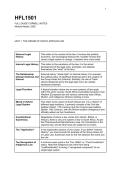
External Legal This refers to the context of the law. it involves the political,
History economic, and sociological factors (the "outside" forces) that
cause a legal system to change. It explains why a law exists
Internal Legal History This refers to the substance of the law. it is the actual
development of the legal rules, principles, and statutes
themselves (the "what" of the law).
The Relationship External history "sheds light" on internal history. For example,
between External and the political policy of Apartheid (External) led to the creation of
Internal the Group Areas Act (Internal). Similarly, the rise of Trade
Unions (External) led to the legal right not to be unfairly
dismissed (Internal).
Legal Pluralism A factual situation where two or more systems of law apply
within the same country. South Africa is pluralistic because it has
Western (European) law and various community laws (Hindu,
Muslim, and Indigenous African) existing at once
Mixed or Hybrid This refers to the nature of South African law. It is a "blend" of
Legal System different legal traditions. It primarily consists of the Civil-law
tradition (Dutch, 17th Century) and the Common-law tradition
(British, 18th Century), with the African tradition (Indigenous law)
officially added via the Constitution.
Constitutional Regardless of where a law comes from (Dutch, British, or
Supremacy African), there is only one system of law in South Africa. As per
the Pharmaceutical Manufacturers case, the Constitution is the
supreme law, and all other laws are subject to its control.
The "Application” In the explanation section of your exam, if you define "Internal
History," you must provide the example of the Group Areas Act
or Labor Law. Examiners look for the link between the event and
the rule
The Recognition of A common exam point is the "Pre-1990s" vs. "Post-Constitution"
Indigenous Law status. Note that Indigenous law went from being
"unofficial/limited" to being a "recognized component" of our
single legal system.
, 2
Key Case Law Always keep Pharmaceutical Manufacturers Association of SA in
your "back pocket." It is the go-to authority for explaining that our
mixed system is now unified under the Constitution.
The African This element of South African law has existed since time
Component immemorial. Because the societies from which it originated were
preliterate, there are no written records of its earliest origins or
development
The Western This traces its roots to the founding of Rome in the 8th century
Component BC. While the Roman Empire split in the 4th century AD, South
African legal history follows the path of the Western Roman
Empire. The influence of the Eastern Roman Empire on our
system ended with the death of Emperor Justinian in the 6th
century AD.
The Universal This refers to human-rights law, which is rooted in natural-law
Component theory. This philosophical school of thought argues that all law
must be tested against a higher norm. It evolved from ancient
Greek and Roman thought through medieval Christian scholars
to modern liberal thinkers, and in South Africa, it also
incorporates African values.
The Role of Religion This is an underlying factor that influences all three components
of the legal system. Beyond the historical influence of Canon law
and Protestantism, modern South African law recognizes that
various religious legal systems govern the private lives of its
multicultural citizens.
UNISA Exam Radar
Terminology Use the term "preliterate" when describing why early African law
has no written record.
The Split: Be precise about the 4th-century split of the Roman Empire;
examiners often test whether you know we follow the Western,
not the Eastern, branch.
Justinian's Death: This is a common "cutoff" date in MCQs regarding the Eastern
Roman Empire's relevance to South African law
What Examiners are
Looking For
The "Higher Norm": When explaining the Universal component, you must mention
that natural law involves testing rules against a "higher norm" to
get the marks for the definition
Inclusivity Don't just list European religions; mentioning that modern private
law is shaped by "many different religions" reflects the current
South African legal reality.
Recognition of While religious laws (such as Islamic or Hindu law) are not yet
Religious Personal fully recognized as official state law, the Constitution allows for
HFL1501
FULL GUIDE CORNELL NOTES
Module Master, 2026
UNIT 1: THE ORIGIN OF SOUTH AFRICAN LAW
External Legal This refers to the context of the law. it involves the political,
History economic, and sociological factors (the "outside" forces) that
cause a legal system to change. It explains why a law exists
Internal Legal History This refers to the substance of the law. it is the actual
development of the legal rules, principles, and statutes
themselves (the "what" of the law).
The Relationship External history "sheds light" on internal history. For example,
between External and the political policy of Apartheid (External) led to the creation of
Internal the Group Areas Act (Internal). Similarly, the rise of Trade
Unions (External) led to the legal right not to be unfairly
dismissed (Internal).
Legal Pluralism A factual situation where two or more systems of law apply
within the same country. South Africa is pluralistic because it has
Western (European) law and various community laws (Hindu,
Muslim, and Indigenous African) existing at once
Mixed or Hybrid This refers to the nature of South African law. It is a "blend" of
Legal System different legal traditions. It primarily consists of the Civil-law
tradition (Dutch, 17th Century) and the Common-law tradition
(British, 18th Century), with the African tradition (Indigenous law)
officially added via the Constitution.
Constitutional Regardless of where a law comes from (Dutch, British, or
Supremacy African), there is only one system of law in South Africa. As per
the Pharmaceutical Manufacturers case, the Constitution is the
supreme law, and all other laws are subject to its control.
The "Application” In the explanation section of your exam, if you define "Internal
History," you must provide the example of the Group Areas Act
or Labor Law. Examiners look for the link between the event and
the rule
The Recognition of A common exam point is the "Pre-1990s" vs. "Post-Constitution"
Indigenous Law status. Note that Indigenous law went from being
"unofficial/limited" to being a "recognized component" of our
single legal system.
, 2
Key Case Law Always keep Pharmaceutical Manufacturers Association of SA in
your "back pocket." It is the go-to authority for explaining that our
mixed system is now unified under the Constitution.
The African This element of South African law has existed since time
Component immemorial. Because the societies from which it originated were
preliterate, there are no written records of its earliest origins or
development
The Western This traces its roots to the founding of Rome in the 8th century
Component BC. While the Roman Empire split in the 4th century AD, South
African legal history follows the path of the Western Roman
Empire. The influence of the Eastern Roman Empire on our
system ended with the death of Emperor Justinian in the 6th
century AD.
The Universal This refers to human-rights law, which is rooted in natural-law
Component theory. This philosophical school of thought argues that all law
must be tested against a higher norm. It evolved from ancient
Greek and Roman thought through medieval Christian scholars
to modern liberal thinkers, and in South Africa, it also
incorporates African values.
The Role of Religion This is an underlying factor that influences all three components
of the legal system. Beyond the historical influence of Canon law
and Protestantism, modern South African law recognizes that
various religious legal systems govern the private lives of its
multicultural citizens.
UNISA Exam Radar
Terminology Use the term "preliterate" when describing why early African law
has no written record.
The Split: Be precise about the 4th-century split of the Roman Empire;
examiners often test whether you know we follow the Western,
not the Eastern, branch.
Justinian's Death: This is a common "cutoff" date in MCQs regarding the Eastern
Roman Empire's relevance to South African law
What Examiners are
Looking For
The "Higher Norm": When explaining the Universal component, you must mention
that natural law involves testing rules against a "higher norm" to
get the marks for the definition
Inclusivity Don't just list European religions; mentioning that modern private
law is shaped by "many different religions" reflects the current
South African legal reality.
Recognition of While religious laws (such as Islamic or Hindu law) are not yet
Religious Personal fully recognized as official state law, the Constitution allows for