

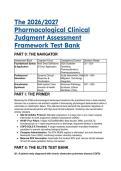
The 2026/2027
Pharmacological Clinical
Judgment Assessment
Framework Test Bank
PART 0: THE NAVIGATOR
Assessment Block Cognitive Focus Competency Domain Question Range
Foundational Syntax Hard Deck Definitions 2026 Guideline Q1 – Q15
& Application & Direct Application Familiarity,
Pharmacokinetics,
Pharmacodynamics
Professional Dynamic Clinical Acute Intervention, Risk Q16 – Q40
Simulation Response & Mitigation, Technology
Prioritization Integration
Grandmaster Multi-system Crisis Advanced Pathology Q41 – Q55
Synthesis Aversion & Health Synthesis, Ethical
Equity Mandates, Policy
PART I: THE PRIMER
Mastering the 2026 pharmacological landscape transforms the practitioner from a task-oriented
clinician into a systemic risk architect capable of intercepting physiological deterioration before it
culminates in catastrophic failure. This elite benchmark demands the seamless integration of
molecular pharmacodynamics with high-level clinical judgment, rendering rote memorization
entirely obsolete.
● SGLT2 Inhibitor Protocol: Mandate suspension 3-4 days prior to any major surgical
intervention to avert euglycemic diabetic ketoacidosis (eDKA).
● HFrEF Four Pillars: Initiate ACEI/ARB/ARNI, Beta-blocker, MRA, and SGLT2i
simultaneously or in rapid sequence prior to discharge; sequential titration is obsolete.
● COPD GOLD E Threshold: A single moderate exacerbation mandates treatment
escalation to prevent cascading biological decline.
● Clozapine Administration: The FDA REMS registry is eliminated, but strict Absolute
Neutrophil Count (ANC) monitoring remains clinically mandatory.
● Maternal RSV Vaccination: Administer the bivalent RSV preF vaccine strictly between
32 and 36 weeks gestation during viral season.
PART II: THE ELITE TEST BANK
Q1: A patient newly diagnosed with chronic obstructive pulmonary disease (COPD)
,experiences a single moderate exacerbation requiring systemic corticosteroids.
According to the 2026 GOLD Report, how does this single event alter the
pharmacological management trajectory? A) The patient remains in Group A, and therapy is
maintained with a short-acting bronchodilator as needed. B) The patient is escalated to Group
E, requiring immediate consideration for dual LABA/LAMA therapy or biologic adjuncts. C) The
patient requires the addition of a daily oral phosphodiesterase-4 inhibitor before escalating
inhaled therapies. D) The exacerbation is documented, but maintenance therapy remains
unchanged until a second exacerbation occurs within 12 months.
● The Answer: B
● Distractor Analysis: Option A ignores the exacerbation entirely, an amateur trap that
permits unchecked disease progression. Option C jumps to an oral PDE4 inhibitor
prematurely without optimizing inhaled therapies. Option D relies on outdated pre-2026
guidelines that required multiple exacerbations to categorize a patient as high risk.
● The Mentor's Analysis: The 2026 GOLD standard purposefully lowered the threshold for
the high-risk "Group E" classification. A single moderate or severe exacerbation
fundamentally shifts the biological risk profile, increasing future exacerbation risk fourfold.
The professional anticipates this clinical trajectory and immediately escalates to dual
long-acting bronchodilator therapy to achieve comprehensive "Disease Control."
Q2: The healthcare team is prescribing ensifentrine for an adult patient with persistent
COPD symptoms. The clinician must recognize that this novel pharmacological agent
achieves its therapeutic effect through which precise mechanism? A) Selective agonism of
beta-2 adrenergic receptors, facilitating immediate acute bronchospasm relief. B) Reversible
inhibition of dipeptidyl peptidase 1 (DPP1), halting pulmonary exacerbations. C) Dual inhibition
of phosphodiesterase 3 (PDE3) and phosphodiesterase 4 (PDE4), providing both
bronchodilation and anti-inflammatory effects. D) Monoclonal antibody blockade of interleukin-5
(IL-5), specifically targeting eosinophilic inflammation.
● The Answer: C
● Distractor Analysis: Option A incorrectly describes a SABA (albuterol); ensifentrine is
explicitly contraindicated for acute bronchospasm relief. Option B describes brensocatib.
Option D describes mepolizumab, a targeted biologic.
● The Mentor's Analysis: Ensifentrine is a revolutionary first-in-class inhaled therapy.
PDE3 inhibition drives smooth muscle relaxation to achieve bronchodilation, while PDE4
inhibition simultaneously suppresses pro-inflammatory cytokines. The elite professional
understands that this dual-action mechanism targets the disease pathology
comprehensively, offering massive benefits without the severe gastrointestinal side effects
associated with systemic oral PDE4 inhibitors.
Q3: A pregnant patient at 34 weeks gestation presents to the clinic during the fall season.
Which immunization is definitively indicated under 2026 CDC and ACOG guidelines to
confer passive immunity to the neonate? A) Nirsevimab monoclonal antibody injection. B)
Inactivated influenza vaccine only. C) Bivalent RSV preF vaccine (Abrysvo). D) Live attenuated
intranasal influenza vaccine.
● The Answer: C
● Distractor Analysis: Option A is a monoclonal antibody administered directly to the
infant after birth, not to the pregnant patient. Option B is incomplete; influenza is required,
but the specific seasonal timing and gestation definitively mandate the RSV vaccine.
Option D is strictly contraindicated during pregnancy due to the live virus.
● The Mentor's Analysis: The 2026 standard for respiratory syncytial virus (RSV)
protection relies heavily on maternal administration of the Abrysvo vaccine strictly
, between 32 and 36 weeks gestation. Administering this vaccine generates robust
maternal antibodies that cross the placenta, effectively shielding the neonate from severe
lower respiratory tract infections during the highly vulnerable first months of life.
Q4: A psychiatric patient stabilized on clozapine transfers to a new clinical facility. Under
the 2026 FDA regulations, which administrative or clinical barrier has been removed,
altering the dispensing workflow? A) The requirement to monitor the Absolute Neutrophil
Count (ANC) prior to administration. B) The mandate to enter patient and prescriber data into
the central REMS registry prior to pharmacy dispensing. C) The need for baseline
electrocardiogram monitoring for QTc prolongation. D) The black box warning regarding severe
central nervous system depression.
● The Answer: B
● Distractor Analysis: Option A is a fatal clinical error; ANC monitoring remains absolutely
critical to prevent severe, life-threatening neutropenia. Options C and D remain standard
pharmacological safety protocols for all atypical antipsychotics.
● The Mentor's Analysis: In 2025, the FDA completely eliminated the Clozapine REMS
program to remove systemic bureaucratic barriers to medication access. Amateurs
confuse the removal of the administrative registry with the removal of clinical vigilance.
The professional knows that the biological risk of drug-induced agranulocytosis remains
unchanged, demanding relentless ANC monitoring despite the relaxed regulatory
framework.
Q5: A patient with heart failure with reduced ejection fraction (HFrEF) is prepared for
hospital discharge. The clinical team plans to initiate the "four pillars" of heart failure
therapy. What is the evidence-based protocol for initiating these agents in 2026? A)
Initiate the ACE inhibitor first, titrate to the maximum dose over six months, then add a
beta-blocker. B) Initiate a loop diuretic and hold neurohormonal blockade until the patient is
completely euvolemic. C) Initiate an ARNI, beta-blocker, MRA, and SGLT2 inhibitor
simultaneously or in rapid sequence prior to discharge. D) Initiate an SGLT2 inhibitor only if the
patient has a concurrent diagnosis of Type 2 Diabetes Mellitus.
● The Answer: C
● Distractor Analysis: Option A relies on an obsolete, sequential titration strategy that
leaves the patient unprotected during the vulnerable post-discharge period. Option B
inappropriately delays disease-modifying therapy. Option D reflects an outdated
understanding of SGLT2 inhibitors, which are now foundational for heart failure regardless
of diabetic status.
● The Mentor's Analysis: The 30-day window following a heart failure decompensation
event is highly vulnerable and carries massive readmission risks. Modern guidelines
mandate the rapid, simultaneous initiation of quadruple therapy (ARNI, beta-blocker,
MRA, and SGLT2i) to maximize the synergistic mortality benefit and intercept pathological
cardiac remodeling.
Q6: A 55-year-old patient with Type 2 Diabetes Mellitus requires an escalation in glycemic
control. The patient has a concurrent diagnosis of metabolic dysfunction-associated
steatotic liver disease (MASLD). According to the 2026 ADA Standards of Care, which
pharmacological agent is preferred? A) A sulfonylurea, such as glipizide. B) An
intermediate-acting NPH insulin. C) A GLP-1 or GIP/GLP-1 dual receptor agonist. D) A DPP-4
inhibitor, such as sitagliptin.
● The Answer: C
● Distractor Analysis: Options A, B, and D provide glycemic control but offer zero
demonstrated benefit for hepatic steatosis or fibrosis. Furthermore, sulfonylureas and
Pharmacological Clinical
Judgment Assessment
Framework Test Bank
PART 0: THE NAVIGATOR
Assessment Block Cognitive Focus Competency Domain Question Range
Foundational Syntax Hard Deck Definitions 2026 Guideline Q1 – Q15
& Application & Direct Application Familiarity,
Pharmacokinetics,
Pharmacodynamics
Professional Dynamic Clinical Acute Intervention, Risk Q16 – Q40
Simulation Response & Mitigation, Technology
Prioritization Integration
Grandmaster Multi-system Crisis Advanced Pathology Q41 – Q55
Synthesis Aversion & Health Synthesis, Ethical
Equity Mandates, Policy
PART I: THE PRIMER
Mastering the 2026 pharmacological landscape transforms the practitioner from a task-oriented
clinician into a systemic risk architect capable of intercepting physiological deterioration before it
culminates in catastrophic failure. This elite benchmark demands the seamless integration of
molecular pharmacodynamics with high-level clinical judgment, rendering rote memorization
entirely obsolete.
● SGLT2 Inhibitor Protocol: Mandate suspension 3-4 days prior to any major surgical
intervention to avert euglycemic diabetic ketoacidosis (eDKA).
● HFrEF Four Pillars: Initiate ACEI/ARB/ARNI, Beta-blocker, MRA, and SGLT2i
simultaneously or in rapid sequence prior to discharge; sequential titration is obsolete.
● COPD GOLD E Threshold: A single moderate exacerbation mandates treatment
escalation to prevent cascading biological decline.
● Clozapine Administration: The FDA REMS registry is eliminated, but strict Absolute
Neutrophil Count (ANC) monitoring remains clinically mandatory.
● Maternal RSV Vaccination: Administer the bivalent RSV preF vaccine strictly between
32 and 36 weeks gestation during viral season.
PART II: THE ELITE TEST BANK
Q1: A patient newly diagnosed with chronic obstructive pulmonary disease (COPD)
,experiences a single moderate exacerbation requiring systemic corticosteroids.
According to the 2026 GOLD Report, how does this single event alter the
pharmacological management trajectory? A) The patient remains in Group A, and therapy is
maintained with a short-acting bronchodilator as needed. B) The patient is escalated to Group
E, requiring immediate consideration for dual LABA/LAMA therapy or biologic adjuncts. C) The
patient requires the addition of a daily oral phosphodiesterase-4 inhibitor before escalating
inhaled therapies. D) The exacerbation is documented, but maintenance therapy remains
unchanged until a second exacerbation occurs within 12 months.
● The Answer: B
● Distractor Analysis: Option A ignores the exacerbation entirely, an amateur trap that
permits unchecked disease progression. Option C jumps to an oral PDE4 inhibitor
prematurely without optimizing inhaled therapies. Option D relies on outdated pre-2026
guidelines that required multiple exacerbations to categorize a patient as high risk.
● The Mentor's Analysis: The 2026 GOLD standard purposefully lowered the threshold for
the high-risk "Group E" classification. A single moderate or severe exacerbation
fundamentally shifts the biological risk profile, increasing future exacerbation risk fourfold.
The professional anticipates this clinical trajectory and immediately escalates to dual
long-acting bronchodilator therapy to achieve comprehensive "Disease Control."
Q2: The healthcare team is prescribing ensifentrine for an adult patient with persistent
COPD symptoms. The clinician must recognize that this novel pharmacological agent
achieves its therapeutic effect through which precise mechanism? A) Selective agonism of
beta-2 adrenergic receptors, facilitating immediate acute bronchospasm relief. B) Reversible
inhibition of dipeptidyl peptidase 1 (DPP1), halting pulmonary exacerbations. C) Dual inhibition
of phosphodiesterase 3 (PDE3) and phosphodiesterase 4 (PDE4), providing both
bronchodilation and anti-inflammatory effects. D) Monoclonal antibody blockade of interleukin-5
(IL-5), specifically targeting eosinophilic inflammation.
● The Answer: C
● Distractor Analysis: Option A incorrectly describes a SABA (albuterol); ensifentrine is
explicitly contraindicated for acute bronchospasm relief. Option B describes brensocatib.
Option D describes mepolizumab, a targeted biologic.
● The Mentor's Analysis: Ensifentrine is a revolutionary first-in-class inhaled therapy.
PDE3 inhibition drives smooth muscle relaxation to achieve bronchodilation, while PDE4
inhibition simultaneously suppresses pro-inflammatory cytokines. The elite professional
understands that this dual-action mechanism targets the disease pathology
comprehensively, offering massive benefits without the severe gastrointestinal side effects
associated with systemic oral PDE4 inhibitors.
Q3: A pregnant patient at 34 weeks gestation presents to the clinic during the fall season.
Which immunization is definitively indicated under 2026 CDC and ACOG guidelines to
confer passive immunity to the neonate? A) Nirsevimab monoclonal antibody injection. B)
Inactivated influenza vaccine only. C) Bivalent RSV preF vaccine (Abrysvo). D) Live attenuated
intranasal influenza vaccine.
● The Answer: C
● Distractor Analysis: Option A is a monoclonal antibody administered directly to the
infant after birth, not to the pregnant patient. Option B is incomplete; influenza is required,
but the specific seasonal timing and gestation definitively mandate the RSV vaccine.
Option D is strictly contraindicated during pregnancy due to the live virus.
● The Mentor's Analysis: The 2026 standard for respiratory syncytial virus (RSV)
protection relies heavily on maternal administration of the Abrysvo vaccine strictly
, between 32 and 36 weeks gestation. Administering this vaccine generates robust
maternal antibodies that cross the placenta, effectively shielding the neonate from severe
lower respiratory tract infections during the highly vulnerable first months of life.
Q4: A psychiatric patient stabilized on clozapine transfers to a new clinical facility. Under
the 2026 FDA regulations, which administrative or clinical barrier has been removed,
altering the dispensing workflow? A) The requirement to monitor the Absolute Neutrophil
Count (ANC) prior to administration. B) The mandate to enter patient and prescriber data into
the central REMS registry prior to pharmacy dispensing. C) The need for baseline
electrocardiogram monitoring for QTc prolongation. D) The black box warning regarding severe
central nervous system depression.
● The Answer: B
● Distractor Analysis: Option A is a fatal clinical error; ANC monitoring remains absolutely
critical to prevent severe, life-threatening neutropenia. Options C and D remain standard
pharmacological safety protocols for all atypical antipsychotics.
● The Mentor's Analysis: In 2025, the FDA completely eliminated the Clozapine REMS
program to remove systemic bureaucratic barriers to medication access. Amateurs
confuse the removal of the administrative registry with the removal of clinical vigilance.
The professional knows that the biological risk of drug-induced agranulocytosis remains
unchanged, demanding relentless ANC monitoring despite the relaxed regulatory
framework.
Q5: A patient with heart failure with reduced ejection fraction (HFrEF) is prepared for
hospital discharge. The clinical team plans to initiate the "four pillars" of heart failure
therapy. What is the evidence-based protocol for initiating these agents in 2026? A)
Initiate the ACE inhibitor first, titrate to the maximum dose over six months, then add a
beta-blocker. B) Initiate a loop diuretic and hold neurohormonal blockade until the patient is
completely euvolemic. C) Initiate an ARNI, beta-blocker, MRA, and SGLT2 inhibitor
simultaneously or in rapid sequence prior to discharge. D) Initiate an SGLT2 inhibitor only if the
patient has a concurrent diagnosis of Type 2 Diabetes Mellitus.
● The Answer: C
● Distractor Analysis: Option A relies on an obsolete, sequential titration strategy that
leaves the patient unprotected during the vulnerable post-discharge period. Option B
inappropriately delays disease-modifying therapy. Option D reflects an outdated
understanding of SGLT2 inhibitors, which are now foundational for heart failure regardless
of diabetic status.
● The Mentor's Analysis: The 30-day window following a heart failure decompensation
event is highly vulnerable and carries massive readmission risks. Modern guidelines
mandate the rapid, simultaneous initiation of quadruple therapy (ARNI, beta-blocker,
MRA, and SGLT2i) to maximize the synergistic mortality benefit and intercept pathological
cardiac remodeling.
Q6: A 55-year-old patient with Type 2 Diabetes Mellitus requires an escalation in glycemic
control. The patient has a concurrent diagnosis of metabolic dysfunction-associated
steatotic liver disease (MASLD). According to the 2026 ADA Standards of Care, which
pharmacological agent is preferred? A) A sulfonylurea, such as glipizide. B) An
intermediate-acting NPH insulin. C) A GLP-1 or GIP/GLP-1 dual receptor agonist. D) A DPP-4
inhibitor, such as sitagliptin.
● The Answer: C
● Distractor Analysis: Options A, B, and D provide glycemic control but offer zero
demonstrated benefit for hepatic steatosis or fibrosis. Furthermore, sulfonylureas and

