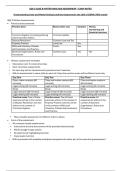
SQE 2 CASE & MATTER ANALYSIS ASSESSMENT – EXAM NOTES
Understanding Case and Matter Analysis and the Assessment: the skill of C&MA; IRAC model
SQE 2 Written Assessments
• Practice areas assessed
Practice Area Black Letter Law Taxation Money
laundering and
financial services
Criminal Litigation (including advising Criminal Liability
clients at police station
Dispute Resolution Contract Law and Tort
Property Practice Land Law Yes
Wills and Intestacy, Probate Trusts Yes
Administration and Practice
Business Organisation, Rules and Contract Law Yes Yes
Procedures
• Written assessment timetable
o Takes place over 3 consecutive days
o Total 12 written assessments
o On each day will sit 4 assessments spread across 2 sessions
o Will sit assessments in same skills on each of 3 days but practice areas will be different each day
Day One Day Two Day Three
Case matter analysis (60 Case and matter analysis (60 Case and matter analysis
minutes) minutes) (60 minutes)
Legal writing (30 minutes) Legal writing (30 minutes) Legal writing (30 minutes)
Break Break Break
Legal research (60 minutes) Legal research (60 minutes) Legal research (60 minutes)
Legal drafting (45 minutes) Legal drafting (45 minutes) Legal drafting (45 minutes)
Practice areas: Two of these Practice areas: Two of these Practice areas: All
exercises will be in the context exercises will be in the context of assessments will be in the
of Dispute Resolution and two Property Practice and two will be context of Business
will be in the context of in the context of Wills and Organisation, Rules and
Criminal Litigation Intestacy, Probate Administration Procedures
and Practice
▪ May complete assessment in different order to above
• Form of the assessment
o All computer based assessments
▪ Instructions and any documents will be provided electronically
▪ Will be a page to type answer
▪ No spell check/ highlighting function
▪ Copy/ paste function
o Will be provided with erasable whiteboard notepad and marker pen to be used during assessment
, • Assessment objective
o Sets out in one sentence what candidate can demonstrate in each assessment
SQE2 written assessment Assessment Objective
Candidates can demonstrate that they are able to …
Case & Matter Analysis Produce a written report to a partner giving a legal analysis of the case and
client focused advice
Legal Research Conduct legal research from a variety of resources provided and produce a
written report
Legal Writing Produce a letter or email as the solicitor acting in a matter
Legal Drafting Draft a legal document or parts of a legal document for a client
Written Communication Skills
• Spelling, punctuation and grammar
o No spell check function in assessment
o Candidates wont be penalised for minor spelling mistakes
▪ Shouldn’t lose marks for spelling mistakes that would normally be flagged by spell check and which
don’t impact on the legal accuracy, clarity &/ certainty of the written text
o candidates shouldn’t lose marks for grammatical errors that don’t impact on the legal accuracy, clarity &/
certainty of the written text and don’t make the written test inaccessible to the intended reader
• Commonly misspelt words
o E.g. Stationery/ stationary
▪ stationEry = noun → paper pencils etc
▪ stationAry = adjective → not moving
• Grammar
o Firms usually write to each other in first person plural e.g. ‘we have the following comments…’
o Shall/ will
▪ Mean different things when combined with 1st, 2nd and 3rd person
▪ First person
• Shall → implies choice i.e. something going to be voluntarily
• Will → suggests obligation i.e. something must do
▪ Second/ third person → other way round
• Shall → implies obligation
• Will → describes what is going to be done in the future
• Vocabulary
o Assessment criteria emphasises using clear, succinct and accurate language and avoiding technical
terms where these aren’t appropriate to the recipient
o When considering whether to use technical language, should consider your audience
▪ Opponents in litigation will know meaning of e.g. Part 36 offer but lay client wont
o avoid using acronyms which might be unfamiliar/ have several different meanings unless meaning is
obvious from context
▪ e.g. CPR = Civil Procedure Rules, Canadian Pacific Railway, cardiopulmonary resuscitation etc
o if using legal/ technical terms is unavoidable, consider providing plain English translation
o avoid tautology/ saying same things twice using different words e.g. unfilled vacancy, true facts etc
o avoid excessive use of adjectives which don’t make meaning more precise e.g. grave and fatal error
o use active voice and not passive voice where possible
▪ problems with the passive
• over-use of passive voice lengthens a sentence and can make it sound weak
• can obscure meaning
Understanding Case and Matter Analysis and the Assessment: the skill of C&MA; IRAC model
SQE 2 Written Assessments
• Practice areas assessed
Practice Area Black Letter Law Taxation Money
laundering and
financial services
Criminal Litigation (including advising Criminal Liability
clients at police station
Dispute Resolution Contract Law and Tort
Property Practice Land Law Yes
Wills and Intestacy, Probate Trusts Yes
Administration and Practice
Business Organisation, Rules and Contract Law Yes Yes
Procedures
• Written assessment timetable
o Takes place over 3 consecutive days
o Total 12 written assessments
o On each day will sit 4 assessments spread across 2 sessions
o Will sit assessments in same skills on each of 3 days but practice areas will be different each day
Day One Day Two Day Three
Case matter analysis (60 Case and matter analysis (60 Case and matter analysis
minutes) minutes) (60 minutes)
Legal writing (30 minutes) Legal writing (30 minutes) Legal writing (30 minutes)
Break Break Break
Legal research (60 minutes) Legal research (60 minutes) Legal research (60 minutes)
Legal drafting (45 minutes) Legal drafting (45 minutes) Legal drafting (45 minutes)
Practice areas: Two of these Practice areas: Two of these Practice areas: All
exercises will be in the context exercises will be in the context of assessments will be in the
of Dispute Resolution and two Property Practice and two will be context of Business
will be in the context of in the context of Wills and Organisation, Rules and
Criminal Litigation Intestacy, Probate Administration Procedures
and Practice
▪ May complete assessment in different order to above
• Form of the assessment
o All computer based assessments
▪ Instructions and any documents will be provided electronically
▪ Will be a page to type answer
▪ No spell check/ highlighting function
▪ Copy/ paste function
o Will be provided with erasable whiteboard notepad and marker pen to be used during assessment
, • Assessment objective
o Sets out in one sentence what candidate can demonstrate in each assessment
SQE2 written assessment Assessment Objective
Candidates can demonstrate that they are able to …
Case & Matter Analysis Produce a written report to a partner giving a legal analysis of the case and
client focused advice
Legal Research Conduct legal research from a variety of resources provided and produce a
written report
Legal Writing Produce a letter or email as the solicitor acting in a matter
Legal Drafting Draft a legal document or parts of a legal document for a client
Written Communication Skills
• Spelling, punctuation and grammar
o No spell check function in assessment
o Candidates wont be penalised for minor spelling mistakes
▪ Shouldn’t lose marks for spelling mistakes that would normally be flagged by spell check and which
don’t impact on the legal accuracy, clarity &/ certainty of the written text
o candidates shouldn’t lose marks for grammatical errors that don’t impact on the legal accuracy, clarity &/
certainty of the written text and don’t make the written test inaccessible to the intended reader
• Commonly misspelt words
o E.g. Stationery/ stationary
▪ stationEry = noun → paper pencils etc
▪ stationAry = adjective → not moving
• Grammar
o Firms usually write to each other in first person plural e.g. ‘we have the following comments…’
o Shall/ will
▪ Mean different things when combined with 1st, 2nd and 3rd person
▪ First person
• Shall → implies choice i.e. something going to be voluntarily
• Will → suggests obligation i.e. something must do
▪ Second/ third person → other way round
• Shall → implies obligation
• Will → describes what is going to be done in the future
• Vocabulary
o Assessment criteria emphasises using clear, succinct and accurate language and avoiding technical
terms where these aren’t appropriate to the recipient
o When considering whether to use technical language, should consider your audience
▪ Opponents in litigation will know meaning of e.g. Part 36 offer but lay client wont
o avoid using acronyms which might be unfamiliar/ have several different meanings unless meaning is
obvious from context
▪ e.g. CPR = Civil Procedure Rules, Canadian Pacific Railway, cardiopulmonary resuscitation etc
o if using legal/ technical terms is unavoidable, consider providing plain English translation
o avoid tautology/ saying same things twice using different words e.g. unfilled vacancy, true facts etc
o avoid excessive use of adjectives which don’t make meaning more precise e.g. grave and fatal error
o use active voice and not passive voice where possible
▪ problems with the passive
• over-use of passive voice lengthens a sentence and can make it sound weak
• can obscure meaning