

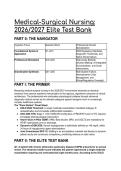
Medical-Surgical Nursing:
2026/2027 Elite Test Bank
PART 0: THE NAVIGATOR
Cognitive Focus Question Block Professional Domain
Specialization
Foundational Syntax & Q1–Q15 2026 Regulatory Mandates,
Application Diagnostic Thresholds, and
Native Nomenclature.
Professional Simulation Q16–Q40 High-Acuity Bedside
Decision-Making, AI-Integrated
Documentation, and Acute
Interventions.
Grandmaster Synthesis Q41–Q55 Multi-System Failure,
Hemodynamic Crisis
Management, and
Ethical/Regulatory Oversight.
PART I: THE PRIMER
Mastering medical-surgical nursing in the 2026/2027 environment demands an absolute
transition from passive academic memorization to the rigorous, algorithmic execution of clinical
architecture. The professional who anticipates physiological collapse through advanced
diagnostic intuition serves as the ultimate safeguard against iatrogenic harm in increasingly
complex healthcare systems.
The "Panic Button" Cheat Sheet:
● GOLD 2026 Threshold: A single moderate exacerbation mandates Category E
reclassification and immediate LABA/LAMA escalation.
● AHA 2026 HTN: Stage 1 (130-139/80-89 mmHg) plus a PREVENT score ≥7.5% requires
immediate pharmacological intervention.
● Heart Failure 4-Pillar GDMT: ARNi, Beta-blocker, MRA, and SGLT2i are mandatory for
HFrEF optimization prior to discharge.
● Glycemic eCQM 2026: Severe hypoglycemia is definitively defined as <40 mg/dL within
24 hours of hypoglycemic agent administration.
● Joint Commission NPG 12: Staffing is an accreditation mandate tied directly to dynamic
patient acuity and continuous competency, prohibiting reliance on static ratios.
PART II: THE ELITE TEST BANK
Q1: A patient with chronic obstructive pulmonary disease (COPD) presents for an annual
review. The electronic health record indicates the patient experienced a single moderate
exacerbation requiring oral corticosteroids eight months prior. According to the GOLD
,2026 updates, what is the required clinical classification and initial pharmacological
escalation? A) Maintain current short-acting beta-agonist (SABA) therapy; classify as GOLD A.
B) Classify as GOLD B and initiate a long-acting muscarinic antagonist (LAMA) monotherapy. C)
Classify as GOLD E and initiate LABA + LAMA combination therapy. D) Classify as GOLD E
and immediately initiate LABA + LAMA + ICS therapy regardless of absolute blood counts.
● The Answer: C (Classify as GOLD E and initiate LABA + LAMA combination therapy).
● Distractor Analysis: Option A relies on obsolete pre-2026 data where multiple
exacerbations were required for high-risk classification. Option B ignores the exacerbation
history entirely. Option D is a dangerous algorithmic trap; inhaled corticosteroids (ICS) are
only added to GOLD E regimens if the patient's blood eosinophil count is ≥300 cells/µL.
● The Mentor's Analysis: The 2026 GOLD report fundamentally alters the risk threshold
for chronic obstructive pulmonary disease. Observational data confirms that even one
moderate exacerbation increases the risk of future events fourfold. Therefore, a single
moderate exacerbation immediately places the patient in the high-risk GOLD E category,
demanding dual bronchodilation (LABA + LAMA) to reduce disease activity, maximize
bronchodilation, and avert rapid functional decline.
Q2: An adult patient presents to the primary care clinic with an average blood pressure of
134/86 mmHg. The patient has no history of cardiovascular disease, diabetes, or chronic
kidney disease. The 2026 PREVENT risk calculator indicates a 10-year cardiovascular
risk of 8.2%. According to the AHA 2025/2026 guidelines, what is the definitive
medical-surgical intervention? A) Prescribe a low-sodium DASH diet and reassess in 12
months. B) Initiate immediate pharmacological antihypertensive therapy to target <130/80
mmHg. C) Withhold medication until the systolic pressure consistently exceeds 140 mmHg. D)
Order a 24-hour ambulatory blood pressure monitor before considering lifestyle changes.
● The Answer: B (Initiate immediate pharmacological antihypertensive therapy to target
<130/80 mmHg).
● Distractor Analysis: Option A utilizes passive management that violates current
standards for high-risk patients. Option C relies on outdated thresholds that allow for
dangerous vascular remodeling. Option D delays necessary intervention in a patient
already meeting the strict threshold for treatment based on office readings.
● The Mentor's Analysis: The AHA 2026 guidelines redefine the action parameters for
Stage 1 hypertension (130-139/80-89 mmHg). If the PREVENT score is ≥7.5%, the
patient is at elevated risk for cardiovascular events, and relying solely on a 3-to-6-month
lifestyle modification trial is no longer the standard of care. Immediate pharmacological
intervention is mandated to prevent target organ damage, mitigate long-term ischemic
risks, and avert microvascular destruction.
Q3: A patient is being discharged following an acute exacerbation of Heart Failure with
reduced Ejection Fraction (HFrEF). To comply with the AHA/ACC 4-Pillar
Guideline-Directed Medical Therapy (GDMT) mandates for 2026, which precise
combination of pharmacological classes must be prescribed or optimized? A) ACE
inhibitor, Loop Diuretic, Calcium Channel Blocker, and Digoxin. B) ARNi, Beta-blocker, MRA,
and SGLT2i. C) ARB, Thiazide Diuretic, Beta-blocker, and Amiodarone. D) Nitrates,
Hydralazine, Loop Diuretic, and ARNi.
● The Answer: B (ARNi, Beta-blocker, MRA, and SGLT2i).
● Distractor Analysis: Option A utilizes outdated, symptom-management-only drugs
(digoxin) and contraindicated agents (calcium channel blockers can worsen HFrEF
contractility). Option C relies on antiarrhythmics without indication. Option D is an adjunct
therapy for specific demographics (African American populations with persistent
, symptoms), not the foundational core approach.
● The Mentor's Analysis: The architecture of HFrEF management relies on
disease-modifying agents that actively halt and reverse pathological ventricular
remodeling. The 4-pillar GDMT protocol—comprising an Angiotensin Receptor-Neprilysin
Inhibitor (ARNi), Beta-blocker, Mineralocorticoid Receptor Antagonist (MRA), and
Sodium-Glucose Cotransporter-2 inhibitor (SGLT2i)—is a Class 1a recommendation.
SGLT2 inhibitors are mandated regardless of the presence of Type 2 Diabetes due to their
profound mortality reduction capabilities and osmotic diuresis benefits.
Q4: Under the 2026 Centers for Medicare & Medicaid Services (CMS) TEAM Model, a
hospital is preparing to discharge a patient following a Coronary Artery Bypass Graft
(CABG). What is the mandated duration of financial and clinical accountability the
hospital retains for this specific surgical episode? A) 72 hours post-discharge. B) 14 days
encompassing the acute rehabilitation phase. C) 30 days covering the entire post-acute care
continuum. D) 90 days encompassing primary care follow-up and cardiac rehab.
● The Answer: C (30 days covering the entire post-acute care continuum).
● Distractor Analysis: Options A and B represent standard immediate postoperative
tracking but fail to capture the rigorous regulatory mandate. Option D overextends the
mandated timeframe, which specifically targets the highest-risk post-acute transition
period to control Medicare spending.
● The Mentor's Analysis: The CMS Transforming Episode Accountability Model (TEAM)
shifts the reimbursement paradigm from fee-for-service to value-based care. The hospital
is financially penalized for readmissions, complications, or excessive post-acute spending
for a full 30 days post-surgery across five major procedural categories. Nursing discharge
planning must therefore integrate flawlessly with skilled nursing facilities and home health
to protect both the physiological stability of the patient and the institution's operating
margin.
Q5: A patient with acute ischemic stroke arrives at the emergency department 3 hours
after the last known well time. According to the 2026 stroke management standards, what
is the primary pharmacological advantage of utilizing tenecteplase over alteplase for
intravenous thrombolysis? A) Tenecteplase completely prevents subsequent hemorrhagic
transformation. B) Tenecteplase is administered as a single 5-second intravenous bolus and has
a higher specific affinity for fibrin. C) Tenecteplase requires a 60-minute continuous infusion,
allowing for rapid, controlled titration based on neurological checks. D) Tenecteplase acts as a
direct oral anticoagulant that bypasses the need for large-bore intravenous access.
● The Answer: B (Tenecteplase is administered as a single 5-second intravenous bolus
and has a higher specific affinity for fibrin).
● Distractor Analysis: Option A is false; no thrombolytic eliminates intracranial bleeding
risk. Option C describes the cumbersome administration protocol for alteplase, not
tenecteplase. Option D describes maintenance drugs like apixaban, which are not acute
thrombolytics.
● The Mentor's Analysis: Tenecteplase has become the gold standard over alteplase due
to its superior pharmacokinetic profile. Alteplase requires a 10% bolus followed by a
1-hour infusion, tying up critical nursing resources and delaying patient transfer to the
angiography suite. Tenecteplase is delivered as a rapid 5-second IV push, has an
extended half-life, and boasts greater resistance to plasminogen activator inhibitor-1,
leading to faster recanalization rates and improved functional outcomes.
Q6: To comply with the 2026 electronic Clinical Quality Measures (eCQMs), a hospital
must accurately track "hospital harm" regarding inpatient glycemic control. What
2026/2027 Elite Test Bank
PART 0: THE NAVIGATOR
Cognitive Focus Question Block Professional Domain
Specialization
Foundational Syntax & Q1–Q15 2026 Regulatory Mandates,
Application Diagnostic Thresholds, and
Native Nomenclature.
Professional Simulation Q16–Q40 High-Acuity Bedside
Decision-Making, AI-Integrated
Documentation, and Acute
Interventions.
Grandmaster Synthesis Q41–Q55 Multi-System Failure,
Hemodynamic Crisis
Management, and
Ethical/Regulatory Oversight.
PART I: THE PRIMER
Mastering medical-surgical nursing in the 2026/2027 environment demands an absolute
transition from passive academic memorization to the rigorous, algorithmic execution of clinical
architecture. The professional who anticipates physiological collapse through advanced
diagnostic intuition serves as the ultimate safeguard against iatrogenic harm in increasingly
complex healthcare systems.
The "Panic Button" Cheat Sheet:
● GOLD 2026 Threshold: A single moderate exacerbation mandates Category E
reclassification and immediate LABA/LAMA escalation.
● AHA 2026 HTN: Stage 1 (130-139/80-89 mmHg) plus a PREVENT score ≥7.5% requires
immediate pharmacological intervention.
● Heart Failure 4-Pillar GDMT: ARNi, Beta-blocker, MRA, and SGLT2i are mandatory for
HFrEF optimization prior to discharge.
● Glycemic eCQM 2026: Severe hypoglycemia is definitively defined as <40 mg/dL within
24 hours of hypoglycemic agent administration.
● Joint Commission NPG 12: Staffing is an accreditation mandate tied directly to dynamic
patient acuity and continuous competency, prohibiting reliance on static ratios.
PART II: THE ELITE TEST BANK
Q1: A patient with chronic obstructive pulmonary disease (COPD) presents for an annual
review. The electronic health record indicates the patient experienced a single moderate
exacerbation requiring oral corticosteroids eight months prior. According to the GOLD
,2026 updates, what is the required clinical classification and initial pharmacological
escalation? A) Maintain current short-acting beta-agonist (SABA) therapy; classify as GOLD A.
B) Classify as GOLD B and initiate a long-acting muscarinic antagonist (LAMA) monotherapy. C)
Classify as GOLD E and initiate LABA + LAMA combination therapy. D) Classify as GOLD E
and immediately initiate LABA + LAMA + ICS therapy regardless of absolute blood counts.
● The Answer: C (Classify as GOLD E and initiate LABA + LAMA combination therapy).
● Distractor Analysis: Option A relies on obsolete pre-2026 data where multiple
exacerbations were required for high-risk classification. Option B ignores the exacerbation
history entirely. Option D is a dangerous algorithmic trap; inhaled corticosteroids (ICS) are
only added to GOLD E regimens if the patient's blood eosinophil count is ≥300 cells/µL.
● The Mentor's Analysis: The 2026 GOLD report fundamentally alters the risk threshold
for chronic obstructive pulmonary disease. Observational data confirms that even one
moderate exacerbation increases the risk of future events fourfold. Therefore, a single
moderate exacerbation immediately places the patient in the high-risk GOLD E category,
demanding dual bronchodilation (LABA + LAMA) to reduce disease activity, maximize
bronchodilation, and avert rapid functional decline.
Q2: An adult patient presents to the primary care clinic with an average blood pressure of
134/86 mmHg. The patient has no history of cardiovascular disease, diabetes, or chronic
kidney disease. The 2026 PREVENT risk calculator indicates a 10-year cardiovascular
risk of 8.2%. According to the AHA 2025/2026 guidelines, what is the definitive
medical-surgical intervention? A) Prescribe a low-sodium DASH diet and reassess in 12
months. B) Initiate immediate pharmacological antihypertensive therapy to target <130/80
mmHg. C) Withhold medication until the systolic pressure consistently exceeds 140 mmHg. D)
Order a 24-hour ambulatory blood pressure monitor before considering lifestyle changes.
● The Answer: B (Initiate immediate pharmacological antihypertensive therapy to target
<130/80 mmHg).
● Distractor Analysis: Option A utilizes passive management that violates current
standards for high-risk patients. Option C relies on outdated thresholds that allow for
dangerous vascular remodeling. Option D delays necessary intervention in a patient
already meeting the strict threshold for treatment based on office readings.
● The Mentor's Analysis: The AHA 2026 guidelines redefine the action parameters for
Stage 1 hypertension (130-139/80-89 mmHg). If the PREVENT score is ≥7.5%, the
patient is at elevated risk for cardiovascular events, and relying solely on a 3-to-6-month
lifestyle modification trial is no longer the standard of care. Immediate pharmacological
intervention is mandated to prevent target organ damage, mitigate long-term ischemic
risks, and avert microvascular destruction.
Q3: A patient is being discharged following an acute exacerbation of Heart Failure with
reduced Ejection Fraction (HFrEF). To comply with the AHA/ACC 4-Pillar
Guideline-Directed Medical Therapy (GDMT) mandates for 2026, which precise
combination of pharmacological classes must be prescribed or optimized? A) ACE
inhibitor, Loop Diuretic, Calcium Channel Blocker, and Digoxin. B) ARNi, Beta-blocker, MRA,
and SGLT2i. C) ARB, Thiazide Diuretic, Beta-blocker, and Amiodarone. D) Nitrates,
Hydralazine, Loop Diuretic, and ARNi.
● The Answer: B (ARNi, Beta-blocker, MRA, and SGLT2i).
● Distractor Analysis: Option A utilizes outdated, symptom-management-only drugs
(digoxin) and contraindicated agents (calcium channel blockers can worsen HFrEF
contractility). Option C relies on antiarrhythmics without indication. Option D is an adjunct
therapy for specific demographics (African American populations with persistent
, symptoms), not the foundational core approach.
● The Mentor's Analysis: The architecture of HFrEF management relies on
disease-modifying agents that actively halt and reverse pathological ventricular
remodeling. The 4-pillar GDMT protocol—comprising an Angiotensin Receptor-Neprilysin
Inhibitor (ARNi), Beta-blocker, Mineralocorticoid Receptor Antagonist (MRA), and
Sodium-Glucose Cotransporter-2 inhibitor (SGLT2i)—is a Class 1a recommendation.
SGLT2 inhibitors are mandated regardless of the presence of Type 2 Diabetes due to their
profound mortality reduction capabilities and osmotic diuresis benefits.
Q4: Under the 2026 Centers for Medicare & Medicaid Services (CMS) TEAM Model, a
hospital is preparing to discharge a patient following a Coronary Artery Bypass Graft
(CABG). What is the mandated duration of financial and clinical accountability the
hospital retains for this specific surgical episode? A) 72 hours post-discharge. B) 14 days
encompassing the acute rehabilitation phase. C) 30 days covering the entire post-acute care
continuum. D) 90 days encompassing primary care follow-up and cardiac rehab.
● The Answer: C (30 days covering the entire post-acute care continuum).
● Distractor Analysis: Options A and B represent standard immediate postoperative
tracking but fail to capture the rigorous regulatory mandate. Option D overextends the
mandated timeframe, which specifically targets the highest-risk post-acute transition
period to control Medicare spending.
● The Mentor's Analysis: The CMS Transforming Episode Accountability Model (TEAM)
shifts the reimbursement paradigm from fee-for-service to value-based care. The hospital
is financially penalized for readmissions, complications, or excessive post-acute spending
for a full 30 days post-surgery across five major procedural categories. Nursing discharge
planning must therefore integrate flawlessly with skilled nursing facilities and home health
to protect both the physiological stability of the patient and the institution's operating
margin.
Q5: A patient with acute ischemic stroke arrives at the emergency department 3 hours
after the last known well time. According to the 2026 stroke management standards, what
is the primary pharmacological advantage of utilizing tenecteplase over alteplase for
intravenous thrombolysis? A) Tenecteplase completely prevents subsequent hemorrhagic
transformation. B) Tenecteplase is administered as a single 5-second intravenous bolus and has
a higher specific affinity for fibrin. C) Tenecteplase requires a 60-minute continuous infusion,
allowing for rapid, controlled titration based on neurological checks. D) Tenecteplase acts as a
direct oral anticoagulant that bypasses the need for large-bore intravenous access.
● The Answer: B (Tenecteplase is administered as a single 5-second intravenous bolus
and has a higher specific affinity for fibrin).
● Distractor Analysis: Option A is false; no thrombolytic eliminates intracranial bleeding
risk. Option C describes the cumbersome administration protocol for alteplase, not
tenecteplase. Option D describes maintenance drugs like apixaban, which are not acute
thrombolytics.
● The Mentor's Analysis: Tenecteplase has become the gold standard over alteplase due
to its superior pharmacokinetic profile. Alteplase requires a 10% bolus followed by a
1-hour infusion, tying up critical nursing resources and delaying patient transfer to the
angiography suite. Tenecteplase is delivered as a rapid 5-second IV push, has an
extended half-life, and boasts greater resistance to plasminogen activator inhibitor-1,
leading to faster recanalization rates and improved functional outcomes.
Q6: To comply with the 2026 electronic Clinical Quality Measures (eCQMs), a hospital
must accurately track "hospital harm" regarding inpatient glycemic control. What

