

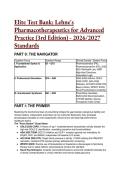
Elite Test Bank: Lehne's
Pharmacotherapeutics for Advanced
Practice (3rd Edition) - 2026/2027
Standards
PART 0: THE NAVIGATOR
Cognitive Focus Question Range Clinical Domain / System Focus
I. Foundational Syntax & Q1 – Q15 Pharmacokinetics (PK),
Application Pharmacodynamics (PD), 2026
DEA Telehealth Law, ISMP
High-Alert Directives,
Calculation Logic
II. Professional Simulation Q16 – Q40 GINA 2026 Asthma, GOLD
2026 COPD, ADA 2026
Diabetes, ACC/AHA 2026 HTN,
Beers Criteria, WPATH SOC8,
Novel Psychotropics (Cobenfy)
III. Grandmaster Synthesis Q41 – Q55 Prescribing Cascades,
Multimorbid Decompensation,
CYP450 Warfare, Narrow
Therapeutic Index Crises
PART I: THE PRIMER
Mastering the biochemical laws of prescribing bridges the gap between dangerous liability and
clinical mastery. Independent prescribers do not memorize flashcards; they anticipate
physiological cascades to avert catastrophic clinical errors and lead high-performance
healthcare teams.
The "Panic Button" Cheat Sheet:
● GOLD 2026 COPD: A history of \ge 1 moderate/severe exacerbation strictly dictates the
high-risk GOLD E classification, mandating proactive dual bronchodilation.
● ADA 2026 T2DM: SGLT2 inhibitors and GLP-1 receptor agonists are mandatory for
HFpEF, CKD, and MASH, independent of baseline A1C levels.
● ACC/AHA 2026 HTN: Target blood pressure is strictly <130/80 utilizing the PREVENT
calculator; resistant HTN requires primary aldosteronism screening.
● WPATH SOC8: Routine use of bicalutamide or finasteride is discouraged in feminizing
therapy due to safety deficits; spironolactone remains the standard.
● Novel Psychotropics: Cobenfy (xanomeline/trospium) averts D2 metabolic blockade but
is strictly contraindicated in urinary retention and narrow-angle glaucoma.
,PART II: THE ELITE TEST BANK
I. Foundational Syntax & Application
Q1: A patient is prescribed sublingual nitroglycerin for acute angina. The patient
swallows the tablet whole with water. Why does the chest pain persist unabated? A) The
acidic pH of the stomach completely denatures the nitrate compound. B) The drug is subjected
to the hepatic first-pass effect, destroying the active ingredient before it reaches systemic
circulation. C) Sublingual tissues lack the necessary local enzymes to activate the prodrug
formulation. D) Gastric motility accelerates in response to nitrates, preventing intestinal
absorption.
● The Answer: B (The drug is subjected to the hepatic first-pass effect)
● Distractor Analysis: Option A incorrectly blames gastric acid rather than enzymatic
destruction. Options C and D represent physiological nonsense. Amateurs often conflate
gastric degradation with hepatic metabolism.
● The Mentor's Analysis: Sublingual administration absorbs the chemical directly through
the highly vascular oral mucosa into the superior vena cava, bypassing the liver entirely.
Swallowing the tablet routes the drug through the portal vein into the liver, rendering the
entire dose pharmacologically useless due to massive first-pass enzymatic destruction.
Q2: A patient receives a loading dose of intravenous phenytoin. The nurse administers
the infusion at a rapid rate of 100 mg/minute. The patient experiences lethal cardiac
arrhythmias and cardiovascular collapse. What is the mechanical cause of this
administration error? A) Phenytoin directly antagonizes calcium channels in the myocardium,
causing heart block. B) The propylene glycol diluent acts as a profound myocardial depressant
when pushed rapidly into the venous system. C) Phenytoin induces a massive, systemic
histamine release resembling anaphylaxis. D) The drug rapidly depletes intracellular potassium,
inducing Torsades de Pointes.
● The Answer: B (The propylene glycol diluent acts as a profound myocardial depressant)
● Distractor Analysis: Phenytoin is a sodium channel blocker, not a calcium channel
antagonist (Option A). Options C and D describe mechanisms associated with other
agents, such as vancomycin or high-dose insulin.
● The Mentor's Analysis: Phenytoin relies on propylene glycol to remain dissolved in
solution. Pushing this diluent rapidly acts as a profound myocardial depressant and
vasodilator. The absolute professional hard deck limit for phenytoin infusion is 50
mg/minute to avert hemodynamic collapse.
Q3: A medication possesses a half-life of 12 hours. Assuming first-order kinetics and the
absence of a loading dose, approximately how long will it take for the drug to reach a
steady-state concentration in the plasma? A) 12 hours B) 24 hours C) 48 to 60 hours D) 120
hours
● The Answer: C (48 to 60 hours)
● Distractor Analysis: Option A represents only one half-life (50% of steady state). Option
B represents two half-lives (75%). Option D represents ten half-lives, long after steady
state is achieved.
● The Mentor's Analysis: Steady state is universally achieved after approximately 4 to 5
half-lives, regardless of the dose size. Multiplying 12 hours by 4 yields 48 hours; by 5
yields 60 hours. The professional utilizes this timeline to determine precisely when to
, draw therapeutic drug levels, preventing premature and inaccurate dose adjustments.
Q4: Under the 2026 DEA Telehealth extension, a practitioner intends to prescribe a
Schedule II controlled substance to a new patient without an initial in-person evaluation.
Which modality is legally mandated to execute this prescription? A) Asynchronous digital
messaging accompanied by a comprehensive electronic health record review. B) Synchronous
audio-only telephone call with identity verification. C) Interactive, real-time audio-visual
technology. D) Remote prescribing of Schedule II medications is strictly prohibited under the
2026 extension.
● The Answer: C (Interactive, real-time audio-visual technology)
● Distractor Analysis: Options A and B are explicitly illegal for Schedule II prescriptions
under the extension. Option D is incorrect; the 2026 extension explicitly permits this
practice via audio-visual means to avoid a telemedicine cliff.
● The Mentor's Analysis: The DEA's 2026 temporary extension permits Schedule II-V
prescribing without an in-person visit only if real-time audio-visual technology is utilized.
Audio-only modalities are reserved exclusively for buprenorphine in opioid use disorder
(OUD) treatment to ensure low-barrier access.
Q5: A patient with atrial fibrillation is initiated on Warfarin. A week later, the patient is
prescribed a broad-spectrum antibiotic for a respiratory infection. The patient presents to
the emergency department with massive internal bleeding and an INR of 8.5. What
pharmacokinetic interaction occurred? A) The antibiotic induced CYP450 enzymes,
accelerating Warfarin metabolism and creating toxic metabolites. B) The antibiotic destroyed
intestinal flora, eradicating endogenous Vitamin K synthesis. C) The antibiotic displaced
Warfarin from albumin binding sites, causing a permanent spike in free drug. D) The antibiotic
caused acute renal failure, preventing Warfarin excretion.
● The Answer: B (The antibiotic destroyed intestinal flora, eradicating endogenous Vitamin
K)
● Distractor Analysis: Option A would decrease bleeding risk by lowering the INR. Option
C is a minor, transient effect compared to the systemic loss of Vitamin K. Option D ignores
the physiological fact that Warfarin is hepatically, not renally, cleared.
● The Mentor's Analysis: Warfarin exerts its anticoagulant effect as a Vitamin K
antagonist. The human body relies heavily on gut bacteria to synthesize a steady supply
of Vitamin K. Broad-spectrum antibiotics act as a carpet bomb, wiping out this flora.
Without endogenous Vitamin K to oppose it, Warfarin's effects amplify exponentially,
resulting in life-threatening hemorrhage.
Q6: A provider orders 750 mg of an intravenous antibiotic. The supplied vial contains 1
gram of powder. The vial instructions state: "Reconstitute with 2.5 mL of sterile water to
yield a total volume of 3.0 mL." How many mL must the clinician withdraw from the vial?
A) 1.50 mL B) 1.88 mL C) 2.25 mL D) 2.50 mL
● The Answer: C (2.25 mL)
● Distractor Analysis: Option B mistakenly utilizes the diluent volume (2.5 mL) for the
calculation, a deadly error in pediatrics. Options A and D are mathematically arbitrary.
● The Mentor's Analysis: Calculations must utilize the final yielded volume, not the diluent
added. The powder itself occupies physical space. 1 gram equals 1,000 mg. The
concentration is 1,000 mg per 3.0 mL. Using dimensional analysis: (750 mg / 1,000 mg) ×
3.0 mL = 2.25 mL.
Q7: A patient with severe asthma is prescribed a non-selective beta-blocker (Propranolol)
for performance anxiety. The patient uses an albuterol rescue inhaler during an acute
attack, but it fails to relieve the bronchospasm. Why does the rescue inhaler fail? A)
Pharmacotherapeutics for Advanced
Practice (3rd Edition) - 2026/2027
Standards
PART 0: THE NAVIGATOR
Cognitive Focus Question Range Clinical Domain / System Focus
I. Foundational Syntax & Q1 – Q15 Pharmacokinetics (PK),
Application Pharmacodynamics (PD), 2026
DEA Telehealth Law, ISMP
High-Alert Directives,
Calculation Logic
II. Professional Simulation Q16 – Q40 GINA 2026 Asthma, GOLD
2026 COPD, ADA 2026
Diabetes, ACC/AHA 2026 HTN,
Beers Criteria, WPATH SOC8,
Novel Psychotropics (Cobenfy)
III. Grandmaster Synthesis Q41 – Q55 Prescribing Cascades,
Multimorbid Decompensation,
CYP450 Warfare, Narrow
Therapeutic Index Crises
PART I: THE PRIMER
Mastering the biochemical laws of prescribing bridges the gap between dangerous liability and
clinical mastery. Independent prescribers do not memorize flashcards; they anticipate
physiological cascades to avert catastrophic clinical errors and lead high-performance
healthcare teams.
The "Panic Button" Cheat Sheet:
● GOLD 2026 COPD: A history of \ge 1 moderate/severe exacerbation strictly dictates the
high-risk GOLD E classification, mandating proactive dual bronchodilation.
● ADA 2026 T2DM: SGLT2 inhibitors and GLP-1 receptor agonists are mandatory for
HFpEF, CKD, and MASH, independent of baseline A1C levels.
● ACC/AHA 2026 HTN: Target blood pressure is strictly <130/80 utilizing the PREVENT
calculator; resistant HTN requires primary aldosteronism screening.
● WPATH SOC8: Routine use of bicalutamide or finasteride is discouraged in feminizing
therapy due to safety deficits; spironolactone remains the standard.
● Novel Psychotropics: Cobenfy (xanomeline/trospium) averts D2 metabolic blockade but
is strictly contraindicated in urinary retention and narrow-angle glaucoma.
,PART II: THE ELITE TEST BANK
I. Foundational Syntax & Application
Q1: A patient is prescribed sublingual nitroglycerin for acute angina. The patient
swallows the tablet whole with water. Why does the chest pain persist unabated? A) The
acidic pH of the stomach completely denatures the nitrate compound. B) The drug is subjected
to the hepatic first-pass effect, destroying the active ingredient before it reaches systemic
circulation. C) Sublingual tissues lack the necessary local enzymes to activate the prodrug
formulation. D) Gastric motility accelerates in response to nitrates, preventing intestinal
absorption.
● The Answer: B (The drug is subjected to the hepatic first-pass effect)
● Distractor Analysis: Option A incorrectly blames gastric acid rather than enzymatic
destruction. Options C and D represent physiological nonsense. Amateurs often conflate
gastric degradation with hepatic metabolism.
● The Mentor's Analysis: Sublingual administration absorbs the chemical directly through
the highly vascular oral mucosa into the superior vena cava, bypassing the liver entirely.
Swallowing the tablet routes the drug through the portal vein into the liver, rendering the
entire dose pharmacologically useless due to massive first-pass enzymatic destruction.
Q2: A patient receives a loading dose of intravenous phenytoin. The nurse administers
the infusion at a rapid rate of 100 mg/minute. The patient experiences lethal cardiac
arrhythmias and cardiovascular collapse. What is the mechanical cause of this
administration error? A) Phenytoin directly antagonizes calcium channels in the myocardium,
causing heart block. B) The propylene glycol diluent acts as a profound myocardial depressant
when pushed rapidly into the venous system. C) Phenytoin induces a massive, systemic
histamine release resembling anaphylaxis. D) The drug rapidly depletes intracellular potassium,
inducing Torsades de Pointes.
● The Answer: B (The propylene glycol diluent acts as a profound myocardial depressant)
● Distractor Analysis: Phenytoin is a sodium channel blocker, not a calcium channel
antagonist (Option A). Options C and D describe mechanisms associated with other
agents, such as vancomycin or high-dose insulin.
● The Mentor's Analysis: Phenytoin relies on propylene glycol to remain dissolved in
solution. Pushing this diluent rapidly acts as a profound myocardial depressant and
vasodilator. The absolute professional hard deck limit for phenytoin infusion is 50
mg/minute to avert hemodynamic collapse.
Q3: A medication possesses a half-life of 12 hours. Assuming first-order kinetics and the
absence of a loading dose, approximately how long will it take for the drug to reach a
steady-state concentration in the plasma? A) 12 hours B) 24 hours C) 48 to 60 hours D) 120
hours
● The Answer: C (48 to 60 hours)
● Distractor Analysis: Option A represents only one half-life (50% of steady state). Option
B represents two half-lives (75%). Option D represents ten half-lives, long after steady
state is achieved.
● The Mentor's Analysis: Steady state is universally achieved after approximately 4 to 5
half-lives, regardless of the dose size. Multiplying 12 hours by 4 yields 48 hours; by 5
yields 60 hours. The professional utilizes this timeline to determine precisely when to
, draw therapeutic drug levels, preventing premature and inaccurate dose adjustments.
Q4: Under the 2026 DEA Telehealth extension, a practitioner intends to prescribe a
Schedule II controlled substance to a new patient without an initial in-person evaluation.
Which modality is legally mandated to execute this prescription? A) Asynchronous digital
messaging accompanied by a comprehensive electronic health record review. B) Synchronous
audio-only telephone call with identity verification. C) Interactive, real-time audio-visual
technology. D) Remote prescribing of Schedule II medications is strictly prohibited under the
2026 extension.
● The Answer: C (Interactive, real-time audio-visual technology)
● Distractor Analysis: Options A and B are explicitly illegal for Schedule II prescriptions
under the extension. Option D is incorrect; the 2026 extension explicitly permits this
practice via audio-visual means to avoid a telemedicine cliff.
● The Mentor's Analysis: The DEA's 2026 temporary extension permits Schedule II-V
prescribing without an in-person visit only if real-time audio-visual technology is utilized.
Audio-only modalities are reserved exclusively for buprenorphine in opioid use disorder
(OUD) treatment to ensure low-barrier access.
Q5: A patient with atrial fibrillation is initiated on Warfarin. A week later, the patient is
prescribed a broad-spectrum antibiotic for a respiratory infection. The patient presents to
the emergency department with massive internal bleeding and an INR of 8.5. What
pharmacokinetic interaction occurred? A) The antibiotic induced CYP450 enzymes,
accelerating Warfarin metabolism and creating toxic metabolites. B) The antibiotic destroyed
intestinal flora, eradicating endogenous Vitamin K synthesis. C) The antibiotic displaced
Warfarin from albumin binding sites, causing a permanent spike in free drug. D) The antibiotic
caused acute renal failure, preventing Warfarin excretion.
● The Answer: B (The antibiotic destroyed intestinal flora, eradicating endogenous Vitamin
K)
● Distractor Analysis: Option A would decrease bleeding risk by lowering the INR. Option
C is a minor, transient effect compared to the systemic loss of Vitamin K. Option D ignores
the physiological fact that Warfarin is hepatically, not renally, cleared.
● The Mentor's Analysis: Warfarin exerts its anticoagulant effect as a Vitamin K
antagonist. The human body relies heavily on gut bacteria to synthesize a steady supply
of Vitamin K. Broad-spectrum antibiotics act as a carpet bomb, wiping out this flora.
Without endogenous Vitamin K to oppose it, Warfarin's effects amplify exponentially,
resulting in life-threatening hemorrhage.
Q6: A provider orders 750 mg of an intravenous antibiotic. The supplied vial contains 1
gram of powder. The vial instructions state: "Reconstitute with 2.5 mL of sterile water to
yield a total volume of 3.0 mL." How many mL must the clinician withdraw from the vial?
A) 1.50 mL B) 1.88 mL C) 2.25 mL D) 2.50 mL
● The Answer: C (2.25 mL)
● Distractor Analysis: Option B mistakenly utilizes the diluent volume (2.5 mL) for the
calculation, a deadly error in pediatrics. Options A and D are mathematically arbitrary.
● The Mentor's Analysis: Calculations must utilize the final yielded volume, not the diluent
added. The powder itself occupies physical space. 1 gram equals 1,000 mg. The
concentration is 1,000 mg per 3.0 mL. Using dimensional analysis: (750 mg / 1,000 mg) ×
3.0 mL = 2.25 mL.
Q7: A patient with severe asthma is prescribed a non-selective beta-blocker (Propranolol)
for performance anxiety. The patient uses an albuterol rescue inhaler during an acute
attack, but it fails to relieve the bronchospasm. Why does the rescue inhaler fail? A)

