Lecture 1- groups
What is a group?
“two or more people who are connected and are inter-dependent in the sense that their
needs and goals cause them to influence each other. “
How can you describe a group?
Characteristics of Groups 10 Characteristics
1) Composition= Who belongs to the group?
2) Boundaries=
- Open groups: membership is fluid (voluntarily come and go without consequences)
- Closed groups: membership roster changes more slowly. Individuals are more likely
to focus on the collective nature of the group and to identify with the group
3) Size= number of members. Ties= n(n-1)/2
- Small groups= closer bonds
- Large groups= can be divided into subgroup & leads to more ties
4) Interaction
- Relationship: emotional and personal bonds
- Task: generating ideas, executing etc
5) Interdependence
6) Structure
- Structures- roles= You are expected to act in a certain way. “coherent set of
behaviors expected of people who occupy specific positions.”
- Structure- norms= There is a set of things members agree on when they are in a
group. “consensual standards that describe what behaviors should (or should not) be
performed in certain contexts.”
7) Goals= what is the groups purpose?
- Generating
- Executing
- Negotiating
- choosing
8) Origin= how the group came to be
- planned= based on criteria
- emergent= just happening at random
Taxonomy of groups: Is the group created by forces within the group (internal origins) or
forces outside of the group (external origins)?
- Concocted= by an authority
- Founded= by a member of the group
- Circumstantial= when external forces set the stage for people to get together
- Self-organized= when interacting individuals
gradually align their activities in a cooperative
system of interdependence.
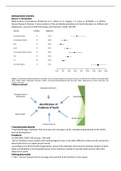
9) Unity= cohesiveness: qualities of a group that binds
members together. This is the actual tie within the group
and how close people are. Divided into four options
,10) Entitativity= extent to which assemblage of individuals are perceived to be a group. So
not the actual cohesiveness but the perceptions people have about this.
Stages of Group development (Tuckmans, 1965)
1. Forming= orientation towards each other
2. Storming= conflict arises when members define their status
3. Norming= creating structure to overcome conflict
4. Performing= moving beyond disagreement to get the work done
5. Adjourning= dissolution
Lecture 2- methods
A good research questions
- Adds to literature
- Is specific
- Describes a general process
Methods
1. Case study= using literature and archival data develop ideas
Pros Cons
Natural No access to all information
Detailed External validity
No relationships
Depends on interpretation
2. Correlational study explore possible relationships
Pros Cons
Strengths of relationships No inferences about causality
natural
3. Experimental research= you have an experimental and a control condition find
causal relations
Pros Cons
Internal validity Not always feasible
causality low external validity= no real reflection
Measurements
1. Observation
a. Decide on ‘what when where’
b. Naïve observer= to overcome bias
c. Accuracy of observer? = use multiple observers for consistency
Types of observation
o Covert= you don’t tell that you are an observer
+ you don’t influence the group
- you don’t get all information
- not ethical to just observe people
, o Overt= you say that you are observing
+ you can ask for more information
- Hawthorn effect= people change their behavior when being studied
o Participant= you join the group you observe
+ get access to special information
- Hawthorn effect
Coding observations
o Interaction process analysis
Relationship
Positive/ negative
Task
Questions/answers
o Sociometry
Asking questions create sociogram
2. Self-report= Researchers ask questions and ask individuals to complete these
questions.
o + you might get personal answers
o - people can be unaware of socially desirable answers
o - people don’t want to disclose everything
3. Physiological= measuring blood pressure, heartrate, skin conductance
o + people cannot control this
o – it is open to interpretation what a high heart beat means
4. Virtual reality= using technology to create situations
o + no ethical issues
o + you can manipulate the environment
o – external validity might be low
Lecture 3- inclusion
Why do we seek inclusion?
- The need to belong: “a pervasive drive to form and maintain at least a minimum
quantity of lasting, positive, and impactful interpersonal relationships.”(Baumeister&
Leary, 1995) based on evolutionary sociology
- Informational support
- Emotional support
Loneliness
- Emotional loneliness; occurs when the problem is a lack of a long-term, meaningful,
intimate relationship with another person
- Social loneliness; occurs when people feel cut off from their network of friends,
acquaintances, and group members.
Ostracism= being excluded or ignored
- Is ubiquitous= happens over all ages and cultures
What is a group?
“two or more people who are connected and are inter-dependent in the sense that their
needs and goals cause them to influence each other. “
How can you describe a group?
Characteristics of Groups 10 Characteristics
1) Composition= Who belongs to the group?
2) Boundaries=
- Open groups: membership is fluid (voluntarily come and go without consequences)
- Closed groups: membership roster changes more slowly. Individuals are more likely
to focus on the collective nature of the group and to identify with the group
3) Size= number of members. Ties= n(n-1)/2
- Small groups= closer bonds
- Large groups= can be divided into subgroup & leads to more ties
4) Interaction
- Relationship: emotional and personal bonds
- Task: generating ideas, executing etc
5) Interdependence
6) Structure
- Structures- roles= You are expected to act in a certain way. “coherent set of
behaviors expected of people who occupy specific positions.”
- Structure- norms= There is a set of things members agree on when they are in a
group. “consensual standards that describe what behaviors should (or should not) be
performed in certain contexts.”
7) Goals= what is the groups purpose?
- Generating
- Executing
- Negotiating
- choosing
8) Origin= how the group came to be
- planned= based on criteria
- emergent= just happening at random
Taxonomy of groups: Is the group created by forces within the group (internal origins) or
forces outside of the group (external origins)?
- Concocted= by an authority
- Founded= by a member of the group
- Circumstantial= when external forces set the stage for people to get together
- Self-organized= when interacting individuals
gradually align their activities in a cooperative
system of interdependence.
9) Unity= cohesiveness: qualities of a group that binds
members together. This is the actual tie within the group
and how close people are. Divided into four options
,10) Entitativity= extent to which assemblage of individuals are perceived to be a group. So
not the actual cohesiveness but the perceptions people have about this.
Stages of Group development (Tuckmans, 1965)
1. Forming= orientation towards each other
2. Storming= conflict arises when members define their status
3. Norming= creating structure to overcome conflict
4. Performing= moving beyond disagreement to get the work done
5. Adjourning= dissolution
Lecture 2- methods
A good research questions
- Adds to literature
- Is specific
- Describes a general process
Methods
1. Case study= using literature and archival data develop ideas
Pros Cons
Natural No access to all information
Detailed External validity
No relationships
Depends on interpretation
2. Correlational study explore possible relationships
Pros Cons
Strengths of relationships No inferences about causality
natural
3. Experimental research= you have an experimental and a control condition find
causal relations
Pros Cons
Internal validity Not always feasible
causality low external validity= no real reflection
Measurements
1. Observation
a. Decide on ‘what when where’
b. Naïve observer= to overcome bias
c. Accuracy of observer? = use multiple observers for consistency
Types of observation
o Covert= you don’t tell that you are an observer
+ you don’t influence the group
- you don’t get all information
- not ethical to just observe people
, o Overt= you say that you are observing
+ you can ask for more information
- Hawthorn effect= people change their behavior when being studied
o Participant= you join the group you observe
+ get access to special information
- Hawthorn effect
Coding observations
o Interaction process analysis
Relationship
Positive/ negative
Task
Questions/answers
o Sociometry
Asking questions create sociogram
2. Self-report= Researchers ask questions and ask individuals to complete these
questions.
o + you might get personal answers
o - people can be unaware of socially desirable answers
o - people don’t want to disclose everything
3. Physiological= measuring blood pressure, heartrate, skin conductance
o + people cannot control this
o – it is open to interpretation what a high heart beat means
4. Virtual reality= using technology to create situations
o + no ethical issues
o + you can manipulate the environment
o – external validity might be low
Lecture 3- inclusion
Why do we seek inclusion?
- The need to belong: “a pervasive drive to form and maintain at least a minimum
quantity of lasting, positive, and impactful interpersonal relationships.”(Baumeister&
Leary, 1995) based on evolutionary sociology
- Informational support
- Emotional support
Loneliness
- Emotional loneliness; occurs when the problem is a lack of a long-term, meaningful,
intimate relationship with another person
- Social loneliness; occurs when people feel cut off from their network of friends,
acquaintances, and group members.
Ostracism= being excluded or ignored
- Is ubiquitous= happens over all ages and cultures