

Escrito por estudiantes que aprobaron Inmediatamente disponible después del pago Leer en línea o como PDF ¿Documento equivocado? Cámbialo gratis 4,6 TrustPilot
logo-home
Document preview thumbnail
Vista previa 4 fuera de 1065 páginas
Examen

CONSUMER BEHAVIOUR: BUYING, HAVING, AND BEING NINTH CANADIAN EDITION 2026 SOLOMON TEST BANK – BUS 442 COMPLETE CHAPTERS 1-15 WITH ANSWERS

Document preview thumbnail
Vista previa 4 fuera de 1065 páginas

PREMIUM CONSUMER BEHAVIOUR TEST BANK – YOUR ULTIMATE STUDY COMPANION FOR EXAM SUCCESS! Ace your BUS 442, MKTG 340, or PSYC 330 exams with this comprehensive test bank for the Ninth Canadian Edition of Solomon's market-leading textbook. Perfect for mastering the psychological, social, and cultural foundations of consumer decision-making! What This Test Bank Includes: All 15 Chapters Covered – Complete test bank from Ch. 1 through Ch. 15 Numerous Questions Per Chapter – Extensive practice with multiple formats Verified Answers Included – All answers clearly marked for self-assessment Question Formats: Multiple Choice, True/False, Essay Questions – As shown in document Bloom's Level Identified – Questions tagged for comprehension level Application & Concept Questions – Test both theoretical understanding and real-world application Searchable PDF – Find specific topics instantly Mobile-Ready – Study anywhere, anytime Chapter Highlights: Ch. 1 (An Introduction to Consumer Behaviour): Psychographics, consumption process, relationship marketing, segmentation variables, consumer trends, ethics, "dark side" behaviours, research methodologies Ch. 2 (Perception): Three-stage perception process, sensory systems (sight, sound, smell, taste, touch), absolute/differential thresholds, Weber's Law, subliminal perception, attention factors, gestalt principles, positioning strategies Ch. 3 (Learning and Memory): Behavioural learning theories (classical/operant conditioning), stimulus generalization/discrimination, reinforcement schedules, cognitive learning, memory process (encoding/storage/retrieval), associative networks, nostalgia Ch. 4 (Motivation and Affect): Drive vs. expectancy theories, biogenic/psychogenic needs, motivational conflicts (approach-approach, approach-avoidance, avoidance-avoidance), Maslow's hierarchy, involvement, flow state, emotions vs. moods Ch. 5 (The Self): Self-concept dimensions, ideal vs. actual self, multiple selves, symbolic interactionism, extended self, gender roles, androgyny, body image, fattism, self-decoration purposes Ch. 6 (Personality, Lifestyles, and Values): Freudian systems (id/ego/superego), motivational research, trait theory (innovativeness, materialism, need for cognition), brand personality, animism, psychographics, VALS framework, core values Ch. 7 (Attitudes): ABC model of attitudes (affect/behaviour/cognition), hierarchy of effects, functional theory, cognitive dissonance, balance theory, multi-attribute models (Fishbein model), theory of reasoned action, descriptive vs. injunctive norms Ch. 8 (Attitude Change and Interactive Communications): Persuasion principles (reciprocity, scarcity, authority), communications model, source credibility/attractiveness, sleeper effect, match-up hypothesis, message appeals (sex, humour, fear), elaboration likelihood model (ELM) Ch. 9 (Individual Decision Making): Consumer hyperchoice, rational vs. experiential perspectives, problem recognition, information search, evaluative criteria, evoked set, decision rules (compensatory/non-compensatory), heuristics, ethnocentrism Ch. 10 (Buying and Disposing): Situational effects, co-consumers, consumer contamination, crowding vs. density, temporal factors, queuing theory, shopping orientations, retail theming, atmospherics, impulse buying, exchange theory, post-purchase satisfaction/dissatisfaction, disposal options Ch. 11 (Group Influence and Social Media): Reference group influence (informational/utilitarian/value-expressive), social power types (referent, expert, reward, coercive), conformity, deindividuation, risky shift, social loafing, opinion leaders, word-of-mouth (WOM), buzz vs. hype, guerrilla marketing, viral marketing, social networking Ch. 12 (Income, Social Class, and Family Structure): Status symbols, discretionary income, spendthrifts vs. tightwads, consumer confidence, social stratification, achieved vs. ascribed status, social mobility, conspicuous consumption, leisure class, Veblen's theory, family life cycle, sandwich generation, boomerang kids Ch. 13 (Subcultures): Age cohorts (Gen Z, Millennials, Gen X, Baby Boomers), teen conflicts, mature consumer market, grey market, regional segmentation, ethnic subcultures (French Canadian, Chinese Canadian), high-context vs. low-context cultures Ch. 14 (Cultural Influences on Consumer Behaviour): Cultural systems (ecology/social structure/ideology), Hofstede's dimensions (power distance, uncertainty avoidance, individualism, masculinity), enacted vs. crescive norms, myths (monomyth), rituals, gift-giving stages, sacred vs. profane consumption, cross-cultural analysis, etic vs. emic perspectives Ch. 15 (The Creation and Diffusion of Culture): Culture production systems (CPS), creative/managerial/communications subsystems, cultural gatekeepers, product placement, advergaming, reality engineering, innovation diffusion, adopter categories, fashion acceptance cycle, trickle-down theory, fads vs. classics Key Topics Covered: Consumer decision-making process and problem recognition Motivation theories and Maslow's hierarchy of needs Perception, attention, and interpretation in marketing Learning theories: classical, operant, and observational conditioning Memory systems and information processing Attitude formation and change (ABC model, ELM) Personality traits and their influence on consumer behaviour Lifestyles, psychographics, and VALS framework Self-concept, body image, and extended self Cultural values and cross-cultural consumer differences Social class, status symbols, and conspicuous consumption Reference group influence and social power Word-of-mouth (WOM), social media, and influencer marketing Family decision-making and life cycle stages Age subcultures: Gen Z, Millennials, Gen X, Baby Boomers Regional and ethnic subcultures in Canada Rituals, myths, and sacred consumption Fashion cycles and innovation diffusion E-commerce and retail atmospherics Post-purchase satisfaction and disposal behaviours Sample Questions Preview: Chapter 1, Question 1: In studying consumers like Gail, a college student, marketers often find it useful to learn their interests in music or clothing, how they spend their leisure time, and even their attitudes about social issues, to be able to categorize consumers according to their lifestyles. This sort of information is called: (Answer: B – Psychographics) Chapter 2, Question 1: The process by which stimuli are selected, organized, and interpreted is called: (Answer: B – Perception) Chapter 3, Question 1: ________ refers to a relatively permanent change in behaviour that is caused by experience. (Answer: A – Learning) Chapter 7, Question 1: A lasting, general evaluation of people (including oneself), objects, and issues is a(n): (Answer: C – Attitude) Chapter 11, Question 1: If you were to buy a new Saturn and join their "Saturn Owners Club," regularly attending club outings, the other club members would be known as a(n): (Answer: B – Reference group) Perfect For: BUS 442, MKTG 340, MKT 212, BUS 320, MKTG 456, PSYC 330, and any Consumer Behaviour, Marketing, or Psychology courses ⏳ DOWNLOAD INSTANTLY ON STUVIA AND MASTER CONSUMER BEHAVIOUR WITH CONFIDENCE!

Vista previa del contenido

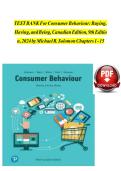
TEST BANK For Consumer Behaviour: Buying,
= = = = = =


Having, and Being, Canadian Edition, 9th Editio
= = = = = =


n, 2024 by Michael R. Solomon Chapters 1 - 15
= = = = = = = = =

,Consumer=Behaviour:=Buying,=Having,=and=Being,=Cdn.=9e=(Solomon)=Chapte
r=1= An=Introduction=to=Consumer=Behaviour


1) In=studying=consumers=like=Gail,=a=college=student,=marketers=often=find=it=useful=to=learn=their=
interests=in=music=or=clothing,=how=they=spend=their=leisure=time,=and=even=their=attitudes=about=s
ocial=issues,=to=be=able=to=categorize=consumers=according=to=their=lifestyles.=This=sort=of=informa
tion=is=called:
A) core=values.
B) psychographics.
C) configurations.
D) physiognomies.
ANSWER:= B
=


Type:=MC
Page=Ref:=2
= Skill:= Application
Objective:= L1-01=Consumer=behaviour=is=a=process.


2) Tina,=a=supervisor=of=displays=for=Sears=Canada,=knows=that=attractive=displays=can=generate=
additional=sales=of=particular=items.=From=a=marketer's=perspective,=this=is:
A) a=purchase=issue.
B) a=post=purchase=issue.
C) merchandising=complexity.
D) a=loss=leader.
ANSWER:= A
Type:=MC
Page=Ref:=3
= Skill:= Application
Objective:= L1-01=Consumer=behaviour=is=a=process.

3) John=is=the=vice=president=of=marketing=for=a=local=tour=guide=company.=He=is=concerned=that=

,his=customers=are=not=recommending=his=company=to=their=friends.=For=John,=this=problem=is=a:
A) purchase=issue.
B) demographic=problem.
C) prepurchase=issue.
D) post=purchase=issue.
= ANSWER:= D
Type:=MC
Page=Ref:=3
= Skill:= Application
Objective:= L1-01=Consumer=behaviour=is=a=process.

, 4) The=expanded=view=of=the=exchange=that=includes=the=issues=that=influence=the=consumer=
before,=during,=and=after=a=purchase=is=called:
A) the=value.
B) the=strategic=focus.
C) the=pre-sell=strategy.
D) the=consumption=process.
= ANSWER:= D
Type:=MC
Page=Ref:=3
= Skill:= Concept
Objective:= L1-01=Consumer=behaviour=is=a=process.

5) Gail=decides=to=take=a=break=from=studying=and=goes=online=to=check=things=out.=She=connects=
with=one=of=the=product=discussion=groups=that=she=participates=in.=This=is=an=example=of=a:
A) lifestyle=discussion.
B) brand=competition.
C) consumption=community.
D) marketplace=competition.
= ANSWER:= C
Type:=MC
Page=Ref:=2
= Skill:= Application
Objective:= L1-01=Consumer=behaviour=is=a=process.


6) If=a=product=succeeds=in=satisfying=needs=and=is=purchased=over=and=over=again,=it=most=likely=
has=attained:
A) product=separation.
B) brand=loyalty.
C) lifestyle=variation.
D) purchase=conception.
ANSWER:= B
Type:=MC


Libro relacionado
 image
Michael Solomon, Rebekah Russell-Bennett, Josephine Previte Consumer Behaviour
Edición: 2012 ISBN: 9781442564992 Edición: Desconocido

Información del documento

Subido en
25 de febrero de 2026
Número de páginas
1065
Escrito en
2025/2026
Tipo
Examen
Contiene
Preguntas y respuestas
$17.09

¿Documento equivocado? Cámbialo gratis Dentro de los 14 días posteriores a la compra y antes de descargarlo, puedes elegir otro documento. Puedes gastar el importe de nuevo.
Escrito por estudiantes que aprobaron
Inmediatamente disponible después del pago
Leer en línea o como PDF

Seller avatar
Los indicadores de reputación están sujetos a la cantidad de artículos vendidos por una tarifa y las reseñas que ha recibido por esos documentos. Hay tres niveles: Bronce, Plata y Oro. Cuanto mayor reputación, más podrás confiar en la calidad del trabajo del vendedor.
Speeddocs
4.7
(3)
Vendido
13
Seguidores
1
Artículos
223
Última venta
2 semanas hace


Por qué los estudiantes eligen Stuvia

Creado por compañeros estudiantes, verificado por reseñas

Calidad en la que puedes confiar: escrito por estudiantes que aprobaron y evaluado por otros que han usado estos resúmenes.

¿No estás satisfecho? Elige otro documento

¡No te preocupes! Puedes elegir directamente otro documento que se ajuste mejor a lo que buscas.

Paga como quieras, empieza a estudiar al instante

Sin suscripción, sin compromisos. Paga como estés acostumbrado con tarjeta de crédito y descarga tu documento PDF inmediatamente.

Student with book image

“Comprado, descargado y aprobado. Así de fácil puede ser.”

Alisha Student

Preguntas frecuentes