

Escrito por estudiantes que aprobaron Inmediatamente disponible después del pago Leer en línea o como PDF ¿Documento equivocado? Cámbialo gratis 4,6 TrustPilot
logo-home
Document preview thumbnail
Vista previa 4 fuera de 465 páginas
Examen

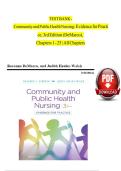
TEST BANK FOR COMMUNITY AND PUBLIC HEALTH NURSING 3RD EDITION DEMARCO WALSH – NUR 420 COMPLETE CHAPTERS 1-25 WITH ANSWERS

Document preview thumbnail
Vista previa 4 fuera de 465 páginas

MASTER COMMUNITY AND PUBLIC HEALTH NURSING WITH THIS COMPREHENSIVE TEST BANK! Ready to make a difference in population health? This essential test bank for DeMarco & Walsh's Community and Public Health Nursing: Evidence for Practice, 3rd Edition is your ultimate resource for understanding the core concepts of caring for communities and populations. With hundreds of practice questions, you'll be fully prepared for exams and for a rewarding career in public health. What This Test Bank Includes: Complete Coverage of Chapters 1-25 – All major topics from public health science to occupational health nursing are included, as shown in the Table of Contents. Verified Answers – Every multiple-choice and select-all-that-apply question includes a correct answer key with detailed feedback, enabling you to self-assess and reinforce your understanding instantly. NCLEX-Style Questions – Practice with questions designed to mirror the format and difficulty of your course exams. Real-World Scenarios – Questions are based on authentic community health situations, helping you apply theory to practice. Searchable PDF Format – Easily navigate to specific chapters or topics for focused study sessions. Mobile-Ready – Study anytime, anywhere on your phone, tablet, or laptop. Chapter Highlights: Ch. 1: Public Health Nursing – Understand the history, core functions, and principles of public health, including the Healthy People 2020 goals and the eight domains of public health nursing practice. Ch. 2: Public Health Systems – Explore the organization of public health at the global, federal, state, and local levels, including the roles of multilateral agencies, NGOs, and philanthropies. Ch. 3: Health Policy, Politics, and Reform – Master the policy-making process, from setting an agenda to policy modification, and understand the impact of the Patient Protection and Affordable Care Act (ACA). Ch. 4: Health and the Global Environment – Analyze global health trends, determinants of health (social, economic, environmental), and the Millennium Development Goals. Ch. 5: Frameworks for Health Promotion – Apply behavior change models, including the Health Belief Model, Transtheoretical Model, and Motivational Interviewing, to community health interventions. Ch. 6-8: Epidemiology – Master the science of prevention, including rates (incidence, prevalence), epidemiologic study designs (cohort, case-control), and measures of association (relative risk). Ch. 9: Planning for Community Change – Learn to use logic models, SMART objectives, and force field analysis to plan, implement, and evaluate community health programs. Ch. 10: Culture Diversity and Values – Develop cultural competence, understand ethnocentrism, and learn to provide culturally safe care using the L.E.A.R.N. model. Ch. 11: Community Assessment – Conduct comprehensive community assessments using tools like windshield surveys, geographic information systems (GIS), and the functional health pattern model. Ch. 12: Care Management & Case Management – Differentiate between care management and case management, and understand the roles of home health, parish nursing, and telehealth. Ch. 13: Family Assessment – Apply grand nursing theories to family assessment, use genograms and ecomaps, and conduct a focused 15-minute family interview. Ch. 14: Risk of Infectious and Communicable Diseases – Analyze the chain of infection, modes of transmission, and surveillance systems for diseases like influenza, TB, and STIs. Ch. 15: Emerging Infectious Diseases – Explore factors leading to disease emergence (antigenic drift, microbial adaptation) and prevention strategies for diseases like SARS, MERS-CoV, and West Nile Virus. Ch. 16: Violence and Abuse – Understand intimate partner violence (IPV), risk factors, levels of prevention, and the nurse's role in screening and safety planning. Ch. 17: Substance Use – Learn about substance use disorders, screening tools (CAGE, T-ACE), pharmacologic treatments, and motivational interviewing. Ch. 18: Underserved Populations – Explore the unique health challenges of rural populations, the incarcerated, immigrants, and refugees, and the seven A's of rural health. Ch. 19: Environmental Health – Understand exposure pathways, environmental epidemiology, and the nurse's role in assessing and mitigating environmental risks. Ch. 20: Community Preparedness – Master disaster management phases (preimpact, impact, postimpact), triage systems (START), and the nurse's role in terrorism and pandemic response. Ch. 21: Community Mental Health – Explore community-based mental health care, deinstitutionalization, and the treatment of major mental illnesses (schizophrenia, depression, bipolar disorder). Ch. 22: School Health – Understand the eight components of a comprehensive school health program and the school nurse's roles as a clinician, advocate, and educator. Ch. 23: Faith-Oriented Communities – Explore models of faith community nursing (congregation-based, institution-based) and the nurse's role in promoting health within a spiritual context. Ch. 24: Palliative and End-of-Life Care – Understand the difference between hospice and palliative care, pain management principles, and the phases of grief. Ch. 25: Occupational Health Nursing – Learn about workplace hazards (biological, chemical, physical, psychosocial), OSHA regulations, and the occupational health nurse's roles. Key Topics Covered: Core Functions of Public Health (Assessment, Policy Development, Assurance) Levels of Prevention (Primary, Secondary, Tertiary) The Epidemiologic Triad (Host, Agent, Environment) Healthy People 2020 Leading Health Indicators Social Determinants of Health Community Assessment Methods (Windshield Survey, GIS, Data Mining) Program Planning and Evaluation (Logic Models, SMART Objectives) Cultural Competence and Cultural Safety Infectious Disease Transmission and Control Disaster Management and Emergency Preparedness Family Assessment and Genograms Care of Vulnerable Populations (Rural, Homeless, Incarcerated) Environmental Health and Exposure Pathways Mental Health and Substance Abuse in the Community Sample Questions Preview: Ch 1, Q 1: A nurse is striving to practice patient-centered care at a hospital. Which action best exemplifies providing patient-centered care? (Answer Provided in Key) Ch 6, Q 2: Who first described pulmonary tuberculosis in detail? (Answer Provided in Key) Ch 9, Q 2: The nurse is in charge of a local community program that uses a logic model as a planning and communication tool. Which key components are included in this model? Select all that apply. (Answer Provided in Key) Ch 14, Q 1: A client with tuberculosis sneezes in the waiting room and infects several other clients who are sitting on the other side of the room. Which mechanism of transmission is involved in this case? (Answer Provided in Key) ⏳ BECOME A LEADER IN COMMUNITY HEALTH – DOWNLOAD THIS TEST BANK INSTANTLY AND START YOUR JOURNEY TO IMPROVING THE HEALTH OF POPULATIONS TODAY!

Vista previa del contenido

TEST BANK - = =


= Community and Public Health Nursing: Evidence for Practi
= = = = = = =


ce, 3rd Edition (DeMarco),
= = = =


Chapters 1 - 25 | All Chapters
= = = = = =

,TABLE OF CONTENTS
= =

,Chapter 1: Public Health Nursing
= = = =


1. A=nurse=is=striving=to=practice=patient-
centered=care=at=a=hospital.=Which=action=best=exemplifies=providing=patient-
centered=care?
A) Having=a=client=complete=a=self-
reported=functional=status=indicator=and=then=reviewing=it= with=the=client
B) Explaining=to=a=client=the=benefits=of=computer-
assisted=robotic=surgical=techniques,=which=the=hospital=recently=implem
ented
C) Recording=a=client's=signs=and=symptoms=in=an=electronic=health=record
D) Performing=continuous=glucose=monitoring=of=a=client=while=the=client=is=in=the=
hospital
ANSWER:= A
Feedback:
Patient-
centered=care=considers=cultural=traditions,=personal=preferences,=values,=families,=and=lif
estyles.=Clients=become=active=participants=in=their=own=care,=and=monitoring=health=bec
omes=the=client's=responsibility.=To=help=clients=and=their=healthcare=providers=make=bett
er=decisions,=the=Agency=for=Healthcare=Research=and=Quality=(AHRQ)=has=developed=a=
series=of=tools=that=empower=clients=and=assist=providers=in=achieving=desired=outcomes,=
including=client-reported=functional=status=indicators.=Computer-
assisted=robotic=surgical=techniques,=electronic=health=records,=and=continuous=glucose=m
onitoring=in=the=hospital=are=all=technological=advances=in=healthcare,=but=they=do=not=hel
p=the=client=become=a=more=active=participant=in=his=or=her=care,=and=thus=are=not=good=exa
mples=of=patient-centered=care.


Origin:= Chapter=1-=Public=Health=Nursing,=2
2. A=nurse=is=caring=for=an=older=client=who=is=struggling=to=manage=her=type=2=diabetes=m
ellitus.=The=nurse=should=recognize=which=social=determinants=of=this=client's=health?=(S
elect= all=that= apply.)

, A) Household=income=of=$23,000=per=year
B) Reading=level=of=a=third=grader
C) Medication=ineffective=due=to=error=in=prescription
D) Originally=from=Sudan
E) No=family=in=the=area=
ANSWER:= A,=B,=D,=E=Fe
edback:
The=social=conditions=in=which=people=live,=their=income,=social=status,=education,=literac
y,= home=and=work=environment,=support=networks,=gender,=culture,=and=availability=of=h
ealth=services=are=the=social=determinants=of=health.=These=conditions=have=an=impact=on=
the=extent=to=which=a=person=or=community=possesses=the=physical,=social,=and=personal=r
esources=necessary=to=attain=and=maintain=health.=A=medical=error=on=the=part=of=the=client
's=primary=care=provider=or=nurse=would=not=constitute=a=social=determinant=of=the=client's
= health.

Libro relacionado
 image
Rosanna DeMarco, Judith Healey-Walsh Community and Public Health Nursing
Edición: 2019 ISBN: 9781975111700 Edición: Desconocido

Información del documento

Subido en
25 de febrero de 2026
Número de páginas
465
Escrito en
2025/2026
Tipo
Examen
Contiene
Preguntas y respuestas
$18.29

¿Documento equivocado? Cámbialo gratis Dentro de los 14 días posteriores a la compra y antes de descargarlo, puedes elegir otro documento. Puedes gastar el importe de nuevo.
Escrito por estudiantes que aprobaron
Inmediatamente disponible después del pago
Leer en línea o como PDF

Seller avatar
Los indicadores de reputación están sujetos a la cantidad de artículos vendidos por una tarifa y las reseñas que ha recibido por esos documentos. Hay tres niveles: Bronce, Plata y Oro. Cuanto mayor reputación, más podrás confiar en la calidad del trabajo del vendedor.
Speeddocs
4.7
(3)
Vendido
13
Seguidores
1
Artículos
223
Última venta
2 semanas hace


Por qué los estudiantes eligen Stuvia

Creado por compañeros estudiantes, verificado por reseñas

Calidad en la que puedes confiar: escrito por estudiantes que aprobaron y evaluado por otros que han usado estos resúmenes.

¿No estás satisfecho? Elige otro documento

¡No te preocupes! Puedes elegir directamente otro documento que se ajuste mejor a lo que buscas.

Paga como quieras, empieza a estudiar al instante

Sin suscripción, sin compromisos. Paga como estés acostumbrado con tarjeta de crédito y descarga tu documento PDF inmediatamente.

Student with book image

“Comprado, descargado y aprobado. Así de fácil puede ser.”

Alisha Student

Preguntas frecuentes