Concepten IME
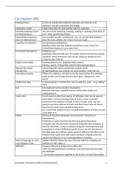
Entertainment A form of activity that holds the attention and interest of an
audience, that gives pleasure and delight
Interactive media Media that allow for interactivity with the audience
Passively enjoying a form You are merely watching, listening, reading (+ making connections in
of entertainment your mind, questioning things)
Interactively enjoying a You actually become a participant, you can control what happens,
form of entertainment how the story unfolds, the choices that are made...
Cognitive interactivity Interpretative participation.
Reading a story but also making connection in your mind. This
interactivity happens in your own mind.
Functional interactivity Utilitarian use.
Switching channels with your TV remote control, turning the volume
up/down. More functional, how we are using our media but not
related to the content.
Explicit interactivity Exerting influence on, shaping media content.
Playing a game, clicking links online (following hyperlinks).
Beyond-the-object Interacting with media outside the contents itself.
interactivity By participating in fan culture, fan communities, create fan art.
Interactive e-books Where the audience can help move the story further (for example:
solve puzzles and change how the story goes, change your own
story).
Chatter bot apps A virtual person / creature that you can talk too, poke… (e.g. Talking
Tom)
ICA International Communication Association.
Divisions that have a specific focus on interactive media and
entertainment.
Push cards Punch cards are like these pieces of stiff paper that can be used to
store data o. (so by punching holes in them or not). so by the
presence or the absence of holes in these French cards, you are
going to yes store laid out on them and then these holes of course
have to be a push cards predefined positions.
So it cannot be random to be in predefined positions in them you can
store data on it.
ENIAC Electronic Numeric Integrator and Computer; University of
Pennsylvania.
Historians to agree that the very first truly general-purpose
computer was the electronic numerical integrator and computer or
ensures the ENIAC. It was a modular computer meaning that it was
composed of several individual panels as you can also see here on
the slide and each of these panels perform different functions so for
instance they could send and receive numbers compute save the
answer and then go on to a next operation or function.
Natural language or voice Spoken interface where the user interacts with the computer by
user interface (VUI) talking to it (Siri, Alexa…)
ARPANET Advanced Research Project Association Net.
1969: the US Department of Defense commissioned and launched
the ARPANET.
“Connecting computers together to allow them to send information
Concepten ‘Interactive Media & Entertainment’ 1
, back and forth even though geographically distant from one
another”
MUD Multi-User Dungeon / Multi-User Domain / Multi-User Dimension.
Text-based role-playing adventure game.
Uniform Resource A web address: a reference to a web resource that specifies its
Locators (URLs) location on a computer network and a mechanism for retrieving it.
Hypertext Markup The standard markup language for creating web pages and web
Language (HTML) applications.
Hypertext Transfer An application protocol for distributed, collaborative, hypermedia
Protocol (HTTP) information systems.
Usenet A worldwide discussion system that allows Internet users to read and
to post public messages which were called news on that platform
and you could post it to one or more categories which were known
as newsgroups.
SixDegrees.com The first social networking site (SNS) (1997).
Open diary A SNS that brought together online diary writers into one
community.
Friendster Originally designed as an online dating site.
MySpace Friendster rival that quickly became the go-to site for
musicians/artists and teenagers.
Facebook It was initially designed to support college networks only so
specifically Facebook began in early 2004 as a Harvard only social
network site so to be able to join a user had to have a Harvard email
address.
And later on, Facebook also began supporting other schools as well
and at this point in time Facebook was a private community for
college students mostly.
Beginning in September 2005: gradually expanded to include high
school students, professionals inside corporate networks, and
eventually, everyone.
In 2006: everyone who was 30 years old has been allowed to become
a registred member of fb. Still the largest global SNS.
Web 2.0 Software devices and end-users started to utilize the WWW in a new
way.
Content and apps are no longer merely published by a sole
creator/individual but they are continuously modified by all users in
a participatory and collaborative fashion! (e.g. blogs, wikis, SNS,
collaborative projects…)
User Generated Content Web 2.0 represents the ideological foundation of social media and
(UGC) then we've got user generated content or UGC as it will be
abbreviated here and there which can be seen as the sum of all ways
in which people make use of social media.
Three requirements:
- Published on a publicly accessible website/SNS
- Show a certain amount of creative effort
- Created outside of professional routines and practices
Social Presence Theory Social presence refers to the sensation that we can have when we
((SPT) Williams & Christie) are interacting with someone in another place and feel as if were
there in the moment with them.
Media Richness Theory Theory used to describe a medium’s ability to reproduce the
Concepten ‘Interactive Media & Entertainment’ 2
Entertainment A form of activity that holds the attention and interest of an
audience, that gives pleasure and delight
Interactive media Media that allow for interactivity with the audience
Passively enjoying a form You are merely watching, listening, reading (+ making connections in
of entertainment your mind, questioning things)
Interactively enjoying a You actually become a participant, you can control what happens,
form of entertainment how the story unfolds, the choices that are made...
Cognitive interactivity Interpretative participation.
Reading a story but also making connection in your mind. This
interactivity happens in your own mind.
Functional interactivity Utilitarian use.
Switching channels with your TV remote control, turning the volume
up/down. More functional, how we are using our media but not
related to the content.
Explicit interactivity Exerting influence on, shaping media content.
Playing a game, clicking links online (following hyperlinks).
Beyond-the-object Interacting with media outside the contents itself.
interactivity By participating in fan culture, fan communities, create fan art.
Interactive e-books Where the audience can help move the story further (for example:
solve puzzles and change how the story goes, change your own
story).
Chatter bot apps A virtual person / creature that you can talk too, poke… (e.g. Talking
Tom)
ICA International Communication Association.
Divisions that have a specific focus on interactive media and
entertainment.
Push cards Punch cards are like these pieces of stiff paper that can be used to
store data o. (so by punching holes in them or not). so by the
presence or the absence of holes in these French cards, you are
going to yes store laid out on them and then these holes of course
have to be a push cards predefined positions.
So it cannot be random to be in predefined positions in them you can
store data on it.
ENIAC Electronic Numeric Integrator and Computer; University of
Pennsylvania.
Historians to agree that the very first truly general-purpose
computer was the electronic numerical integrator and computer or
ensures the ENIAC. It was a modular computer meaning that it was
composed of several individual panels as you can also see here on
the slide and each of these panels perform different functions so for
instance they could send and receive numbers compute save the
answer and then go on to a next operation or function.
Natural language or voice Spoken interface where the user interacts with the computer by
user interface (VUI) talking to it (Siri, Alexa…)
ARPANET Advanced Research Project Association Net.
1969: the US Department of Defense commissioned and launched
the ARPANET.
“Connecting computers together to allow them to send information
Concepten ‘Interactive Media & Entertainment’ 1
, back and forth even though geographically distant from one
another”
MUD Multi-User Dungeon / Multi-User Domain / Multi-User Dimension.
Text-based role-playing adventure game.
Uniform Resource A web address: a reference to a web resource that specifies its
Locators (URLs) location on a computer network and a mechanism for retrieving it.
Hypertext Markup The standard markup language for creating web pages and web
Language (HTML) applications.
Hypertext Transfer An application protocol for distributed, collaborative, hypermedia
Protocol (HTTP) information systems.
Usenet A worldwide discussion system that allows Internet users to read and
to post public messages which were called news on that platform
and you could post it to one or more categories which were known
as newsgroups.
SixDegrees.com The first social networking site (SNS) (1997).
Open diary A SNS that brought together online diary writers into one
community.
Friendster Originally designed as an online dating site.
MySpace Friendster rival that quickly became the go-to site for
musicians/artists and teenagers.
Facebook It was initially designed to support college networks only so
specifically Facebook began in early 2004 as a Harvard only social
network site so to be able to join a user had to have a Harvard email
address.
And later on, Facebook also began supporting other schools as well
and at this point in time Facebook was a private community for
college students mostly.
Beginning in September 2005: gradually expanded to include high
school students, professionals inside corporate networks, and
eventually, everyone.
In 2006: everyone who was 30 years old has been allowed to become
a registred member of fb. Still the largest global SNS.
Web 2.0 Software devices and end-users started to utilize the WWW in a new
way.
Content and apps are no longer merely published by a sole
creator/individual but they are continuously modified by all users in
a participatory and collaborative fashion! (e.g. blogs, wikis, SNS,
collaborative projects…)
User Generated Content Web 2.0 represents the ideological foundation of social media and
(UGC) then we've got user generated content or UGC as it will be
abbreviated here and there which can be seen as the sum of all ways
in which people make use of social media.
Three requirements:
- Published on a publicly accessible website/SNS
- Show a certain amount of creative effort
- Created outside of professional routines and practices
Social Presence Theory Social presence refers to the sensation that we can have when we
((SPT) Williams & Christie) are interacting with someone in another place and feel as if were
there in the moment with them.
Media Richness Theory Theory used to describe a medium’s ability to reproduce the
Concepten ‘Interactive Media & Entertainment’ 2