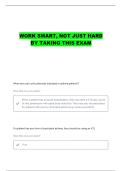
When are oral corticosteroids indicated in asthma patients?
Give this one a try later!
When a patient has an acute exacerbation, they will need a 5-10 day course
of oral prednisone with rapid dose reduction. They may also be prescribed
for patients with poorly controlled asthma (e.g. severe persistent).
If a patient has any form of persistent asthma, they should be using an ICS.
Give this one a try later!
True.
,If patient is using a SABA more than twice a week, they are not well-controlled.
Give this one a try later!
True
What factors affect medication compliance?
Give this one a try later!
complex medication regimens, cost of the drug, side effects of the drug,
ease of administration and/or drug form (e.g., large tablets or capsules),
education and communication between provider and patient, perceived
side effects not truly related to the medication, functional and/or mental
deficits (eg. vision changes, dementia, arthritis of hands), provider
approachability, perception of patient respect, belief that the therapy is
beneficial and outweighs the risks or side effects, the degree to which the
patient participates in the development of the treatment regimen, degree
to which patient believes that expectations and concerns are being met,
degree to which the practitioner motivates the patient to adhere to the
regimen, degree to which the regimen is compatible with the patient's busy
lifestyle, medication taste.
Appropriate use/precautions/administration of acetaminophen in children and adults:
Give this one a try later!
Due to 4% of the drug converting to a toxic metabolite in the liver, taking
more than the recommended dose per day could cause fatal liver necrosis.
In adults, generally, the maximum daily dose is 4,000 mg. This should be
lowered in those who drink two or more alcoholic beverages per day or if
liver disease is present. In older adults, it is now suggested to lower the
, daily dose to 3,000 mg daily. In children through 12 years of age, Tylenol
should be based on weight, may be taken every 4-6 hrs., not to exceed 5
doses in a 24 hour period (2.6 g) It is important to teach parents not to
administer any other medication that may contain acetaminophen at the
same time (cold meds, etc.)
Biphosphonate teaching and monitoring:
Give this one a try later!
Biphosphonates are used for preventing and treating osteoporosis.
Examples are: Aredia, Nerixia, Olpadronate, Fosamax, Boniva, Actonel, and
Aclasta. Education: sit upright for 30 minutes after taking. Boniva is given via
IV infusion over 15-30 mins. Always take oral biphisphonates with 8 ounces
of water. Patients with esophageal issues and diarrhea shouldn't take
biphosphonates. Continue to monitor BMD while taking them. Dexascans
should be performed every 2 years. Treatment may be lifelong, but some
experts state that a holiday should be taken after 5 yrs.
How do you address medication compliance issues?
Give this one a try later!
Give this one a try later!
When a patient has an acute exacerbation, they will need a 5-10 day course
of oral prednisone with rapid dose reduction. They may also be prescribed
for patients with poorly controlled asthma (e.g. severe persistent).
If a patient has any form of persistent asthma, they should be using an ICS.
Give this one a try later!
True.
,If patient is using a SABA more than twice a week, they are not well-controlled.
Give this one a try later!
True
What factors affect medication compliance?
Give this one a try later!
complex medication regimens, cost of the drug, side effects of the drug,
ease of administration and/or drug form (e.g., large tablets or capsules),
education and communication between provider and patient, perceived
side effects not truly related to the medication, functional and/or mental
deficits (eg. vision changes, dementia, arthritis of hands), provider
approachability, perception of patient respect, belief that the therapy is
beneficial and outweighs the risks or side effects, the degree to which the
patient participates in the development of the treatment regimen, degree
to which patient believes that expectations and concerns are being met,
degree to which the practitioner motivates the patient to adhere to the
regimen, degree to which the regimen is compatible with the patient's busy
lifestyle, medication taste.
Appropriate use/precautions/administration of acetaminophen in children and adults:
Give this one a try later!
Due to 4% of the drug converting to a toxic metabolite in the liver, taking
more than the recommended dose per day could cause fatal liver necrosis.
In adults, generally, the maximum daily dose is 4,000 mg. This should be
lowered in those who drink two or more alcoholic beverages per day or if
liver disease is present. In older adults, it is now suggested to lower the
, daily dose to 3,000 mg daily. In children through 12 years of age, Tylenol
should be based on weight, may be taken every 4-6 hrs., not to exceed 5
doses in a 24 hour period (2.6 g) It is important to teach parents not to
administer any other medication that may contain acetaminophen at the
same time (cold meds, etc.)
Biphosphonate teaching and monitoring:
Give this one a try later!
Biphosphonates are used for preventing and treating osteoporosis.
Examples are: Aredia, Nerixia, Olpadronate, Fosamax, Boniva, Actonel, and
Aclasta. Education: sit upright for 30 minutes after taking. Boniva is given via
IV infusion over 15-30 mins. Always take oral biphisphonates with 8 ounces
of water. Patients with esophageal issues and diarrhea shouldn't take
biphosphonates. Continue to monitor BMD while taking them. Dexascans
should be performed every 2 years. Treatment may be lifelong, but some
experts state that a holiday should be taken after 5 yrs.
How do you address medication compliance issues?
Give this one a try later!