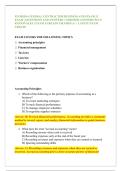
FLORIDA GENERAL CONTRACTOR BUSINESS AND FINANCE
EXAM | QUESTIONS AND ANSWERS | VERIFIED ANSWERS PLUS
RATIONALES | EXAM ALREADY GRADED A+ | LATEST EXAM
UPDATE
EXAM COVERS THE FOLLOWING TOPICS
Accounting principles
Financial management
Tax laws
Lien law
Workers’ compensation
Business organization
Accounting Principles
1. Which of the following is the primary purpose of accounting in a
business?
A) To create marketing strategies
B) To track financial performance
C) To manage employee schedules
D) To negotiate supplier contracts
Answer: B) To track financial performance. Accounting provides a systematic
method to record, report, and analyze financial information to guide business
decisions.
2. What does the term "accrual accounting" mean?
A) Recording income when cash is received
B) Recording expenses only at the end of the fiscal year
C) Recording revenues and expenses when they are earned or incurred
D) Ignoring outstanding debts
Answer: C) Recording revenues and expenses when they are earned or
incurred. Accrual accounting gives a more accurate picture of financial
,health by recognizing transactions when they occur, not when cash changes
hands.
3. Which financial statement shows a company’s assets, liabilities, and
equity at a specific point in time?
A) Income Statement
B) Balance Sheet
C) Cash Flow Statement
D) Statement of Retained Earnings
Answer: B) Balance Sheet. The balance sheet provides a snapshot of what the
company owns (assets), owes (liabilities), and the owners’ equity at a given
date.
4. In accounting, what is the matching principle?
A) Matching employees to job roles
B) Matching revenues with the expenses incurred to generate them
C) Matching suppliers to orders
D) Matching tax returns with financial statements
Answer: B) Matching revenues with the expenses incurred to generate them.
This ensures that income statements reflect true profitability for a period.
5. What is considered a current asset?
A) Land
B) Accounts Receivable
C) Buildings
D) Equipment
Answer: B) Accounts Receivable. Current assets are expected to be converted
into cash within one year, and accounts receivable represents money owed by
customers.
6. Depreciation is used in accounting to:
A) Increase asset values over time
B) Allocate the cost of a tangible asset over its useful life
C) Reduce liabilities
D) Track current cash flow
Answer: B) Allocate the cost of a tangible asset over its useful life.
Depreciation spreads the expense of long-term assets over multiple
accounting periods.
7. Which of the following is NOT a fundamental accounting assumption?
A) Economic Entity
, B) Going Concern
C) Historical Cost
D) Inflation Adjustment
Answer: D) Inflation Adjustment. Fundamental accounting assumptions
include economic entity, going concern, and historical cost; inflation
adjustments are not a core assumption.
8. What is the main purpose of an income statement?
A) To show cash inflows and outflows
B) To summarize revenues, expenses, and net income over a period
C) To list company assets and liabilities
D) To reconcile bank statements
Answer: B) To summarize revenues, expenses, and net income over a period.
It indicates whether a company is profitable during a specific timeframe.
9. What does the term "liability" refer to in accounting?
A) Company profits
B) Company obligations or debts
C) Shareholder equity
D) Company revenue
Answer: B) Company obligations or debts. Liabilities are amounts owed to
creditors, suppliers, or other entities.
10.Which account type increases with a debit?
A) Liabilities
B) Equity
C) Expenses
D) Revenue
Answer: C) Expenses. In double-entry accounting, asset and expense
accounts increase with debits, while liability, equity, and revenue accounts
increase with credits.
11.What is the double-entry accounting system?
A) Recording each transaction once
B) Using two separate books for cash and credit
C) Recording each transaction with equal debits and credits
D) Recording income twice for verification
Answer: C) Recording each transaction with equal debits and credits. This
ensures that the accounting equation (Assets = Liabilities + Equity) remains
balanced.
, 12.Which of the following is an example of an intangible asset?
A) Inventory
B) Patents
C) Vehicles
D) Cash
Answer: B) Patents. Intangible assets are non-physical assets like patents,
trademarks, or goodwill.
13.What is the purpose of a trial balance?
A) To prepare tax returns
B) To ensure total debits equal total credits
C) To manage cash flow
D) To calculate depreciation
Answer: B) To ensure total debits equal total credits. A trial balance checks
the accuracy of recorded transactions before preparing financial statements.
14.Revenue recognition occurs when:
A) Cash is received
B) A sale is made and the earnings process is complete
C) Inventory is purchased
D) An invoice is sent
Answer: B) A sale is made and the earnings process is complete. Revenue
should be recognized when earned, not necessarily when cash is received.
15.What is the accounting equation?
A) Assets = Liabilities – Equity
B) Assets = Liabilities + Equity
C) Assets + Liabilities = Equity
D) Revenue – Expenses = Net Income
Answer: B) Assets = Liabilities + Equity. This fundamental equation
represents the relationship between a company’s resources, debts, and
owner’s stake.
16.Which method of inventory valuation assumes the oldest inventory is sold
first?
A) LIFO (Last In, First Out)
B) FIFO (First In, First Out)
C) Weighted Average
D) Specific Identification
EXAM | QUESTIONS AND ANSWERS | VERIFIED ANSWERS PLUS
RATIONALES | EXAM ALREADY GRADED A+ | LATEST EXAM
UPDATE
EXAM COVERS THE FOLLOWING TOPICS
Accounting principles
Financial management
Tax laws
Lien law
Workers’ compensation
Business organization
Accounting Principles
1. Which of the following is the primary purpose of accounting in a
business?
A) To create marketing strategies
B) To track financial performance
C) To manage employee schedules
D) To negotiate supplier contracts
Answer: B) To track financial performance. Accounting provides a systematic
method to record, report, and analyze financial information to guide business
decisions.
2. What does the term "accrual accounting" mean?
A) Recording income when cash is received
B) Recording expenses only at the end of the fiscal year
C) Recording revenues and expenses when they are earned or incurred
D) Ignoring outstanding debts
Answer: C) Recording revenues and expenses when they are earned or
incurred. Accrual accounting gives a more accurate picture of financial
,health by recognizing transactions when they occur, not when cash changes
hands.
3. Which financial statement shows a company’s assets, liabilities, and
equity at a specific point in time?
A) Income Statement
B) Balance Sheet
C) Cash Flow Statement
D) Statement of Retained Earnings
Answer: B) Balance Sheet. The balance sheet provides a snapshot of what the
company owns (assets), owes (liabilities), and the owners’ equity at a given
date.
4. In accounting, what is the matching principle?
A) Matching employees to job roles
B) Matching revenues with the expenses incurred to generate them
C) Matching suppliers to orders
D) Matching tax returns with financial statements
Answer: B) Matching revenues with the expenses incurred to generate them.
This ensures that income statements reflect true profitability for a period.
5. What is considered a current asset?
A) Land
B) Accounts Receivable
C) Buildings
D) Equipment
Answer: B) Accounts Receivable. Current assets are expected to be converted
into cash within one year, and accounts receivable represents money owed by
customers.
6. Depreciation is used in accounting to:
A) Increase asset values over time
B) Allocate the cost of a tangible asset over its useful life
C) Reduce liabilities
D) Track current cash flow
Answer: B) Allocate the cost of a tangible asset over its useful life.
Depreciation spreads the expense of long-term assets over multiple
accounting periods.
7. Which of the following is NOT a fundamental accounting assumption?
A) Economic Entity
, B) Going Concern
C) Historical Cost
D) Inflation Adjustment
Answer: D) Inflation Adjustment. Fundamental accounting assumptions
include economic entity, going concern, and historical cost; inflation
adjustments are not a core assumption.
8. What is the main purpose of an income statement?
A) To show cash inflows and outflows
B) To summarize revenues, expenses, and net income over a period
C) To list company assets and liabilities
D) To reconcile bank statements
Answer: B) To summarize revenues, expenses, and net income over a period.
It indicates whether a company is profitable during a specific timeframe.
9. What does the term "liability" refer to in accounting?
A) Company profits
B) Company obligations or debts
C) Shareholder equity
D) Company revenue
Answer: B) Company obligations or debts. Liabilities are amounts owed to
creditors, suppliers, or other entities.
10.Which account type increases with a debit?
A) Liabilities
B) Equity
C) Expenses
D) Revenue
Answer: C) Expenses. In double-entry accounting, asset and expense
accounts increase with debits, while liability, equity, and revenue accounts
increase with credits.
11.What is the double-entry accounting system?
A) Recording each transaction once
B) Using two separate books for cash and credit
C) Recording each transaction with equal debits and credits
D) Recording income twice for verification
Answer: C) Recording each transaction with equal debits and credits. This
ensures that the accounting equation (Assets = Liabilities + Equity) remains
balanced.
, 12.Which of the following is an example of an intangible asset?
A) Inventory
B) Patents
C) Vehicles
D) Cash
Answer: B) Patents. Intangible assets are non-physical assets like patents,
trademarks, or goodwill.
13.What is the purpose of a trial balance?
A) To prepare tax returns
B) To ensure total debits equal total credits
C) To manage cash flow
D) To calculate depreciation
Answer: B) To ensure total debits equal total credits. A trial balance checks
the accuracy of recorded transactions before preparing financial statements.
14.Revenue recognition occurs when:
A) Cash is received
B) A sale is made and the earnings process is complete
C) Inventory is purchased
D) An invoice is sent
Answer: B) A sale is made and the earnings process is complete. Revenue
should be recognized when earned, not necessarily when cash is received.
15.What is the accounting equation?
A) Assets = Liabilities – Equity
B) Assets = Liabilities + Equity
C) Assets + Liabilities = Equity
D) Revenue – Expenses = Net Income
Answer: B) Assets = Liabilities + Equity. This fundamental equation
represents the relationship between a company’s resources, debts, and
owner’s stake.
16.Which method of inventory valuation assumes the oldest inventory is sold
first?
A) LIFO (Last In, First Out)
B) FIFO (First In, First Out)
C) Weighted Average
D) Specific Identification