

2026 GRADED A+ EXAM
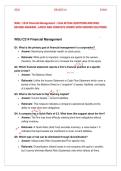
WGU - C214 Financial Management – Final ACTUAL QUESTIONS AND WELL
REVISED ANSWERS - LATEST AND COMPLETE UPDATE WITH VERIFIED SOLUTIONS
WGU C214 Financial Management
Q1: What is the primary goal of financial management in a corporation?
• Answer: Maximizing shareholder wealth (or stock price).
• Rationale: While profit is important, managers are agents for the owners;
therefore, the ultimate objective is to increase the market value of the equity.
Q2: Which financial statement reports a firm's financial position at a specific
point in time?
• Answer: The Balance Sheet.
• Rationale: Unlike the Income Statement or Cash Flow Statement which cover a
period of time, the Balance Sheet is a "snapshot" of assets, liabilities, and equity
at a specific date.
Q3: What is the formula for Net Working Capital?
• Answer: Current Assets – Current Liabilities.
• Rationale: This measure indicates a company's operational liquidity and its
ability to meet short-term obligations.
Q4: A company has a Quick Ratio of 0.5. What does this suggest about the firm?
• Answer: The firm may have difficulty meeting short-term obligations without
selling inventory.
• Rationale: A Quick Ratio (Acid-Test) excludes inventory; a value below 1.0
indicates that liquid assets are insufficient to cover current liabilities.
Q5: Which type of risk can be eliminated through diversification?
• Answer: Idiosyncratic Risk (Unsystematic/Firm-specific risk).
• Rationale: Diversification offsets losses in one company with gains in another,
but it cannot eliminate Market Risk (Systematic risk) which affects all firms.
,2026 GRADED A+ EXAM
Q6: What does a high Inventory Turnover ratio typically indicate?
• Answer: Efficient inventory management or strong sales.
• Rationale: A higher ratio means the company is selling and replacing its stock
frequently, reducing the capital tied up in unsold goods.
Q7: In a Time Value of Money (TVM) calculation, what happens to the Present
Value (PV) as the discount rate increases?
• Answer: The Present Value decreases.
• Rationale: There is an inverse relationship between interest rates and PV; a
higher rate "discounts" the future value more aggressively.
Q8: What is the definition of an Annuity Due?
• Answer: A series of equal payments made at the beginning of each period.
• Rationale: This differs from an Ordinary Annuity, where payments are made at
the end of each period (e.g., a standard mortgage).
Q9: If a bond's Coupon Rate is higher than the Market Interest Rate (YTM), the
bond will sell at:
• Answer: A Premium.
• Rationale: Investors are willing to pay more than par value for a bond that offers
a higher interest payment than the current market average.
Q10: What is the relationship between bond prices and market interest rates?
• Answer: Inverse relationship.
• Rationale: When market rates rise, existing bonds with lower fixed coupons
become less attractive, causing their prices to fall.
Q11: Which capital budgeting technique is generally considered the best for
decision-making?
• Answer: Net Present Value (NPV).
• Rationale: NPV accounts for the time value of money and directly measures the
expected increase in shareholder wealth in dollar terms.
Q12: If the Internal Rate of Return (IRR) is greater than the Cost of Capital
(WACC), the project should be:
• Answer: Accepted.
, 2026 GRADED A+ EXAM
• Rationale: An IRR exceeding the required return indicates that the project’s
expected return is higher than the cost of the funds used to finance it.
Q13: What does the Weighted Average Cost of Capital (WACC) represent?
• Answer: The average cost a firm pays to its investors (debt and equity holders)
for using their capital.
• Rationale: It is the "hurdle rate" that projects must beat to create value for the
firm.
Q14: Why is the cost of debt usually lower than the cost of equity?
• Answer: Debt is less risky for investors (seniority) and interest payments are tax-
deductible.
• Rationale: The "tax shield" reduces the effective cost of debt to the firm,
whereas dividends are paid with after-tax dollars.
Q15: What is the formula for the Gordon Growth Model (Constant Growth Model)?
• Answer: Price = D1 / (k - g).
• Rationale: This model values a stock based on the next expected dividend (D1)
divided by the required return (k) minus the constant growth rate (g).
Q16: What is a "Sunk Cost" in capital budgeting?
• Answer: A cost that has already been incurred and cannot be recovered.
• Rationale: Sunk costs (like a market study done last year) should
be ignored when deciding whether to accept a new project.
Q17: What does Beta (β) measure in the CAPM model?
• Answer: Systematic Risk (Market Risk).
• Rationale: Beta measures how much an individual stock moves in relation to the
overall market. A beta of 1.0 moves exactly with the market.
Q18: Which ratio measures a firm's ability to pay its interest expense?
• Answer: Times Interest Earned (TIE) ratio.
• Rationale: Calculated as EBIT / Interest Expense; it shows how many "times"
over the company can cover its debt obligations with operating income.
Q19: What is the primary disadvantage of the Payback Period method?
WGU - C214 Financial Management – Final ACTUAL QUESTIONS AND WELL
REVISED ANSWERS - LATEST AND COMPLETE UPDATE WITH VERIFIED SOLUTIONS
WGU C214 Financial Management
Q1: What is the primary goal of financial management in a corporation?
• Answer: Maximizing shareholder wealth (or stock price).
• Rationale: While profit is important, managers are agents for the owners;
therefore, the ultimate objective is to increase the market value of the equity.
Q2: Which financial statement reports a firm's financial position at a specific
point in time?
• Answer: The Balance Sheet.
• Rationale: Unlike the Income Statement or Cash Flow Statement which cover a
period of time, the Balance Sheet is a "snapshot" of assets, liabilities, and equity
at a specific date.
Q3: What is the formula for Net Working Capital?
• Answer: Current Assets – Current Liabilities.
• Rationale: This measure indicates a company's operational liquidity and its
ability to meet short-term obligations.
Q4: A company has a Quick Ratio of 0.5. What does this suggest about the firm?
• Answer: The firm may have difficulty meeting short-term obligations without
selling inventory.
• Rationale: A Quick Ratio (Acid-Test) excludes inventory; a value below 1.0
indicates that liquid assets are insufficient to cover current liabilities.
Q5: Which type of risk can be eliminated through diversification?
• Answer: Idiosyncratic Risk (Unsystematic/Firm-specific risk).
• Rationale: Diversification offsets losses in one company with gains in another,
but it cannot eliminate Market Risk (Systematic risk) which affects all firms.
,2026 GRADED A+ EXAM
Q6: What does a high Inventory Turnover ratio typically indicate?
• Answer: Efficient inventory management or strong sales.
• Rationale: A higher ratio means the company is selling and replacing its stock
frequently, reducing the capital tied up in unsold goods.
Q7: In a Time Value of Money (TVM) calculation, what happens to the Present
Value (PV) as the discount rate increases?
• Answer: The Present Value decreases.
• Rationale: There is an inverse relationship between interest rates and PV; a
higher rate "discounts" the future value more aggressively.
Q8: What is the definition of an Annuity Due?
• Answer: A series of equal payments made at the beginning of each period.
• Rationale: This differs from an Ordinary Annuity, where payments are made at
the end of each period (e.g., a standard mortgage).
Q9: If a bond's Coupon Rate is higher than the Market Interest Rate (YTM), the
bond will sell at:
• Answer: A Premium.
• Rationale: Investors are willing to pay more than par value for a bond that offers
a higher interest payment than the current market average.
Q10: What is the relationship between bond prices and market interest rates?
• Answer: Inverse relationship.
• Rationale: When market rates rise, existing bonds with lower fixed coupons
become less attractive, causing their prices to fall.
Q11: Which capital budgeting technique is generally considered the best for
decision-making?
• Answer: Net Present Value (NPV).
• Rationale: NPV accounts for the time value of money and directly measures the
expected increase in shareholder wealth in dollar terms.
Q12: If the Internal Rate of Return (IRR) is greater than the Cost of Capital
(WACC), the project should be:
• Answer: Accepted.
, 2026 GRADED A+ EXAM
• Rationale: An IRR exceeding the required return indicates that the project’s
expected return is higher than the cost of the funds used to finance it.
Q13: What does the Weighted Average Cost of Capital (WACC) represent?
• Answer: The average cost a firm pays to its investors (debt and equity holders)
for using their capital.
• Rationale: It is the "hurdle rate" that projects must beat to create value for the
firm.
Q14: Why is the cost of debt usually lower than the cost of equity?
• Answer: Debt is less risky for investors (seniority) and interest payments are tax-
deductible.
• Rationale: The "tax shield" reduces the effective cost of debt to the firm,
whereas dividends are paid with after-tax dollars.
Q15: What is the formula for the Gordon Growth Model (Constant Growth Model)?
• Answer: Price = D1 / (k - g).
• Rationale: This model values a stock based on the next expected dividend (D1)
divided by the required return (k) minus the constant growth rate (g).
Q16: What is a "Sunk Cost" in capital budgeting?
• Answer: A cost that has already been incurred and cannot be recovered.
• Rationale: Sunk costs (like a market study done last year) should
be ignored when deciding whether to accept a new project.
Q17: What does Beta (β) measure in the CAPM model?
• Answer: Systematic Risk (Market Risk).
• Rationale: Beta measures how much an individual stock moves in relation to the
overall market. A beta of 1.0 moves exactly with the market.
Q18: Which ratio measures a firm's ability to pay its interest expense?
• Answer: Times Interest Earned (TIE) ratio.
• Rationale: Calculated as EBIT / Interest Expense; it shows how many "times"
over the company can cover its debt obligations with operating income.
Q19: What is the primary disadvantage of the Payback Period method?

