NSG 6001 FINAL EXAM 1 – QUESTION AND ANSWERS (Graded A+) LATEST UPDATE
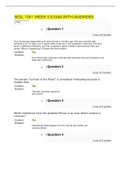
NSG 6001 FINAL EXAM 1 – QUESTION AND ANSWERS 1. More than half of all cardiac arrhymias involve the atria 2. What are the most common symptoms caused by tachyarryhthmias - Palpitations 3. For women with known cad and diabetes, which is the most appropriate to assess CAD risk 4. Of the following, which is the best answer when asked about the advantage of echocardiogram exercise testing over thallium stress testing 5. You patient has uncomplicated pyelonephritis. In deciding your recommended treatment, you consider the most common pathogenic reason for this diagnosis. What pathogen accounts for the majority of pyelonephritis? 6. What purpose does the principle of fidelity serve In CAD after both systolic and diastolic dysfunction have occurred. The typical pattern of chest pain and related EKG changes occur. During an ekg you should expect to see ST segment and T wave changes that are central to demonstration of ischemia occurring relatively late in the ischemic cascade is this true or false 7. The leads on the ECG showing ischemic changes during or immediately after an ETT can correlate roughly to the culprit artery or arteries with significant CAD. Is this true or false 8. Skin cancer is the most common malignant neoplasms in males in the us . What is the second leading cause of cancer deaths in men greater than 50 years of age 9. What ech changes can reduce the specificity of the ETT 10. You have confirmed that your patient does indeed have an abdominal aortic aneurysm. In teaching your patient about symptoms to report immediately to the vascular surgeon you instruct the patient to report which of the following Which is one of the common causes of a saccular abdominal aneurysm 11. The diagnostic accuracy of stress testing is decreased among women compared to men for what reasons 12. Population disease management is a term used to describe 13. You receive a report back on the suspected abdominal aortic aneurysm for your patient. It confirms your suspicion of AAA. The report describes the aneurysm as a symmetric weakness of the entire circumference of the aorta. You know that this form of aneurysm is referred to as what kind of aneurysm 14. You practice partner just ordered an exercise echocardiograph 2DE for a patient with suspected cardiovascular risk. This patient has known resting wall motion abnormalities. Why would this not be the best test to assess this patient’s cardiac risk 15. Your 60-year-old male patient arrives for his appointment. He complains of general malaise and fever over the past several days with low back pain. He also states that he is getting up at night more often to urinate and never feels his bladder is completely empty. What differential diagnosis should you consider in this patient We all know that collaboration in integral to becoming a successful nurse practitioner. Among collaboration, however, only one can be considered the most important. While each example below is important, which is the most important collaboration. The one that occurs 16. The sensitivity of a routine ETT is effort dependent. What physiological changes occur during effort in the routine ETT? 17. A 47-year-old female with general complaints of fatigue and shortness of breath show up in your clinic as a referral from another nurse practitioner. Several blood tests and chest xrays have been completed without any diagnosis or outstanding abnormalities. You decide to order an ETT despite the fact that the recent ecg does not show any abnormalities. From the answers below which would be the best answer to support your decision
Escuela, estudio y materia
- Institución
- Walden University
- Grado
- NSG 6001 FINAL EXAM 1 – QUESTION AND ANSWERS (NSG6001FINALEXAM1–QUESTIONANDANSWERS)
Información del documento
- Subido en
- 30 de marzo de 2021
- Número de páginas
- 7
- Escrito en
- 2020/2021
- Tipo
- Examen
- Contiene
- Preguntas y respuestas
Temas
-
nsg 6001 final exam 1 – question and answers 1 more than half of all cardiac arrhymias involve the atria 2 what are the most common symptoms caused by tachyarryhthmias palpitations 3 for women