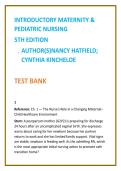
INTRODUCTORY MATERNITY &
PEDIATRIC NURSING
5TH EDITION
• AUTHOR(S)NANCY HATFIELD;
CYNTHIA KINCHELOE
TEST BANK
Ch. 1 — The Nurse’s Role in a Changing Maternal–Child
Healthcare Environment
1) A 24-hour postpartum mother who had a spontaneous
vaginal birth says she feels “overwhelmed” and tearful while
her partner has returned to work. The mother reports she is
unsure how to care for the newborn and is reluctant to ask
family members for help. Which nursing action is the best initial
approach?
A. Arrange a social work consult for home-visiting support after
discharge.
,B. Teach the mother step-by-step newborn care tasks and
provide a written checklist.
C. Encourage the mother to call a family member and schedule
a family teaching session.
D. Assess the mother’s emotional state, coping resources, and
immediate support needs.
Correct answer: D
Rationale — Correct: Assessing the mother’s emotional state
and immediate support/coping resources is the priority to
determine risk for postpartum mood disorder and to tailor
interventions. This assessment guides whether immediate
teaching, referrals, or safety planning are necessary and aligns
with family-centered, individualized care.
Rationale — Incorrect A: Social work referral may be
appropriate but is premature before assessing current coping
and urgency; it also delays immediate nursing interventions.
Rationale — Incorrect B: Teaching is important, but without
assessing emotional readiness and coping the education may be
ineffective.
Rationale — Incorrect C: Family involvement can help, but the
mother may need immediate assessment and support before
outreach.
Teaching point: Always assess coping/support before planning
postpartum interventions.
Citation: Hatfield, N., & Kincheloe, C. (2023). Introductory
maternity & pediatric nursing (5th ed.). Ch. 1.
,Ch. 1 — The Nurse’s Role in a Changing Maternal–Child
Healthcare Environment
2) A nurse on a pediatric unit is delegating tasks to a nursing
assistant (UAP). Which delegated task is appropriate for the
UAP?
A. Measure and document oral temperature on a 3-year-old
with fever.
B. Teach a parent how to perform infant CPR.
C. Perform an initial assessment of a newborn on admission.
D. Administer oral antibiotics to a preschooler.
Correct answer: A
Rationale — Correct: Measuring and documenting vital signs is
within typical UAP scope when the nurse provides direction and
remains responsible for interpreting findings. Delegation of
routine data collection is appropriate provided competency and
supervision.
Rationale — Incorrect B: Teaching CPR is a nursing
responsibility requiring clinical judgement and assessment of
learning needs— not appropriate to delegate to UAP.
Rationale — Incorrect C: Initial assessment requires clinical
judgment and interpretation; the nurse must perform it.
Rationale — Incorrect D: Medication administration requires
licensure and is not delegable to UAP.
, Teaching point: Delegate data collection, not assessment or
teaching/medication tasks.
Citation: Hatfield, N., & Kincheloe, C. (2023). Introductory
maternity & pediatric nursing (5th ed.). Ch. 1.
Ch. 1 — The Nurse’s Role in a Changing Maternal–Child
Healthcare Environment
3) A 16-year-old pregnant adolescent arrives for prenatal care
requesting confidentiality about her visit from her parents.
According to nursing responsibilities, what is the nurse’s best
action?
A. Refuse and notify the parents immediately because the
adolescent is a minor.
B. Explain the limits of confidentiality and provide private
counseling while encouraging parental involvement.
C. Require the adolescent to have a parent present before any
services are provided.
D. Document the visit but avoid discussing confidentiality or
parental notification.
Correct answer: B
Rationale — Correct: The nurse should explain confidentiality
limits, provide private, nonjudgmental counseling, and
encourage parental involvement when appropriate.
Adolescents often have rights to confidential reproductive
health services; the nurse must balance legal/ethical
PEDIATRIC NURSING
5TH EDITION
• AUTHOR(S)NANCY HATFIELD;
CYNTHIA KINCHELOE
TEST BANK
Ch. 1 — The Nurse’s Role in a Changing Maternal–Child
Healthcare Environment
1) A 24-hour postpartum mother who had a spontaneous
vaginal birth says she feels “overwhelmed” and tearful while
her partner has returned to work. The mother reports she is
unsure how to care for the newborn and is reluctant to ask
family members for help. Which nursing action is the best initial
approach?
A. Arrange a social work consult for home-visiting support after
discharge.
,B. Teach the mother step-by-step newborn care tasks and
provide a written checklist.
C. Encourage the mother to call a family member and schedule
a family teaching session.
D. Assess the mother’s emotional state, coping resources, and
immediate support needs.
Correct answer: D
Rationale — Correct: Assessing the mother’s emotional state
and immediate support/coping resources is the priority to
determine risk for postpartum mood disorder and to tailor
interventions. This assessment guides whether immediate
teaching, referrals, or safety planning are necessary and aligns
with family-centered, individualized care.
Rationale — Incorrect A: Social work referral may be
appropriate but is premature before assessing current coping
and urgency; it also delays immediate nursing interventions.
Rationale — Incorrect B: Teaching is important, but without
assessing emotional readiness and coping the education may be
ineffective.
Rationale — Incorrect C: Family involvement can help, but the
mother may need immediate assessment and support before
outreach.
Teaching point: Always assess coping/support before planning
postpartum interventions.
Citation: Hatfield, N., & Kincheloe, C. (2023). Introductory
maternity & pediatric nursing (5th ed.). Ch. 1.
,Ch. 1 — The Nurse’s Role in a Changing Maternal–Child
Healthcare Environment
2) A nurse on a pediatric unit is delegating tasks to a nursing
assistant (UAP). Which delegated task is appropriate for the
UAP?
A. Measure and document oral temperature on a 3-year-old
with fever.
B. Teach a parent how to perform infant CPR.
C. Perform an initial assessment of a newborn on admission.
D. Administer oral antibiotics to a preschooler.
Correct answer: A
Rationale — Correct: Measuring and documenting vital signs is
within typical UAP scope when the nurse provides direction and
remains responsible for interpreting findings. Delegation of
routine data collection is appropriate provided competency and
supervision.
Rationale — Incorrect B: Teaching CPR is a nursing
responsibility requiring clinical judgement and assessment of
learning needs— not appropriate to delegate to UAP.
Rationale — Incorrect C: Initial assessment requires clinical
judgment and interpretation; the nurse must perform it.
Rationale — Incorrect D: Medication administration requires
licensure and is not delegable to UAP.
, Teaching point: Delegate data collection, not assessment or
teaching/medication tasks.
Citation: Hatfield, N., & Kincheloe, C. (2023). Introductory
maternity & pediatric nursing (5th ed.). Ch. 1.
Ch. 1 — The Nurse’s Role in a Changing Maternal–Child
Healthcare Environment
3) A 16-year-old pregnant adolescent arrives for prenatal care
requesting confidentiality about her visit from her parents.
According to nursing responsibilities, what is the nurse’s best
action?
A. Refuse and notify the parents immediately because the
adolescent is a minor.
B. Explain the limits of confidentiality and provide private
counseling while encouraging parental involvement.
C. Require the adolescent to have a parent present before any
services are provided.
D. Document the visit but avoid discussing confidentiality or
parental notification.
Correct answer: B
Rationale — Correct: The nurse should explain confidentiality
limits, provide private, nonjudgmental counseling, and
encourage parental involvement when appropriate.
Adolescents often have rights to confidential reproductive
health services; the nurse must balance legal/ethical