HAZARDOUS EARTH
1. WHAT IS THE EVIDENCE FOR CONTINENTAL DRIFT AND PLATE TECTONICS?
1.A. THERE IS A VARIETY OF EVIDENCE FOR THE THEORIES OF CONTINENTAL DRIFT AND
PLATE TECTONICS.
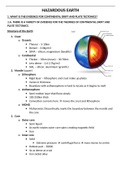
Structure of the Earth
1. Crust
o Oceanic
Thinner – 5-10km
Denser – 3.0kg/m3
SIMA – silicon, magnesium (basaltic)
o Continental
Thicker – 35km (mean) – 30-70km
Less dense – 2.6-2.7kg/m3
SIAL – silicon, aluminium (granitic)
2. Mantle (upper)
o Lithosphere
Rigid layer – lithosphere and crust make up plates
Varies in thickness
Boundary with asthenosphere is hard to locate as it begins to melt
o Asthenosphere
Semi-molten layer that flows slowly
100-250km thick
Convection currents here moves the crust and lithosphere
o MOHO
Mohorovicic Discontinuity marks the boundary between the mantle and
the core
3. Core
o Outer core
Semi liquid
As earth rotates outer core spins creating magnetic field
Iron
o Inner core
Solid
Extreme pressure centrifugal force mass moves to centre
Hottest part – 5000C
4x as dense as crust
Iron-nickel alloy
,Plate Movement
Convection Currents
1. Area of intense heat in core caused by radioactive decay/primeval heat
2. This heats mantle causes powerful thermal current of magma rises
towards surface
3. Reaches surface and forced to diverge dragging plate with it (constructive
margin)
4. This occurs due to friction at the Moho
5. Where 2 convection currents converge, crust is dragged inside the earth –
subduction (destructive margin)
6. Magma begins to cool and sink, and the process starts again
Ridge push
o Plates diverge upwelling of hot magma
o This pushes upwards creating a buoyant elevated area of earths surface called
a ridge
o Gravity acts on downward slope of the ridge, pulling it away from the margin
o Rock cools as it moves away, becomes more dense
Slab pull
o Pulling force exerted by old, cold dense oceanic plate subducting
o Cooler sinking plate pulls the rest of the young warmer plate behind it
Evaluation
Importance varies depending on location
Importance varies depending on plate – each plate moves at its own rate
All are important – there is no single mechanism for plate movement
, Continental Drift
‘The present distribution of continents is the result of the breakup of larger
landmasses’
Pangea (supercontinent) Laurasia and Gondwanaland 7 continents
Alfred Wegener
o Meteorologist not geologist
o Disproves lots of other theories wasted research
o Rocks shouldn’t be able to move
Biological Evidence
Fossils of the same organisms have been found in different continents:
o Cynognathus
Reptile found in South America and Africa
o Mesosaurus
Freshwater reptile found in South America and Africa
o Glossopteris
Plant found on all continents
Therefore, land masses must have once been joined land bridge theory? (Edward
Suess)
Geological Evidence
Continents eg South America and Africa fit together almost perfectly – Jigsaw fit
theory
Appalachian Mountains = same rock type, structure and strata as Scottish Highlands
and Scandinavia
Therefore, suggests land masses were once joined together
Paleoclimatic Evidence
Ice Sheets
o Glacial moraine in Africa suggests it was once glaciated so must have been
further south
Tropical Swamps
o Coal found it UK – comes from dead organic matter from nutrient rich tropical
trees so UK must have been further South and had a warmer climate
1. WHAT IS THE EVIDENCE FOR CONTINENTAL DRIFT AND PLATE TECTONICS?
1.A. THERE IS A VARIETY OF EVIDENCE FOR THE THEORIES OF CONTINENTAL DRIFT AND
PLATE TECTONICS.
Structure of the Earth
1. Crust
o Oceanic
Thinner – 5-10km
Denser – 3.0kg/m3
SIMA – silicon, magnesium (basaltic)
o Continental
Thicker – 35km (mean) – 30-70km
Less dense – 2.6-2.7kg/m3
SIAL – silicon, aluminium (granitic)
2. Mantle (upper)
o Lithosphere
Rigid layer – lithosphere and crust make up plates
Varies in thickness
Boundary with asthenosphere is hard to locate as it begins to melt
o Asthenosphere
Semi-molten layer that flows slowly
100-250km thick
Convection currents here moves the crust and lithosphere
o MOHO
Mohorovicic Discontinuity marks the boundary between the mantle and
the core
3. Core
o Outer core
Semi liquid
As earth rotates outer core spins creating magnetic field
Iron
o Inner core
Solid
Extreme pressure centrifugal force mass moves to centre
Hottest part – 5000C
4x as dense as crust
Iron-nickel alloy
,Plate Movement
Convection Currents
1. Area of intense heat in core caused by radioactive decay/primeval heat
2. This heats mantle causes powerful thermal current of magma rises
towards surface
3. Reaches surface and forced to diverge dragging plate with it (constructive
margin)
4. This occurs due to friction at the Moho
5. Where 2 convection currents converge, crust is dragged inside the earth –
subduction (destructive margin)
6. Magma begins to cool and sink, and the process starts again
Ridge push
o Plates diverge upwelling of hot magma
o This pushes upwards creating a buoyant elevated area of earths surface called
a ridge
o Gravity acts on downward slope of the ridge, pulling it away from the margin
o Rock cools as it moves away, becomes more dense
Slab pull
o Pulling force exerted by old, cold dense oceanic plate subducting
o Cooler sinking plate pulls the rest of the young warmer plate behind it
Evaluation
Importance varies depending on location
Importance varies depending on plate – each plate moves at its own rate
All are important – there is no single mechanism for plate movement
, Continental Drift
‘The present distribution of continents is the result of the breakup of larger
landmasses’
Pangea (supercontinent) Laurasia and Gondwanaland 7 continents
Alfred Wegener
o Meteorologist not geologist
o Disproves lots of other theories wasted research
o Rocks shouldn’t be able to move
Biological Evidence
Fossils of the same organisms have been found in different continents:
o Cynognathus
Reptile found in South America and Africa
o Mesosaurus
Freshwater reptile found in South America and Africa
o Glossopteris
Plant found on all continents
Therefore, land masses must have once been joined land bridge theory? (Edward
Suess)
Geological Evidence
Continents eg South America and Africa fit together almost perfectly – Jigsaw fit
theory
Appalachian Mountains = same rock type, structure and strata as Scottish Highlands
and Scandinavia
Therefore, suggests land masses were once joined together
Paleoclimatic Evidence
Ice Sheets
o Glacial moraine in Africa suggests it was once glaciated so must have been
further south
Tropical Swamps
o Coal found it UK – comes from dead organic matter from nutrient rich tropical
trees so UK must have been further South and had a warmer climate