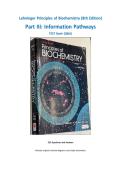
Lehninger-Principles-of-Biochemistry-(8th-Edition)
Part-III:-Information-Pathways
TEST-Bank-(Q&A)
225-Questions-and-Answers
Includes-original-colored-diagrams-and-study-schematics.
,Contents
1. Section-1:-Nucleotides-and-Nucleic-Acids-Basics
2. Section-2:-DNA-Structure,-Chromatin,-and-Topology
3. Section-3:-DNA-Replication-and-Telomeres
4. Section-4:-DNA-Repair,-Damage-Responses,-and-Recombination
5. Section-5:-Transcription-in-Prokaryotes-and-Eukaryotes
6. Section-6:-RNA-Processing-and-RNA-Mediated-Regulation
7. Section-7:-Translation,-Genetic-Code,-and-Antibiotics
8. Section-8:-Protein-Targeting,-Folding,-and-Quality-Control
9. Section-9:-Regulation-of-Gene-Expression-and-Epigenetics
10. Section-10:-Recombinant-DNA,-PCR,-Sequencing,-and-Genome-Editing
11. Section-11:-Genomics,-Transcriptomics,-Proteomics,-and-Bioinformatics
,Section-1:-Nucleotides-and-Nucleic-Acids-Basics
Figure:-Central-dogma-and-information-flow-(schematic).
Q001-[MCQ]-Which-statement-best-distinguishes-a-nucleoside-from-a-nucleotide?
A.-A-nucleoside-contains-phosphate;-a-nucleotide-does-not.
B.-A-nucleoside-is-base-+-sugar;-a-nucleotide-is-base-+-sugar-+-one-or-more-phosphates.
C.-A-nucleoside-contains-ribose-only;-a-nucleotide-contains-deoxyribose-only.
D.-A-nucleoside-contains-two-bases;-a-nucleotide-contains-one-base.
Answer:-B.
Explanation:-Nucleosides-are-composed-of-a-nitrogenous-base-linked-to-a-pentose-sugar;-nucleotides-
add-phosphate-group(s).
Q002-[Short]-Name-the-two-purine-bases-found-in-nucleic-acids.
Answer:-Adenine-and-guanine.
Q003-[Short]-Name-the-three-pyrimidine-bases-commonly-found-in-DNA-and-RNA.
Answer:-Cytosine,-thymine-(DNA),-and-uracil-(RNA).
Q004-[T/F]-In-nucleic-acids,-phosphodiester-bonds-connect-the-3'-hydroxyl-of-one-sugar-to-the-5'-
phosphate-of-the-next-sugar.
Answer:-True.
, Q005-[Fill-in]-The-base-pair-stabilized-by-three-hydrogen-bonds-is-________.
Answer:-G-C-(guanine-cytosine).
Q006-[Short]-What-is-meant-by-'antiparallel'-strands-in-double-stranded-DNA?
Answer:-The-two-strands-run-in-opposite-directions:-one-5'→3'-and-the-other-3'→5'.
Q007-[MCQ]-At-physiological-pH,-which-part-of-a-nucleotide-is-typically-negatively-charged?
A.-The-nitrogenous-base
B.-The-ribose-ring-oxygen
C.-The-phosphate-group(s)
D.-The-glycosidic-bond
Answer:-C.
Explanation:-Phosphate-groups-are-deprotonated-and-carry-negative-charge-at-physiological-pH.
Q008-[Short]-Define-Chargaff's-rules-for-double-stranded-DNA.
Answer:-In-dsDNA,-[A]=[T]-and-[G]=[C];-total-purines-equal-total-pyrimidines.
Q009-[Short]-What-is-the-'hyperchromic-effect'-observed-when-DNA-melts?
Answer:-UV-absorbance-at-260-nm-increases-as-bases-unstack-during-denaturation.
Q010-[Calculation]-A-DNA-sample-has-A260-=-0.80-in-a-1-cm-cuvette.-Using-1-A260-unit-≈-50-µg/mL-
for-dsDNA,-estimate-concentration.
Answer:-Concentration-≈-0.80-×-50-µg/mL-=-40-µg/mL.
Q011-[MCQ]-Which-feature-most-strongly-contributes-to-the-stability-of-the-DNA-double-helix?
A.-Ionic-bonds-between-bases
B.-Base-stacking-(hydrophobic/van-der-Waals)-interactions
C.-Covalent-bonds-between-base-pairs
D.-Peptide-crosslinks
Answer:-B.
Explanation:-Base-stacking-provides-major-stabilizing-energy;-H-bonds-provide-specificity.
Part-III:-Information-Pathways
TEST-Bank-(Q&A)
225-Questions-and-Answers
Includes-original-colored-diagrams-and-study-schematics.
,Contents
1. Section-1:-Nucleotides-and-Nucleic-Acids-Basics
2. Section-2:-DNA-Structure,-Chromatin,-and-Topology
3. Section-3:-DNA-Replication-and-Telomeres
4. Section-4:-DNA-Repair,-Damage-Responses,-and-Recombination
5. Section-5:-Transcription-in-Prokaryotes-and-Eukaryotes
6. Section-6:-RNA-Processing-and-RNA-Mediated-Regulation
7. Section-7:-Translation,-Genetic-Code,-and-Antibiotics
8. Section-8:-Protein-Targeting,-Folding,-and-Quality-Control
9. Section-9:-Regulation-of-Gene-Expression-and-Epigenetics
10. Section-10:-Recombinant-DNA,-PCR,-Sequencing,-and-Genome-Editing
11. Section-11:-Genomics,-Transcriptomics,-Proteomics,-and-Bioinformatics
,Section-1:-Nucleotides-and-Nucleic-Acids-Basics
Figure:-Central-dogma-and-information-flow-(schematic).
Q001-[MCQ]-Which-statement-best-distinguishes-a-nucleoside-from-a-nucleotide?
A.-A-nucleoside-contains-phosphate;-a-nucleotide-does-not.
B.-A-nucleoside-is-base-+-sugar;-a-nucleotide-is-base-+-sugar-+-one-or-more-phosphates.
C.-A-nucleoside-contains-ribose-only;-a-nucleotide-contains-deoxyribose-only.
D.-A-nucleoside-contains-two-bases;-a-nucleotide-contains-one-base.
Answer:-B.
Explanation:-Nucleosides-are-composed-of-a-nitrogenous-base-linked-to-a-pentose-sugar;-nucleotides-
add-phosphate-group(s).
Q002-[Short]-Name-the-two-purine-bases-found-in-nucleic-acids.
Answer:-Adenine-and-guanine.
Q003-[Short]-Name-the-three-pyrimidine-bases-commonly-found-in-DNA-and-RNA.
Answer:-Cytosine,-thymine-(DNA),-and-uracil-(RNA).
Q004-[T/F]-In-nucleic-acids,-phosphodiester-bonds-connect-the-3'-hydroxyl-of-one-sugar-to-the-5'-
phosphate-of-the-next-sugar.
Answer:-True.
, Q005-[Fill-in]-The-base-pair-stabilized-by-three-hydrogen-bonds-is-________.
Answer:-G-C-(guanine-cytosine).
Q006-[Short]-What-is-meant-by-'antiparallel'-strands-in-double-stranded-DNA?
Answer:-The-two-strands-run-in-opposite-directions:-one-5'→3'-and-the-other-3'→5'.
Q007-[MCQ]-At-physiological-pH,-which-part-of-a-nucleotide-is-typically-negatively-charged?
A.-The-nitrogenous-base
B.-The-ribose-ring-oxygen
C.-The-phosphate-group(s)
D.-The-glycosidic-bond
Answer:-C.
Explanation:-Phosphate-groups-are-deprotonated-and-carry-negative-charge-at-physiological-pH.
Q008-[Short]-Define-Chargaff's-rules-for-double-stranded-DNA.
Answer:-In-dsDNA,-[A]=[T]-and-[G]=[C];-total-purines-equal-total-pyrimidines.
Q009-[Short]-What-is-the-'hyperchromic-effect'-observed-when-DNA-melts?
Answer:-UV-absorbance-at-260-nm-increases-as-bases-unstack-during-denaturation.
Q010-[Calculation]-A-DNA-sample-has-A260-=-0.80-in-a-1-cm-cuvette.-Using-1-A260-unit-≈-50-µg/mL-
for-dsDNA,-estimate-concentration.
Answer:-Concentration-≈-0.80-×-50-µg/mL-=-40-µg/mL.
Q011-[MCQ]-Which-feature-most-strongly-contributes-to-the-stability-of-the-DNA-double-helix?
A.-Ionic-bonds-between-bases
B.-Base-stacking-(hydrophobic/van-der-Waals)-interactions
C.-Covalent-bonds-between-base-pairs
D.-Peptide-crosslinks
Answer:-B.
Explanation:-Base-stacking-provides-major-stabilizing-energy;-H-bonds-provide-specificity.