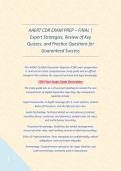
AAERT CDR EXAM PREP – FINAL |
Expert Strategies, Review of Key
Quizzes, and Practice Questions for
Guaranteed Success
This AAERT Certified Deposition Reporter (CDR) exam preparation
is centered on Latest comprehensive study guide and an official
blueprint that outlines the required technical and legal knowledge.
CDR Final Study Guide Description
The study guide acts as a structured roadmap to master the core
competencies of digital deposition reporting. Key components
typically include:
Legal Frameworks: In-depth coverage of U.S. court systems, Federal
Rules of Procedure, and the lifecycle of a case.
Audio Technology: Technical details on microphones (cardioid,
omnidirectional, condenser, and dynamic), sample rates, bit rates,
and multichannel recording.
Procedural Knowledge: Guidelines for exhibit management,
transcript order rules, and handling remote or hybrid proceedings.
Ethics & Professionalism: Strict standards for confidentiality, ethical
obligations, and courtroom etiquette.
Terminology: Comprehensive glossaries for Legal, Medical, and
Latin terminology commonly used in depositions.
1
, Quiz_________________?
Is it appropriate for the reporter to interrupt after a witness has
answered a question non-verbally and ask the witness to answer
out loud? -
Answer☑️
Yes
Quiz_________________?
In the event of an electronic failure, whose responsibiity is it to
interrupt the proceeding? -
Answer☑️
The digital court reporter
Quiz_________________?
Which is preferable when recording audio, a "live" or "dead"
room? -
Answer☑️
Dead
2
, Quiz_________________?
Is it true consistency is not important when making annotations
because the transcriptionist can usually figure it out? -
Answer☑️
False
Quiz_________________?
What needs to happen when a certified question is requested? -
Answer☑️
The digital reporter should make an annotation about the certified
question.
Quiz_________________?
The ________ transcript is usually provided to the first attorney
that orders the transcript. -
Answer☑️
Original
Quiz_________________?
3
Expert Strategies, Review of Key
Quizzes, and Practice Questions for
Guaranteed Success
This AAERT Certified Deposition Reporter (CDR) exam preparation
is centered on Latest comprehensive study guide and an official
blueprint that outlines the required technical and legal knowledge.
CDR Final Study Guide Description
The study guide acts as a structured roadmap to master the core
competencies of digital deposition reporting. Key components
typically include:
Legal Frameworks: In-depth coverage of U.S. court systems, Federal
Rules of Procedure, and the lifecycle of a case.
Audio Technology: Technical details on microphones (cardioid,
omnidirectional, condenser, and dynamic), sample rates, bit rates,
and multichannel recording.
Procedural Knowledge: Guidelines for exhibit management,
transcript order rules, and handling remote or hybrid proceedings.
Ethics & Professionalism: Strict standards for confidentiality, ethical
obligations, and courtroom etiquette.
Terminology: Comprehensive glossaries for Legal, Medical, and
Latin terminology commonly used in depositions.
1
, Quiz_________________?
Is it appropriate for the reporter to interrupt after a witness has
answered a question non-verbally and ask the witness to answer
out loud? -
Answer☑️
Yes
Quiz_________________?
In the event of an electronic failure, whose responsibiity is it to
interrupt the proceeding? -
Answer☑️
The digital court reporter
Quiz_________________?
Which is preferable when recording audio, a "live" or "dead"
room? -
Answer☑️
Dead
2
, Quiz_________________?
Is it true consistency is not important when making annotations
because the transcriptionist can usually figure it out? -
Answer☑️
False
Quiz_________________?
What needs to happen when a certified question is requested? -
Answer☑️
The digital reporter should make an annotation about the certified
question.
Quiz_________________?
The ________ transcript is usually provided to the first attorney
that orders the transcript. -
Answer☑️
Original
Quiz_________________?
3