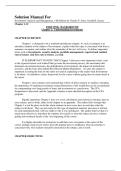
Solution Manual For
Investments Analysis and Management, 14th Edition by Charles P. Jones, Gerald R. Jensen
Chapter 1-22
PART ONE: BACKGROUND
Chapter 1: Understanding Investments
ls for applying theory to practical scenarios. Furthermore, students often practice writing answers to past exams under timed conditions to enhance their ability to structure respo
CHAPTER OVERVIEW
Chapter 1 is designed to be a standard introductory chapter. As such, its purpose is to
introduce students to the subject of Investments, explain what this topic is concerned with from a
summary viewpoint, and outline what the remainder of the text will cover. It defines important
terms such as investments, security analysis, portfolio management, expected and realized
rate of return, risk-free rate of return, and risk.
IT IS IMPORTANT TO NOTE THAT Chapter 1 discusses some important issues, such
as the expected return--risk tradeoff that governs the investment process, the uncertainty that
dominates investment decisions, the globalization of investments, the impact of institutional
investors, and the basic idea behind the Efficient Market Hypothesis. As such, the chapter is
important in setting the tone for the entire text and in explaining to the reader what Investments
is all about. It establishes a basic framework for the course without going into too much detail at
the outset.
Chapter 1 also contains some material that will be of direct interest to students, including
the importance of studying investments (using illustrations of the wealth that can be accumulated
by compounding over long periods of time) and investments as a profession. The CFA
designation is discussed, and the Appendix contains a more detailed description of the CFA
program.
Equally important, Chapter 1 does not cover calculations and statistical concepts, data on
asset returns, and so forth, either in the chapter or an appendix. The author feels strongly that
Chapter 1 is not the place to do this when students in most cases have no real idea what the
subject is all about. They are not ready for this type of important material, and since it will not
be used immediately they will lose sight of why it was introduced. The author believes that it is
much more effective to introduce the students thoroughly to what the subject involves without
getting into technical details at the very beginning of the course.
It is highly desirable for instructors to add their own viewpoints at the outset of the
course, perhaps using recent stories from the popular press to emphasize what investments is
concerned with, why students should be interested in the subject, and so forth.
CHAPTER OBJECTIVES
1
, To introduce students to the subject matter of Investments from an overall viewpoint,
including terminology.
To explain the basic nature of the investing decision as a tradeoff between expected
return and risk.
To explain that the decision process consists of security analysis and portfolio
management and that external factors affect this decision process. These factors include
uncertainty, the necessity to think of investments in a global context, the environment
involving institutional investors, and the impact of the internet on investing.
To organize the remainder of the text.
MAJOR CHAPTER HEADINGS [Contents]
ls for applying theory to practical scenarios. Furthermore, students often practice writing answers to past exams under timed conditions to enhance their ability to structure respo
The Nature of Investments
Some Definitions
[investment; investments; financial and real assets; marketable securities; portfolio]
A Perspective on Investing in Financial Assets
[investing is only one part of overall financial decisions]
Why Do We Invest?
[to increase monetary wealth]
The Importance of Studying Investments
The Personal Aspects
[most people make some type of investment decisions; examples of wealth accumulation
as a result of compounding; how an understanding of the subject will help students when
reading the popular press]
Investments as a Profession
[various jobs, salary ranges; Chartered Financial Analyst designation]
Understanding the Investment Decision Process
The Basis of Investment Decisions
[expected return; realized return; risk; risk-averse investor; the Expected-Return--Risk
Tradeoff; diagram of tradeoff; ex post vs. ex ante; risk-free rate of return, RF]
Structuring the Decision Process
2
, [a two-step process: security analysis and portfolio management; passive and active
investment strategies; the Efficient Market Hypothesis]
Important Considerations in the Investment Decision Process for Today’s Investors
The Great Unknown
[uncertainty dominates decisions--the future is unknown!]
The Global Investments Arena
[the importance of foreign markets; the Euro; emerging markets]
The New Economy vs. The Old Economy
[old economy stocks are the traditional service, consumer and financial
companies; new economy stocks have a focus on technology, e-commerce, etc.
In most cases the latter have little or no earnings, and certainly don’t pay
dividends in virtually all cases]
The Rise of the Internet
[using the internet to invest; the impact of the sharp market decline in 2000-2001]
Institutional Investors
[individual investors compete with institutional investors, but individuals are the
beneficiaries of institutional investor activity, such as pension funds; the issue of market
efficiency]
ls for applying theory to practical scenarios. Furthermore, students often practice writing answers to past exams under timed conditions to enhance their ability to structure respo
Organizing the Text
[Background; Realized and Expected Returns and Risk; Bonds; Stocks; Security
Analysis, including both fundamental and technical analysis; Derivative Securities;
Portfolio Theory and Capital Market Theory; the Portfolio Management Process and
Measuring Portfolio Performance]
Appendix 1-A The Chartered Financial Analyst Program
[a description of the CFA program]
POINTS TO NOTE ABOUT CHAPTER 1
Tables and Figures
3
, There is only one figure in Chapter 1, but it is crucial because it the basis of investing
decisions--indeed, it is the basis of all finance decisions. It shows the expected return--risk
tradeoff available to investors. This diagram may be desirable to use as a transparency because it
can be used to generate much useful discussion, including:
� The upward-sloping tradeoff that dominates Investments.
� The role of RF, the risk-free rate of return.
� The importance of risk in all discussions of investing.
� The different types of financial assets available.
� The distinction between realized and expected return.
NOTE: THIS DIAGRAM IS RELEVANT ON THE FIRST DAY OF CLASS, AND THE
LAST. IT IS A GOOD WAY TO START THE COURSE, AND TO END IT.
Table 1-1 shows wealth accumulations possible from an IRA-type investment. It
typically generates considerable student interest to see the ending wealth that can be produced by
compounding over time. This type of example can be related to 401 (k) plans, which are quickly
becoming of primary importance to many people.
ls for applying theory to practical scenarios. Furthermore, students often practice writing answers to past exams under timed conditions to enhance their ability to structure respo
Boxed Inserts
Box 1-2 is a good example of why Investments is a difficult subject. It highlights some
predictions by the investing community, which did not work too well. This Box Insert is taken
from a regular feature of Smart Money, and offers a good opportunity to start informing students
about the popular press magazines and newspapers available to investors.
Box 1-2 is a discussion of spinoffs. The discussion indicates that spinoffs do well over a period
of one to three years, unlike many IPOs. Most importantly, individual investor can invest in
spinoffs as well as, or better than, institutional investors. In other words, this is an opportunity
for individual investors to compete effectively in the investing arena. Professional managers
often dump spinoffs because they do not fit in with what they are currently doing. Analysts often
ignore them. Thus, this can be an opportunity for individual investors.
4
Investments Analysis and Management, 14th Edition by Charles P. Jones, Gerald R. Jensen
Chapter 1-22
PART ONE: BACKGROUND
Chapter 1: Understanding Investments
ls for applying theory to practical scenarios. Furthermore, students often practice writing answers to past exams under timed conditions to enhance their ability to structure respo
CHAPTER OVERVIEW
Chapter 1 is designed to be a standard introductory chapter. As such, its purpose is to
introduce students to the subject of Investments, explain what this topic is concerned with from a
summary viewpoint, and outline what the remainder of the text will cover. It defines important
terms such as investments, security analysis, portfolio management, expected and realized
rate of return, risk-free rate of return, and risk.
IT IS IMPORTANT TO NOTE THAT Chapter 1 discusses some important issues, such
as the expected return--risk tradeoff that governs the investment process, the uncertainty that
dominates investment decisions, the globalization of investments, the impact of institutional
investors, and the basic idea behind the Efficient Market Hypothesis. As such, the chapter is
important in setting the tone for the entire text and in explaining to the reader what Investments
is all about. It establishes a basic framework for the course without going into too much detail at
the outset.
Chapter 1 also contains some material that will be of direct interest to students, including
the importance of studying investments (using illustrations of the wealth that can be accumulated
by compounding over long periods of time) and investments as a profession. The CFA
designation is discussed, and the Appendix contains a more detailed description of the CFA
program.
Equally important, Chapter 1 does not cover calculations and statistical concepts, data on
asset returns, and so forth, either in the chapter or an appendix. The author feels strongly that
Chapter 1 is not the place to do this when students in most cases have no real idea what the
subject is all about. They are not ready for this type of important material, and since it will not
be used immediately they will lose sight of why it was introduced. The author believes that it is
much more effective to introduce the students thoroughly to what the subject involves without
getting into technical details at the very beginning of the course.
It is highly desirable for instructors to add their own viewpoints at the outset of the
course, perhaps using recent stories from the popular press to emphasize what investments is
concerned with, why students should be interested in the subject, and so forth.
CHAPTER OBJECTIVES
1
, To introduce students to the subject matter of Investments from an overall viewpoint,
including terminology.
To explain the basic nature of the investing decision as a tradeoff between expected
return and risk.
To explain that the decision process consists of security analysis and portfolio
management and that external factors affect this decision process. These factors include
uncertainty, the necessity to think of investments in a global context, the environment
involving institutional investors, and the impact of the internet on investing.
To organize the remainder of the text.
MAJOR CHAPTER HEADINGS [Contents]
ls for applying theory to practical scenarios. Furthermore, students often practice writing answers to past exams under timed conditions to enhance their ability to structure respo
The Nature of Investments
Some Definitions
[investment; investments; financial and real assets; marketable securities; portfolio]
A Perspective on Investing in Financial Assets
[investing is only one part of overall financial decisions]
Why Do We Invest?
[to increase monetary wealth]
The Importance of Studying Investments
The Personal Aspects
[most people make some type of investment decisions; examples of wealth accumulation
as a result of compounding; how an understanding of the subject will help students when
reading the popular press]
Investments as a Profession
[various jobs, salary ranges; Chartered Financial Analyst designation]
Understanding the Investment Decision Process
The Basis of Investment Decisions
[expected return; realized return; risk; risk-averse investor; the Expected-Return--Risk
Tradeoff; diagram of tradeoff; ex post vs. ex ante; risk-free rate of return, RF]
Structuring the Decision Process
2
, [a two-step process: security analysis and portfolio management; passive and active
investment strategies; the Efficient Market Hypothesis]
Important Considerations in the Investment Decision Process for Today’s Investors
The Great Unknown
[uncertainty dominates decisions--the future is unknown!]
The Global Investments Arena
[the importance of foreign markets; the Euro; emerging markets]
The New Economy vs. The Old Economy
[old economy stocks are the traditional service, consumer and financial
companies; new economy stocks have a focus on technology, e-commerce, etc.
In most cases the latter have little or no earnings, and certainly don’t pay
dividends in virtually all cases]
The Rise of the Internet
[using the internet to invest; the impact of the sharp market decline in 2000-2001]
Institutional Investors
[individual investors compete with institutional investors, but individuals are the
beneficiaries of institutional investor activity, such as pension funds; the issue of market
efficiency]
ls for applying theory to practical scenarios. Furthermore, students often practice writing answers to past exams under timed conditions to enhance their ability to structure respo
Organizing the Text
[Background; Realized and Expected Returns and Risk; Bonds; Stocks; Security
Analysis, including both fundamental and technical analysis; Derivative Securities;
Portfolio Theory and Capital Market Theory; the Portfolio Management Process and
Measuring Portfolio Performance]
Appendix 1-A The Chartered Financial Analyst Program
[a description of the CFA program]
POINTS TO NOTE ABOUT CHAPTER 1
Tables and Figures
3
, There is only one figure in Chapter 1, but it is crucial because it the basis of investing
decisions--indeed, it is the basis of all finance decisions. It shows the expected return--risk
tradeoff available to investors. This diagram may be desirable to use as a transparency because it
can be used to generate much useful discussion, including:
� The upward-sloping tradeoff that dominates Investments.
� The role of RF, the risk-free rate of return.
� The importance of risk in all discussions of investing.
� The different types of financial assets available.
� The distinction between realized and expected return.
NOTE: THIS DIAGRAM IS RELEVANT ON THE FIRST DAY OF CLASS, AND THE
LAST. IT IS A GOOD WAY TO START THE COURSE, AND TO END IT.
Table 1-1 shows wealth accumulations possible from an IRA-type investment. It
typically generates considerable student interest to see the ending wealth that can be produced by
compounding over time. This type of example can be related to 401 (k) plans, which are quickly
becoming of primary importance to many people.
ls for applying theory to practical scenarios. Furthermore, students often practice writing answers to past exams under timed conditions to enhance their ability to structure respo
Boxed Inserts
Box 1-2 is a good example of why Investments is a difficult subject. It highlights some
predictions by the investing community, which did not work too well. This Box Insert is taken
from a regular feature of Smart Money, and offers a good opportunity to start informing students
about the popular press magazines and newspapers available to investors.
Box 1-2 is a discussion of spinoffs. The discussion indicates that spinoffs do well over a period
of one to three years, unlike many IPOs. Most importantly, individual investor can invest in
spinoffs as well as, or better than, institutional investors. In other words, this is an opportunity
for individual investors to compete effectively in the investing arena. Professional managers
often dump spinoffs because they do not fit in with what they are currently doing. Analysts often
ignore them. Thus, this can be an opportunity for individual investors.
4