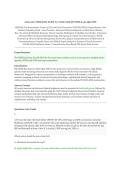
2026/2027 HESI EXIT EXAM V1 | NGN CASE STUDIES & ACTUAL Q&A
HESI RN Exit Examination Version 1 (V1) with Next Generation NCLEX® (NGN) Integration | Core
Domains: Clinical Judgment Application via NGN Items, Comprehensive Patient Scenarios
(Medical-Surgical, Maternal-Newborn, Pediatric, Psychiatric), Pharmacology & Pathophysiology
Integration, Prioritization & Delegation in Complex Cases, Patient Safety & Risk Reduction Strategies,
Therapeutic Communication in Evolving Situations, and Ethical/Legal Considerations in Clinical
Judgment | NCLEX-RN® Readiness Focus | NGN-Enhanced Exit Exam Format
Exam Structure
The HESI Exit Exam V1 with NGN for the 2026/2027 academic cycle is a 150-question, multiple-choice
question (MCQ) and NGN item-type examination.
Introduction
This HESI Exit Exam V1 guide for the 2026/2027 cycle prepares nursing students for the predictor exam
that incorporates foundational Next Generation NCLEX® (NGN) elements. The content assesses clinical
judgment through scenario-based questions and unfolding cases, requiring synthesis of nursing
knowledge, prioritization of care, and application of the nursing process within the NGN framework to
predict readiness for the updated licensure examination.
Answer Format
All correct answers and clinical decisions must be presented in bold and green, followed by detailed
rationales that apply the NGN Clinical Judgment Measurement Model steps, integrate core nursing
knowledge from all content areas, justify priority actions in complex scenarios, and explain the connection
between pathophysiological concepts and nursing interventions.
Questions (150 Total)
1.
A 70-year-old male with heart failure (EF 30%) is admitted with worsening dyspnea, orthopnea, and
bilateral crackles. Vital signs: BP 170/96 mm Hg, HR 118 bpm, RR 30/min, SpO₂ 86% on room air. He is
prescribed furosemide 40 mg IV and oxygen at 2 L/min via nasal cannula.
What is the nurse’s priority action?
A. Administer furosemide as ordered
B. Apply oxygen and elevate head of bed to high Fowler’s position
C. Obtain a STAT chest X-ray
D. Encourage deep breathing exercises
Rationale (NGN Clinical Judgment Model):
Recognize Cues: Severe hypoxia (SpO₂ 86%), tachypnea, crackles, orthopnea.
,Analyze Cues: Signs of acute pulmonary edema—immediate threat to oxygenation.
Prioritize Hypotheses: Inadequate oxygenation is life-threatening and must be addressed before
diuresis.
Generate Solutions: Improve oxygenation via O₂ and positioning to reduce venous return.
Take Action: High Fowler’s position decreases preload; oxygen improves saturation.
Evaluate Outcomes: SpO₂ increases, work of breathing decreases within minutes.
2.
A newborn is delivered via cesarean section at 39 weeks. At 1 minute, the infant has a heart rate of 110
bpm, slow respirations, some flexion, grimacing to stimulation, and acrocyanosis.
What is the Apgar score?
A. 5
B. 6
C. 7
D. 8
Rationale (NGN Clinical Judgment Model):
Recognize Cues: HR >100 = 2; slow respirations = 1; some flexion = 1; grimace = 1; acrocyanosis = 1.
Analyze Cues: Total = 6—moderate transition difficulty.
Prioritize Hypotheses: Requires stimulation and monitoring but not full resuscitation.
Generate Solutions: Dry, warm, stimulate, reassess at 5 minutes.
Take Action: Provide routine newborn care with close observation.
Evaluate Outcomes: Score improves to 8–9 by 5 minutes with supportive care.
3.
A client with schizophrenia refuses antipsychotic medication, stating, “The pills are poison from the
government.”
What is the nurse’s best response?
A. “You have to take your medicine—it’s court-ordered.”
,B. “I understand you’re worried. Can we talk about what concerns you?”
C. “If you don’t take it, you’ll get sicker.”
D. Administer the medication covertly in food
Rationale (NGN Clinical Judgment Model):
Recognize Cues: Delusional thinking, medication refusal.
Analyze Cues: Confrontation may increase paranoia; trust is essential.
Prioritize Hypotheses: Build therapeutic alliance before addressing adherence.
Generate Solutions: Use empathy and open-ended questions to explore fears.
Take Action: Validate feelings without reinforcing delusions.
Evaluate Outcomes: Client feels heard and may agree to discuss alternatives with provider.
4.
A 4-year-old child weighs 16 kg and is prescribed amoxicillin 45 mg/kg/day divided every 12 hours. The
suspension is 250 mg/5 mL.
How many mL should the nurse administer per dose?
A. 6.2 mL
B. 7.2 mL
C. 8.0 mL
D. 9.0 mL
Rationale (NGN Clinical Judgment Model):
Recognize Cues: Weight-based dosing, concentration provided.
Analyze Cues: Total daily dose = 45 × 16 = 720 mg → 360 mg per dose.
Prioritize Hypotheses: Accurate calculation prevents treatment failure or toxicity.
Generate Solutions: (360 mg ÷ 250 mg) × 5 mL = 7.2 mL.
Take Action: Draw up 7.2 mL using calibrated oral syringe.
Evaluate Outcomes: Infection resolves without adverse effects.
, 5.
A postpartum client 24 hours after vaginal delivery has a boggy uterus displaced to the right of midline
and heavy lochia.
What should the nurse do first?
A. Administer oxytocin IV
B. Assist the client to void
C. Massage the fundus vigorously
D. Apply ice packs to the perineum
Rationale (NGN Clinical Judgment Model):
Recognize Cues: Displaced, boggy fundus + heavy bleeding.
Analyze Cues: Full bladder pushes uterus upward and sideways.
Prioritize Hypotheses: Bladder distension is reversible cause of uterine atony.
Generate Solutions: Empty bladder → reassess fundus → massage if still boggy.
Take Action: Offer bedpan or assist to bathroom.
Evaluate Outcomes: Fundus becomes firm and midline; bleeding decreases.
6.
A client with type 1 diabetes has a blood glucose of 52 mg/dL and is conscious but shaky and diaphoretic.
What is the priority intervention?
A. Administer glucagon IM
B. Give 15 g fast-acting carbohydrate (e.g., 4 oz orange juice)
C. Inject regular insulin IV
D. Offer a protein snack
Rationale (NGN Clinical Judgment Model):
Recognize Cues: Hypoglycemia symptoms, conscious patient.
Analyze Cues: Rule of 15 applies for alert patients.
HESI RN Exit Examination Version 1 (V1) with Next Generation NCLEX® (NGN) Integration | Core
Domains: Clinical Judgment Application via NGN Items, Comprehensive Patient Scenarios
(Medical-Surgical, Maternal-Newborn, Pediatric, Psychiatric), Pharmacology & Pathophysiology
Integration, Prioritization & Delegation in Complex Cases, Patient Safety & Risk Reduction Strategies,
Therapeutic Communication in Evolving Situations, and Ethical/Legal Considerations in Clinical
Judgment | NCLEX-RN® Readiness Focus | NGN-Enhanced Exit Exam Format
Exam Structure
The HESI Exit Exam V1 with NGN for the 2026/2027 academic cycle is a 150-question, multiple-choice
question (MCQ) and NGN item-type examination.
Introduction
This HESI Exit Exam V1 guide for the 2026/2027 cycle prepares nursing students for the predictor exam
that incorporates foundational Next Generation NCLEX® (NGN) elements. The content assesses clinical
judgment through scenario-based questions and unfolding cases, requiring synthesis of nursing
knowledge, prioritization of care, and application of the nursing process within the NGN framework to
predict readiness for the updated licensure examination.
Answer Format
All correct answers and clinical decisions must be presented in bold and green, followed by detailed
rationales that apply the NGN Clinical Judgment Measurement Model steps, integrate core nursing
knowledge from all content areas, justify priority actions in complex scenarios, and explain the connection
between pathophysiological concepts and nursing interventions.
Questions (150 Total)
1.
A 70-year-old male with heart failure (EF 30%) is admitted with worsening dyspnea, orthopnea, and
bilateral crackles. Vital signs: BP 170/96 mm Hg, HR 118 bpm, RR 30/min, SpO₂ 86% on room air. He is
prescribed furosemide 40 mg IV and oxygen at 2 L/min via nasal cannula.
What is the nurse’s priority action?
A. Administer furosemide as ordered
B. Apply oxygen and elevate head of bed to high Fowler’s position
C. Obtain a STAT chest X-ray
D. Encourage deep breathing exercises
Rationale (NGN Clinical Judgment Model):
Recognize Cues: Severe hypoxia (SpO₂ 86%), tachypnea, crackles, orthopnea.
,Analyze Cues: Signs of acute pulmonary edema—immediate threat to oxygenation.
Prioritize Hypotheses: Inadequate oxygenation is life-threatening and must be addressed before
diuresis.
Generate Solutions: Improve oxygenation via O₂ and positioning to reduce venous return.
Take Action: High Fowler’s position decreases preload; oxygen improves saturation.
Evaluate Outcomes: SpO₂ increases, work of breathing decreases within minutes.
2.
A newborn is delivered via cesarean section at 39 weeks. At 1 minute, the infant has a heart rate of 110
bpm, slow respirations, some flexion, grimacing to stimulation, and acrocyanosis.
What is the Apgar score?
A. 5
B. 6
C. 7
D. 8
Rationale (NGN Clinical Judgment Model):
Recognize Cues: HR >100 = 2; slow respirations = 1; some flexion = 1; grimace = 1; acrocyanosis = 1.
Analyze Cues: Total = 6—moderate transition difficulty.
Prioritize Hypotheses: Requires stimulation and monitoring but not full resuscitation.
Generate Solutions: Dry, warm, stimulate, reassess at 5 minutes.
Take Action: Provide routine newborn care with close observation.
Evaluate Outcomes: Score improves to 8–9 by 5 minutes with supportive care.
3.
A client with schizophrenia refuses antipsychotic medication, stating, “The pills are poison from the
government.”
What is the nurse’s best response?
A. “You have to take your medicine—it’s court-ordered.”
,B. “I understand you’re worried. Can we talk about what concerns you?”
C. “If you don’t take it, you’ll get sicker.”
D. Administer the medication covertly in food
Rationale (NGN Clinical Judgment Model):
Recognize Cues: Delusional thinking, medication refusal.
Analyze Cues: Confrontation may increase paranoia; trust is essential.
Prioritize Hypotheses: Build therapeutic alliance before addressing adherence.
Generate Solutions: Use empathy and open-ended questions to explore fears.
Take Action: Validate feelings without reinforcing delusions.
Evaluate Outcomes: Client feels heard and may agree to discuss alternatives with provider.
4.
A 4-year-old child weighs 16 kg and is prescribed amoxicillin 45 mg/kg/day divided every 12 hours. The
suspension is 250 mg/5 mL.
How many mL should the nurse administer per dose?
A. 6.2 mL
B. 7.2 mL
C. 8.0 mL
D. 9.0 mL
Rationale (NGN Clinical Judgment Model):
Recognize Cues: Weight-based dosing, concentration provided.
Analyze Cues: Total daily dose = 45 × 16 = 720 mg → 360 mg per dose.
Prioritize Hypotheses: Accurate calculation prevents treatment failure or toxicity.
Generate Solutions: (360 mg ÷ 250 mg) × 5 mL = 7.2 mL.
Take Action: Draw up 7.2 mL using calibrated oral syringe.
Evaluate Outcomes: Infection resolves without adverse effects.
, 5.
A postpartum client 24 hours after vaginal delivery has a boggy uterus displaced to the right of midline
and heavy lochia.
What should the nurse do first?
A. Administer oxytocin IV
B. Assist the client to void
C. Massage the fundus vigorously
D. Apply ice packs to the perineum
Rationale (NGN Clinical Judgment Model):
Recognize Cues: Displaced, boggy fundus + heavy bleeding.
Analyze Cues: Full bladder pushes uterus upward and sideways.
Prioritize Hypotheses: Bladder distension is reversible cause of uterine atony.
Generate Solutions: Empty bladder → reassess fundus → massage if still boggy.
Take Action: Offer bedpan or assist to bathroom.
Evaluate Outcomes: Fundus becomes firm and midline; bleeding decreases.
6.
A client with type 1 diabetes has a blood glucose of 52 mg/dL and is conscious but shaky and diaphoretic.
What is the priority intervention?
A. Administer glucagon IM
B. Give 15 g fast-acting carbohydrate (e.g., 4 oz orange juice)
C. Inject regular insulin IV
D. Offer a protein snack
Rationale (NGN Clinical Judgment Model):
Recognize Cues: Hypoglycemia symptoms, conscious patient.
Analyze Cues: Rule of 15 applies for alert patients.