NR302: Vital Signs, Skin And Nails – Questions With
Step By Step Solutions
Save
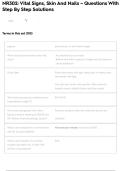
Terms in this set (103)
papura blood spots or skin hemorrages
When should an examiner take vital -As ordered by a provider
signs? -Before and after surgical or diagnostic procedures
-Upon admission
Pulse Rate Pulse rate varies with age, being fast in infancy and
decreases with age.
The rate also varies with gender. After puberty,
females have a slightly faster rate than males.
Which blood pressure reading shows BP 140/90
hypertension stage 2?
The nurse recognizes that with a Pressure present when the ventricles are at rest.
blood pressure reading of 120/90, the
90 reflects what physiologic action? Diastolic
What is an example of a normal heart 48 beats per minute; normal is 60-100
rate for an adult athlete?
What is an example of a normal 92%
oxygen saturation for a client with
chronic lung disease?
,Temperature Temperature is a measurement of the difference
between heat production and heat loss.
While an elevated body temperature can help
destroy foreign invaders (bacteria, viruses, fungi, or
parasites), temperatures exceeding 105° F (40.6° C)
also have the potential to damage normal body cells
Normal range temperatures for 99.6 °F:
different sections RECTAL
TYMPANIC
98.6 °F:
ORAL
97.6 °F:
TEMPORAL
AXILLARY
Hypothermia/Hyperthermia -Low body temp
-High body temp
What is a pulse? A rhythmic beating or vibrating (radial) signifying the
contraction of an artery caused by the ejection of
blood from the left ventricle of the heart.
What is the normal adult pulse rate 60-100 beats per minute.
range?
What is the average adult pulse rate? 80 beats per minute.
, Systolic pressure Top number; measures the pressure in your arteries
when your heart beats and pumps blood; heart is
active
NR: 90-120 mmHg
Diastolic pressure bottom number; measures the pressure in your
arteries when your heart is resting between beats.
NR: 60-80 mmHg
Force of the pulse shows the strength of the heart's stroke volume.
3+ Full, bounding
2+ Normal
1+ Weak, thready
0 Absent
Collecting pulse rate Count the pulsations for one minute. For quicker
ways of obtaining a pulse, counting the pulse for 30
seconds and multiplying by 2,
or counting the pulse for 15 seconds and multiplying
by 4.
Step By Step Solutions
Save
Terms in this set (103)
papura blood spots or skin hemorrages
When should an examiner take vital -As ordered by a provider
signs? -Before and after surgical or diagnostic procedures
-Upon admission
Pulse Rate Pulse rate varies with age, being fast in infancy and
decreases with age.
The rate also varies with gender. After puberty,
females have a slightly faster rate than males.
Which blood pressure reading shows BP 140/90
hypertension stage 2?
The nurse recognizes that with a Pressure present when the ventricles are at rest.
blood pressure reading of 120/90, the
90 reflects what physiologic action? Diastolic
What is an example of a normal heart 48 beats per minute; normal is 60-100
rate for an adult athlete?
What is an example of a normal 92%
oxygen saturation for a client with
chronic lung disease?
,Temperature Temperature is a measurement of the difference
between heat production and heat loss.
While an elevated body temperature can help
destroy foreign invaders (bacteria, viruses, fungi, or
parasites), temperatures exceeding 105° F (40.6° C)
also have the potential to damage normal body cells
Normal range temperatures for 99.6 °F:
different sections RECTAL
TYMPANIC
98.6 °F:
ORAL
97.6 °F:
TEMPORAL
AXILLARY
Hypothermia/Hyperthermia -Low body temp
-High body temp
What is a pulse? A rhythmic beating or vibrating (radial) signifying the
contraction of an artery caused by the ejection of
blood from the left ventricle of the heart.
What is the normal adult pulse rate 60-100 beats per minute.
range?
What is the average adult pulse rate? 80 beats per minute.
, Systolic pressure Top number; measures the pressure in your arteries
when your heart beats and pumps blood; heart is
active
NR: 90-120 mmHg
Diastolic pressure bottom number; measures the pressure in your
arteries when your heart is resting between beats.
NR: 60-80 mmHg
Force of the pulse shows the strength of the heart's stroke volume.
3+ Full, bounding
2+ Normal
1+ Weak, thready
0 Absent
Collecting pulse rate Count the pulsations for one minute. For quicker
ways of obtaining a pulse, counting the pulse for 30
seconds and multiplying by 2,
or counting the pulse for 15 seconds and multiplying
by 4.