Test Bank - Leadership Roles and Management Functions in Nursing 10th Edition (Marquis, 2021)
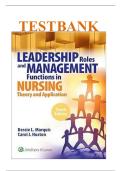
TEST BANK
Leadership Roles and Management Functions in Nursing
Theory and Application
Bessie L. Marquis, Dr. Carol Huston
10th Edition
Page 1
, Test Bank - Leadership Roles and Management Functions in Nursing 10th Edition (Marquis, 2021)
Table of Contents
Unit I: The Critical Triad: Decision Making, Management, and Leadership
Chapter 1: Decision Making, Problem Solving, Critical Thinking, and Clinical Reasoning:
Requisites for Successful Leadership and Management
Chapter 2: Classical Views of Leadership and Management
Chapter 3: Twenty-First-Century Thinking About Leadership and Management
Unit II: Foundation for Effective Leadership and Management: Ethics, Law, and Advocacy
Chapter 4: Ethical Issues
Chapter 5: Legal and Legislative Issues
Chapter 6: Patient, Subordinate, Workplace, and Professional Advocacy
Unit III: Roles and Functions in Planning
Chapter 7: Organization Planning
Chapter 8: Planned Change
Chapter 9: Time Management
Chapter 10: Fiscal Planning and Health-Care Reimbursement
Chapter 11: Career Planning and Development in Nursing
Unit IV: Roles and Functions in Organizing
Chapter 12: Organization Structure
Chapter 13: Organization, Political, and Personal Power
Chapter 14: Organizing Patient Care
Unit V: Roles and Functions in Staffing
Chapter 15: Employee Recruitment, Selection, Placement, and Indoctrination
Chapter 16: Educating and Socializing Staff in a Learning Organization
Chapter 17: Staffing Needs and Scheduling Policies
Unit VI: Roles and Functions in Directing
Chapter 18: Creating a Motivating Climate
Chapter 19: Organization, Interpersonal, and Group Communication in Team Building
Chapter20: Delegation
Chapter 21: Conflict, Workplace Violence, and Negotiations
Chapter 22: Collective Bargaining, Unionization, and Employment Laws
Unit VII: Roles and Functions in Controlling
Chapter 23: Quality Control in Creating a Culture of Patient Safety
Chapter 24: Performance Appraisal
Chapter 25: Problem Employees: Rule Breakers, Marginal Employees, and the Chemically or
Psychologically Impaired
Page 2
, Test Bank - Leadership Roles and Management Functions in Nursing 10th Edition (Marquis, 2021)
Chapter 1 Making, Problem Solving, Critical Thinking, and Clinical Reasoning:
Requisites for successful leadership and management
1. What statement is true regarding decision making?
A) It is an analysis of a situation
B) It is closely related to evaluation
C) It involves choosing between courses of action
D) It is dependent upon finding the cause of a problem Ans: C Feedback:
Decision making is a complex cognitive process often defined as choosing a particular course of action.
Problem solving is part of decision making and is a systematic process that focuses on analyzing a
dificult situation. Critical thinking, sometimes referred to as reflective thinking, is related to evaluation
and has a broader scope than decision making and problem solving.
2. What
1. A) Its need for implementation time
2. B) Its lack of a step requiring evaluation of results
3. C) Its failure to gather suficient data
4. D) Its failure to evaluate alternatives
Ans: A Feedback:
The traditional problem-solving model is less effective when time constraints are a consideration.
Decision making can occur without the full analysis required in problem solving. Because problem
solving attempts to identify the root problem in situations, much time and energy are spent on
identifying the real problem.
3. Which of the following statements is true regarding decision making?
, Test Bank - Leadership Roles and Management Functions in Nursing 10th Edition (Marquis, 2021)
1. A) Scientific methods provide identical decisions by different individuals for the same problems
2. B) Decisions are greatly influenced by each persons value system
3. C) Personal beliefs can be adjusted for when the scientific approach to problem solving is used
4. D) Past experience has little to do with the quality of the decision
Ans: B Feedback:
Values, life experience, individual preference, and individual ways of thinking will influence a persons
decision making. No matter how objective the criteria will be, value judgments will always play a part in
a persons decision making, either consciously or subconsciously.
is a weakness of the traditional problem-solving model? Page 1
4. What influences the quality of a decision most often? A) The decision makers immediate
superior
B) The type of decision that needs to be made
C) Questions asked and alternatives generated
D) The time of day the decision is made Ans:
C Feedback:
The greater the number of alternatives that can be generated by the decision maker, the better the final
decision will be. The alternatives generated and the final choices are limited by each persons value
system.
5. What
1. A) Good decision makers are usually right-brain, intuitive thinkers
2. B) Effective decision makers are sensitive to the situation and to others
3. C) Good decisions are usually made by left-brain, logical thinkers
4. D) Good decision making requires analytical rather than creative processes
, Test Bank - Leadership Roles and Management Functions in Nursing 10th Edition (Marquis, 2021)
Ans: B Feedback:
Good decision makers seem to have antennae that make them particularly sensitive to other
people and situations. Left-brain thinkers are typically better at processing language, logic, numbers, and
sequential ordering, whereas right-brain thinkers excel at nonverbal ideation and holistic synthesizing.
does knowledge about good decision making lead one to believe?
6. What
1. A) The planning process of management
2. B) The evaluation phase of the executive role
3. C) One step in the problem-solving process
4. D) Required to justify the need for scarce items
Ans: C Feedback:
Decision making is a complex, cognitive process often defined as choosing a particular course of action.
Decision making, one step in the problem-solving process, is an important task that relies heavily on
critical thinking and clinical reasoning skills.
is the best definition of decision making? Page 2
7. If decision making is triggered by a problem with what does it end?
1. A) An alternative problem
2. B) A chosen course of action
3. C) An action that guarantees success
4. D) A restatement of the solution
Ans: B Feedback:
, Test Bank - Leadership Roles and Management Functions in Nursing 10th Edition (Marquis, 2021)
A decision is made when a course of action has been chosen. Problem solving is part of decision making
and is a systematic process that focuses on analyzing a dificult situation. Problem solving always
includes a decision-making step.
8. Why do our values often cause personal conflict in decision making?
1. A) Some values are not realistic or healthy
2. B) Not all values are of equal worth
3. C) Our values remain unchanged over time
4. D) Our values often collide with one another
Ans: D Feedback:
Values, life experience, individual preference, and individual ways of thinking will influence a persons
decision making. No matter how objective the criteria will be, value judgments will always play a part in
a persons decision making, either consciously or subconsciously.
9. Which statement is true concerning critical thinking?
1. A) It is a simple approach to decision making
2. B) It is narrower in scope than decision making
3. C) It requires reasoning and creative analysis
4. D) It is a synonym for the problem-solving process
Ans: C Feedback:
Critical thinking has a broader scope than decision making and problem solving. It is sometimes referred
to as reflective thinking. Critical thinking also involves reflecting upon the meaning of statements,
examining the offered evidence and reasoning, and forming judgments about facts.
Page 3
, Test Bank - Leadership Roles and Management Functions in Nursing 10th Edition (Marquis, 2021)
10. How do administrative man managers make the majority of their decisions?
1. A) After gathering all the facts
2. B) In a manner good enough to solve the problem
3. C) In a rational, logical manner
4. D) After generating all the alternatives possible
Ans: B Feedback:
Many managers make decisions that are just igood enoughi because of lack of time, energy, or creativity
to generate a number of alternatives. This is also called isatisficing.i Most
people make decisions too quickly and fail to systematically examine a problem or its alternatives for
solution.
11. What
1. A) Is evaluation necessary when using a good decision-making model?
2. B) Can evaluation be eliminated if the problem is resolved?
3. C) Will the effectiveness of the decision maker be supported?
4. D) Will the evaluation be helpful in increasing ones decision-making skills?
Ans: D Feedback:
The evaluation phase is necessary to find out more about ones ability as a decision maker and to find
out where the decision making was faulty.
12. Which statement concerning the role of the powerful in organizational decision making is true?
1. A) They exert little influence on decisions that are made
, Test Bank - Leadership Roles and Management Functions in Nursing 10th Edition (Marquis, 2021)
2. B) They make decisions made that are in congruence with their own values
3. C) They allow others to make the decisions however they wish
4. D) They make all the important decisions with consideration to others
Ans: B Feedback:
Not only does the preference of the powerful influence decisions of others in the organization, but the
powerful are also able to inhibit the preferences of the less powerful. Powerful people in organizations
are more likely to have decisions made that are congruent with their own preferences and values.
needs to be considered in evaluating the quality of ones decisions? Page 4
13. One of the nurses on the unit said, iMale patients have a low threshold for pain.i This is an
example of what type of illogical thinking?
A)
B)
C)
D)
Ans:
Feedback:
This type of icrookedi thinking occurs when one believes that because A has a particular characteristic,
every other A also has the same characteristic. This kind of thinking is exemplified when stereotypical
statements are used to justify arguments and decisions.
14. What effect of organizational power on decision making is often reflected in the tendency of
staff?
1. A) Making decisions independent of organizational values
2. B) Not trusting others to decide
3. C) Desiring personal power
, Test Bank - Leadership Roles and Management Functions in Nursing 10th Edition (Marquis, 2021)
4. D) Having private beliefs that are separate from corporate ones
Ans: D Feedback:
The ability of the powerful to influence individual decision making in an organization often requires
adopting a private personality and an organizational personality.
Afirming the consequences Arguing from analogy Deductive reasoning Overgeneralizing D
15. What
1. A) Examine alternatives visually and compare each against the same criteria
2. B) Quantify information
3. C) Plot a decision over time
4. D) Predict when events must take place to complete a project on time
Ans: A Feedback:
A decision grid allows one to visually examine the alternatives and compare each against the same
criteria. Although any criteria may be selected, the same criteria are used to analyze each alternative.
does a decision grid allow the decision maker to do?
Page 5
16. What statement regarding management decision-making aides is true? A) They are subject to
human error
B) They ensure good decision making
C) They eliminate uncertainty and risk
D) They tend to save management time Ans: A
Feedback:
, Test Bank - Leadership Roles and Management Functions in Nursing 10th Edition (Marquis, 2021)
Management decision-making aides are subject to human error. Some of these aides encourage
analytical thinking, others are designed to increase intuitive reasoning, and a few encourage the use of
both hemispheres of the brain. Despite the helpfulness of these tools, there is a strong tendency for
managers to favor first impressions when making a decision, and a second tendency, called confirmation
biases, often follows.
17. What
1. A) Discrete, unconscious process to allow individuals to solve problems quickly
2. B) Set of rules to encourage learners to discover solutions for themselves
3. C) Formal process and structure in the decision-making process
4. D) Trial-and-error method or rules-of-thumb approach
Ans: A Feedback:
Most individuals rely on discrete, often unconscious processes known as heuristics, which allows them
to solve problems more quickly and to build upon experiences they have gained in their lives. Thus,
heuristics use trial-and-error methods or a rules-of- thumb approach, rather than set rules, and in doing
so, encourages learners to discover solutions for themselves.
18. Which statement is true regarding an economic man style manager?
1. A) Lacks complete knowledge and generates few alternatives
2. B) Makes decisions that may not be ideal but result in solutions that have an adequate
outcome
3. C) Makes most management decisions using the administrative man model of decision making
4. D) These managers gather as much information as possible and generate many alternatives
Ans: D Feedback:
Economic managers gather as much information as possible and generate many alternatives. Most
management decisions are made by using the administrative man model of decision making. The
administrative man never has complete knowledge and generates fewer alternatives.
TEST BANK
Leadership Roles and Management Functions in Nursing
Theory and Application
Bessie L. Marquis, Dr. Carol Huston
10th Edition
Page 1
, Test Bank - Leadership Roles and Management Functions in Nursing 10th Edition (Marquis, 2021)
Table of Contents
Unit I: The Critical Triad: Decision Making, Management, and Leadership
Chapter 1: Decision Making, Problem Solving, Critical Thinking, and Clinical Reasoning:
Requisites for Successful Leadership and Management
Chapter 2: Classical Views of Leadership and Management
Chapter 3: Twenty-First-Century Thinking About Leadership and Management
Unit II: Foundation for Effective Leadership and Management: Ethics, Law, and Advocacy
Chapter 4: Ethical Issues
Chapter 5: Legal and Legislative Issues
Chapter 6: Patient, Subordinate, Workplace, and Professional Advocacy
Unit III: Roles and Functions in Planning
Chapter 7: Organization Planning
Chapter 8: Planned Change
Chapter 9: Time Management
Chapter 10: Fiscal Planning and Health-Care Reimbursement
Chapter 11: Career Planning and Development in Nursing
Unit IV: Roles and Functions in Organizing
Chapter 12: Organization Structure
Chapter 13: Organization, Political, and Personal Power
Chapter 14: Organizing Patient Care
Unit V: Roles and Functions in Staffing
Chapter 15: Employee Recruitment, Selection, Placement, and Indoctrination
Chapter 16: Educating and Socializing Staff in a Learning Organization
Chapter 17: Staffing Needs and Scheduling Policies
Unit VI: Roles and Functions in Directing
Chapter 18: Creating a Motivating Climate
Chapter 19: Organization, Interpersonal, and Group Communication in Team Building
Chapter20: Delegation
Chapter 21: Conflict, Workplace Violence, and Negotiations
Chapter 22: Collective Bargaining, Unionization, and Employment Laws
Unit VII: Roles and Functions in Controlling
Chapter 23: Quality Control in Creating a Culture of Patient Safety
Chapter 24: Performance Appraisal
Chapter 25: Problem Employees: Rule Breakers, Marginal Employees, and the Chemically or
Psychologically Impaired
Page 2
, Test Bank - Leadership Roles and Management Functions in Nursing 10th Edition (Marquis, 2021)
Chapter 1 Making, Problem Solving, Critical Thinking, and Clinical Reasoning:
Requisites for successful leadership and management
1. What statement is true regarding decision making?
A) It is an analysis of a situation
B) It is closely related to evaluation
C) It involves choosing between courses of action
D) It is dependent upon finding the cause of a problem Ans: C Feedback:
Decision making is a complex cognitive process often defined as choosing a particular course of action.
Problem solving is part of decision making and is a systematic process that focuses on analyzing a
dificult situation. Critical thinking, sometimes referred to as reflective thinking, is related to evaluation
and has a broader scope than decision making and problem solving.
2. What
1. A) Its need for implementation time
2. B) Its lack of a step requiring evaluation of results
3. C) Its failure to gather suficient data
4. D) Its failure to evaluate alternatives
Ans: A Feedback:
The traditional problem-solving model is less effective when time constraints are a consideration.
Decision making can occur without the full analysis required in problem solving. Because problem
solving attempts to identify the root problem in situations, much time and energy are spent on
identifying the real problem.
3. Which of the following statements is true regarding decision making?
, Test Bank - Leadership Roles and Management Functions in Nursing 10th Edition (Marquis, 2021)
1. A) Scientific methods provide identical decisions by different individuals for the same problems
2. B) Decisions are greatly influenced by each persons value system
3. C) Personal beliefs can be adjusted for when the scientific approach to problem solving is used
4. D) Past experience has little to do with the quality of the decision
Ans: B Feedback:
Values, life experience, individual preference, and individual ways of thinking will influence a persons
decision making. No matter how objective the criteria will be, value judgments will always play a part in
a persons decision making, either consciously or subconsciously.
is a weakness of the traditional problem-solving model? Page 1
4. What influences the quality of a decision most often? A) The decision makers immediate
superior
B) The type of decision that needs to be made
C) Questions asked and alternatives generated
D) The time of day the decision is made Ans:
C Feedback:
The greater the number of alternatives that can be generated by the decision maker, the better the final
decision will be. The alternatives generated and the final choices are limited by each persons value
system.
5. What
1. A) Good decision makers are usually right-brain, intuitive thinkers
2. B) Effective decision makers are sensitive to the situation and to others
3. C) Good decisions are usually made by left-brain, logical thinkers
4. D) Good decision making requires analytical rather than creative processes
, Test Bank - Leadership Roles and Management Functions in Nursing 10th Edition (Marquis, 2021)
Ans: B Feedback:
Good decision makers seem to have antennae that make them particularly sensitive to other
people and situations. Left-brain thinkers are typically better at processing language, logic, numbers, and
sequential ordering, whereas right-brain thinkers excel at nonverbal ideation and holistic synthesizing.
does knowledge about good decision making lead one to believe?
6. What
1. A) The planning process of management
2. B) The evaluation phase of the executive role
3. C) One step in the problem-solving process
4. D) Required to justify the need for scarce items
Ans: C Feedback:
Decision making is a complex, cognitive process often defined as choosing a particular course of action.
Decision making, one step in the problem-solving process, is an important task that relies heavily on
critical thinking and clinical reasoning skills.
is the best definition of decision making? Page 2
7. If decision making is triggered by a problem with what does it end?
1. A) An alternative problem
2. B) A chosen course of action
3. C) An action that guarantees success
4. D) A restatement of the solution
Ans: B Feedback:
, Test Bank - Leadership Roles and Management Functions in Nursing 10th Edition (Marquis, 2021)
A decision is made when a course of action has been chosen. Problem solving is part of decision making
and is a systematic process that focuses on analyzing a dificult situation. Problem solving always
includes a decision-making step.
8. Why do our values often cause personal conflict in decision making?
1. A) Some values are not realistic or healthy
2. B) Not all values are of equal worth
3. C) Our values remain unchanged over time
4. D) Our values often collide with one another
Ans: D Feedback:
Values, life experience, individual preference, and individual ways of thinking will influence a persons
decision making. No matter how objective the criteria will be, value judgments will always play a part in
a persons decision making, either consciously or subconsciously.
9. Which statement is true concerning critical thinking?
1. A) It is a simple approach to decision making
2. B) It is narrower in scope than decision making
3. C) It requires reasoning and creative analysis
4. D) It is a synonym for the problem-solving process
Ans: C Feedback:
Critical thinking has a broader scope than decision making and problem solving. It is sometimes referred
to as reflective thinking. Critical thinking also involves reflecting upon the meaning of statements,
examining the offered evidence and reasoning, and forming judgments about facts.
Page 3
, Test Bank - Leadership Roles and Management Functions in Nursing 10th Edition (Marquis, 2021)
10. How do administrative man managers make the majority of their decisions?
1. A) After gathering all the facts
2. B) In a manner good enough to solve the problem
3. C) In a rational, logical manner
4. D) After generating all the alternatives possible
Ans: B Feedback:
Many managers make decisions that are just igood enoughi because of lack of time, energy, or creativity
to generate a number of alternatives. This is also called isatisficing.i Most
people make decisions too quickly and fail to systematically examine a problem or its alternatives for
solution.
11. What
1. A) Is evaluation necessary when using a good decision-making model?
2. B) Can evaluation be eliminated if the problem is resolved?
3. C) Will the effectiveness of the decision maker be supported?
4. D) Will the evaluation be helpful in increasing ones decision-making skills?
Ans: D Feedback:
The evaluation phase is necessary to find out more about ones ability as a decision maker and to find
out where the decision making was faulty.
12. Which statement concerning the role of the powerful in organizational decision making is true?
1. A) They exert little influence on decisions that are made
, Test Bank - Leadership Roles and Management Functions in Nursing 10th Edition (Marquis, 2021)
2. B) They make decisions made that are in congruence with their own values
3. C) They allow others to make the decisions however they wish
4. D) They make all the important decisions with consideration to others
Ans: B Feedback:
Not only does the preference of the powerful influence decisions of others in the organization, but the
powerful are also able to inhibit the preferences of the less powerful. Powerful people in organizations
are more likely to have decisions made that are congruent with their own preferences and values.
needs to be considered in evaluating the quality of ones decisions? Page 4
13. One of the nurses on the unit said, iMale patients have a low threshold for pain.i This is an
example of what type of illogical thinking?
A)
B)
C)
D)
Ans:
Feedback:
This type of icrookedi thinking occurs when one believes that because A has a particular characteristic,
every other A also has the same characteristic. This kind of thinking is exemplified when stereotypical
statements are used to justify arguments and decisions.
14. What effect of organizational power on decision making is often reflected in the tendency of
staff?
1. A) Making decisions independent of organizational values
2. B) Not trusting others to decide
3. C) Desiring personal power
, Test Bank - Leadership Roles and Management Functions in Nursing 10th Edition (Marquis, 2021)
4. D) Having private beliefs that are separate from corporate ones
Ans: D Feedback:
The ability of the powerful to influence individual decision making in an organization often requires
adopting a private personality and an organizational personality.
Afirming the consequences Arguing from analogy Deductive reasoning Overgeneralizing D
15. What
1. A) Examine alternatives visually and compare each against the same criteria
2. B) Quantify information
3. C) Plot a decision over time
4. D) Predict when events must take place to complete a project on time
Ans: A Feedback:
A decision grid allows one to visually examine the alternatives and compare each against the same
criteria. Although any criteria may be selected, the same criteria are used to analyze each alternative.
does a decision grid allow the decision maker to do?
Page 5
16. What statement regarding management decision-making aides is true? A) They are subject to
human error
B) They ensure good decision making
C) They eliminate uncertainty and risk
D) They tend to save management time Ans: A
Feedback:
, Test Bank - Leadership Roles and Management Functions in Nursing 10th Edition (Marquis, 2021)
Management decision-making aides are subject to human error. Some of these aides encourage
analytical thinking, others are designed to increase intuitive reasoning, and a few encourage the use of
both hemispheres of the brain. Despite the helpfulness of these tools, there is a strong tendency for
managers to favor first impressions when making a decision, and a second tendency, called confirmation
biases, often follows.
17. What
1. A) Discrete, unconscious process to allow individuals to solve problems quickly
2. B) Set of rules to encourage learners to discover solutions for themselves
3. C) Formal process and structure in the decision-making process
4. D) Trial-and-error method or rules-of-thumb approach
Ans: A Feedback:
Most individuals rely on discrete, often unconscious processes known as heuristics, which allows them
to solve problems more quickly and to build upon experiences they have gained in their lives. Thus,
heuristics use trial-and-error methods or a rules-of- thumb approach, rather than set rules, and in doing
so, encourages learners to discover solutions for themselves.
18. Which statement is true regarding an economic man style manager?
1. A) Lacks complete knowledge and generates few alternatives
2. B) Makes decisions that may not be ideal but result in solutions that have an adequate
outcome
3. C) Makes most management decisions using the administrative man model of decision making
4. D) These managers gather as much information as possible and generate many alternatives
Ans: D Feedback:
Economic managers gather as much information as possible and generate many alternatives. Most
management decisions are made by using the administrative man model of decision making. The
administrative man never has complete knowledge and generates fewer alternatives.