OpenStax Organic Chemistry: A Tenth Edition Student Solutions Manual
Chapter 19 - Aldehydes and Ketones: Nucleophilic Addition Reactions
Solutions to Problems
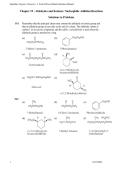
19.1 Remember that the principal chain must contain the aldehyde or ketone group and
that an aldehyde group occurs only at the end of a chain. The aldehyde carbon is
carbon 1 in an acyclic compound, and the suffix -carbaldehyde is used when the
aldehyde group is attached to a ring.
(a) (b)
(c) (d)
(e) (f)
19.2
(a) (b) (c)
(d) (e) (f)
1 10/19/2023
, OpenStax Organic Chemistry: A Tenth Edition Student Solutions Manual
19.3 We have seen the first two methods of aldehyde preparation in earlier chapters.
(a)
(b)
(c)
(d)
19.4 All of these methods are familiar.
(a)
(b)
(c)
(d)
10/19/2023 2
,OpenStax Organic Chemistry: A Tenth Edition Student Solutions Manual
19.5
Step 1: Cyanide anion adds to the positively polarized carbonyl carbon to form
a tetrahedral intermediate.
Step 2: This intermediate is protonated to yield the cyanohydrin.
19.6
The electron-withdrawing nitro group makes the aldehyde carbon of p-nitrobenzaldehyde
more electron-poor (more electrophilic) and more reactive toward nucleophiles than the
aldehyde carbon of p–methoxybenzaldehyde.
19.7
19.8
The above mechanism is similar to other nucleophilic addition mechanisms we have
studied. Since all steps are reversible, we can write the above mechanism in reverse to
show how labeled oxygen is incorporated into an aldehyde or ketone.
3 10/19/2023
, OpenStax Organic Chemistry: A Tenth Edition Student Solutions Manual
This exchange is very slow in water but proceeds more rapidly when either acid or base is
present.
19.9
Cyanohydrin formation is an equilibrium process. Because addition of –CN to 2,2,6-
trimethylcyclohexanone is sterically hindered by the three methyl groups, the equilibrium
lies toward the side of the unreacted ketone.
19.10
Reaction of a ketone or aldehyde with a primary amine yields an imine, in which C=O
has been replaced by C=NR. Reaction of a ketone or aldehyde with a secondary amine
yields an enamine, in which C=O has been replaced by C–NR2, and the double bond has
moved.
10/19/2023 4
Chapter 19 - Aldehydes and Ketones: Nucleophilic Addition Reactions
Solutions to Problems
19.1 Remember that the principal chain must contain the aldehyde or ketone group and
that an aldehyde group occurs only at the end of a chain. The aldehyde carbon is
carbon 1 in an acyclic compound, and the suffix -carbaldehyde is used when the
aldehyde group is attached to a ring.
(a) (b)
(c) (d)
(e) (f)
19.2
(a) (b) (c)
(d) (e) (f)
1 10/19/2023
, OpenStax Organic Chemistry: A Tenth Edition Student Solutions Manual
19.3 We have seen the first two methods of aldehyde preparation in earlier chapters.
(a)
(b)
(c)
(d)
19.4 All of these methods are familiar.
(a)
(b)
(c)
(d)
10/19/2023 2
,OpenStax Organic Chemistry: A Tenth Edition Student Solutions Manual
19.5
Step 1: Cyanide anion adds to the positively polarized carbonyl carbon to form
a tetrahedral intermediate.
Step 2: This intermediate is protonated to yield the cyanohydrin.
19.6
The electron-withdrawing nitro group makes the aldehyde carbon of p-nitrobenzaldehyde
more electron-poor (more electrophilic) and more reactive toward nucleophiles than the
aldehyde carbon of p–methoxybenzaldehyde.
19.7
19.8
The above mechanism is similar to other nucleophilic addition mechanisms we have
studied. Since all steps are reversible, we can write the above mechanism in reverse to
show how labeled oxygen is incorporated into an aldehyde or ketone.
3 10/19/2023
, OpenStax Organic Chemistry: A Tenth Edition Student Solutions Manual
This exchange is very slow in water but proceeds more rapidly when either acid or base is
present.
19.9
Cyanohydrin formation is an equilibrium process. Because addition of –CN to 2,2,6-
trimethylcyclohexanone is sterically hindered by the three methyl groups, the equilibrium
lies toward the side of the unreacted ketone.
19.10
Reaction of a ketone or aldehyde with a primary amine yields an imine, in which C=O
has been replaced by C=NR. Reaction of a ketone or aldehyde with a secondary amine
yields an enamine, in which C=O has been replaced by C–NR2, and the double bond has
moved.
10/19/2023 4